
Why seed cells and larger pots differ
A container growing medium is not the same material as mineral garden soil. Garden soil is dense and behaves differently from a mix designed for containers, so it is a poor default for either seed cells or pots. Seed-starting and mature-container requirements also differ, which is why the same bag is not automatically suited to both stages.
In small cells, a fine, clean medium helps you place seed at a consistent depth and keep moisture even. In a larger pot, the medium must support roots while holding appropriate water and air over a longer period. A formulation for potting balances water retention, nutrients and aeration; that balance is the point to check, not just the product name.
- Identify whether you are filling small seed cells or a larger pot before choosing a medium.
- Read the label's stated purpose and ingredient list for the container size you are using.
- Check the crop's own seed or transplant instructions for any medium guidance.
Source context: University of Maryland Extension · Penn State Extension · University of Maryland Extension
Checking ingredients and fertility
Compost-based media vary with their ingredients, so a recipe name alone does not tell you quality or fertility. Look at what the bag actually lists and what it says about nutrients. A medium described as soilless may still differ from another soilless product, and a compost blend may be richer or leaner depending on its components.
For container vegetables, the supplied guidance lists commercial soilless mix and an equal-volume soilless-mix and compost blend among its options. That is a menu of possibilities, not a rule that every potting soil fails for seeds. Some potting products may suit some seed uses; the label and the crop instructions are what let you decide.
- Compare ingredient lists rather than relying on a recipe or product name.
- Note what the label says about fertility and whether it matches the crop stage.
- Keep the crop's seed instructions alongside the medium label when deciding.
Source context: Penn State Extension · University of Maryland Extension · University of Maryland Extension
Reusing medium without assumptions
Old medium is not unchanged medium. For reuse, remove plant residue, and do not save medium associated with root disease. The supplied guidance describes blending old and fresh material rather than assuming the old mix still performs as it did.
Blending is a practical way to avoid treating used material as identical to new material, but it is not a recipe. Decide how much fresh material to add based on the label and your own plan, and keep diseased medium out of the blend entirely.
- Remove plant residue before considering any reuse.
- Discard medium associated with root disease rather than saving it.
- Blend old and fresh material instead of assuming old mix is unchanged.
Source context: University of Maryland Extension
Measure the seed-tray fill volume
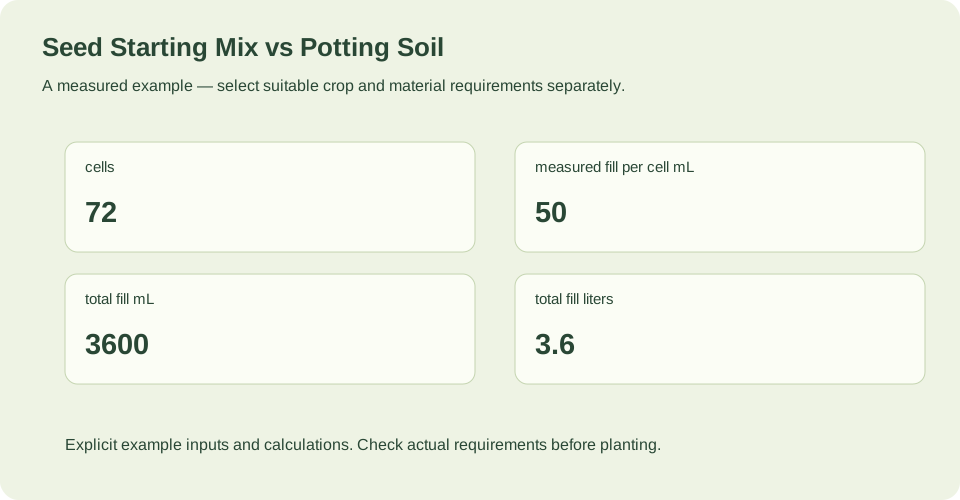
Multiplying 72 measured cell volumes by 50 mL gives 3.6 L. Keep the volume calculation separate from choosing an appropriate clean seed-starting medium.
Package label units govern volume conversions, so check the bag's stated unit before comparing it with your calculated volume. Treat the example as a way to check your own arithmetic, not as advice about how deep to fill a bed or pot.
Source context: University of Maryland Extension
Check your measured example
Seed-tray volume only: a measured tray has 72 identical cells, each holding 50 mL at the chosen fill line. This estimates media inventory, not a universal cell size or seed-starting recipe.
| Quantity | Calculated result |
|---|---|
| cells | 72 |
| measured fill per cell mL | 50 |
| total fill mL | 3600 |
| total fill liters | 3.6 |
Multiplying 72 measured cell volumes by 50 mL gives 3.6 L. Keep the volume calculation separate from choosing an appropriate clean seed-starting medium.
Example inputs explain the method. Review the source context, chosen cultivar and actual site before planting or ordering.
Your before-you-plant checklist
- Container size identified as small seed cells or a larger pot.
- Medium label read for stated purpose, ingredients and fertility.
- Crop seed or transplant instructions checked for medium guidance.
- Package label units confirmed before any volume conversion.
- Old medium checked for plant residue and root disease before any reuse.
Questions that come up while planning
Can I use potting soil for starting seeds?
Not categorically no. Seed-starting and mature-container requirements differ, so check the medium label and the crop's seed instructions before substituting. A fine, clean seed-starting medium is typically chosen for small cells, but some potting products may suit some seed uses.
Is compost-based potting mix better than soilless mix?
Neither is automatically better. Compost-based media vary with their ingredients, so a recipe name alone is not a quality test. For container vegetables, the supplied guidance lists commercial soilless mix and an equal-volume soilless-mix and compost blend among its options.
Can I reuse old potting medium?
You can consider reuse, but do not assume old mix is unchanged. Remove plant residue, do not save medium associated with root disease, and blend old and fresh material rather than treating the old material as identical to new.
Sources & method
Horticultural guidance is linked to its original source and regional context. Geometry and unit conversions are calculated separately. Read how we prepare and check a page.
- Starting Vegetable Seeds IndoorsUniversity of Maryland Extension
- Organic Transplant Production NotesPenn State Extension
- Growing Media (Potting Soil) for ContainersUniversity of Maryland Extension