
Decide what you are growing before choosing a pot
Shallots are a cool-season crop that grows best in full sun with fertile, well-drained soil. In containers, that means a site with direct sun and a medium that supports roots while holding water and air. Dense garden soil behaves differently from a container mix, so do not treat an in-ground row spacing as a pot minimum.
The source describes four usable choices: bulb sets, seeds raised into seedlings, mature bulbs harvested as clusters, and leaves harvested as green onions. These are not interchangeable for spacing. Bulb sets are planted 3 to 6 inches apart. Seeds are sown ½ to ¾ inch apart and thinned to 2 to 4 inches apart. Close spacing is used when the goal is green onions, while wider spacing produces bulb clusters. The source also notes that high-density planting gives smaller, single bulbs.
The source does not provide a shallot container volume. Maryland's container guide gives named minimum volumes for other crops, such as 2 US gallons for bush beans and Swiss chard, but shallot is not among them. Do not convert the in-ground row figure of 12 to 18 inches into a pot diameter or capacity. Instead, use the crop spacing to lay out plants and then check whether the pot's shape and root space suit the number you intend to grow.
- Choose sets, seedlings, mature-bulb clusters or green-onion harvest before measuring a pot.
- Mark the final spacing for that choice: 3 to 6 inches for bulb sets, 2 to 4 inches after thinning seedlings, or close spacing for green onions.
- Reject any pot without open drainage holes, regardless of its labeled volume.
Source context: Utah State University Extension · University of Maryland Extension
Measure the pot and check the growing medium
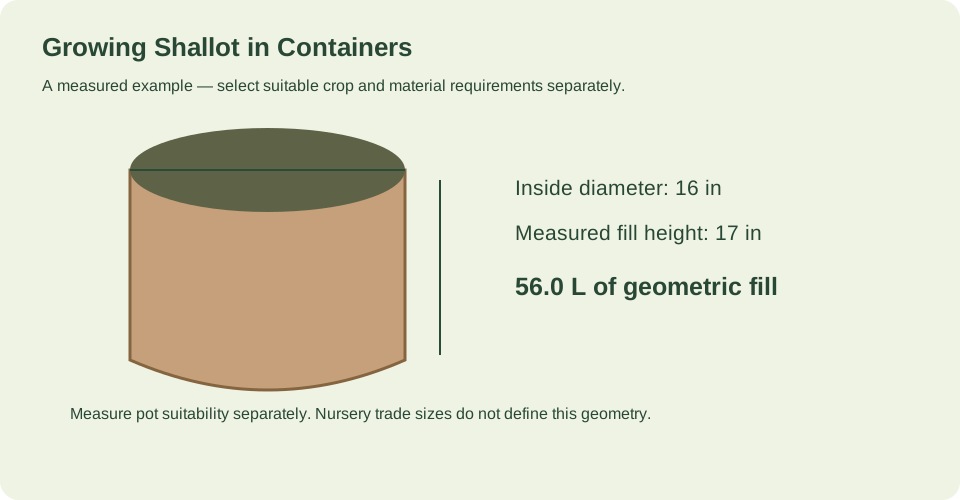
Measure the inside diameter and the usable fill height rather than relying on a nursery trade-gallon label. Leave a rim gap so water can enter and settle. A straight-sided pot is easiest to check because its fill space is a simple cylinder. The worked example in this guide uses a 16-inch inside diameter, an 18-inch inside height and a 1-inch rim gap, giving a fill height of 17 inches. That calculation is a volume-only illustration, not a shallot pot minimum.
For the medium, the container guide lists commercial soilless mix and an equal-volume soilless-mix and compost blend among its options. Either can be considered, but the mix must support roots and drain freely. Keep drainage holes open; stones or gravel under the mix do not improve drainage. Empty saucers so roots are not left saturated. If reusing medium, remove plant residue and do not save medium associated with root disease. Blend old and fresh material rather than assuming old mix is unchanged.
- Measure inside diameter and usable fill height, subtracting any rim gap.
- Confirm drainage holes are open and that no saucer keeps the base saturated.
- Fill with a commercial soilless mix or an equal-volume soilless-mix and compost blend.
- If reusing mix, remove residue and discard any medium linked to root disease.
Source context: University of Maryland Extension · University of Maryland Extension
Set up and monitor the container planting
The source says bulb sets or seeds can be planted in early spring as soon as the ground can be worked. Bulb sets go 1 to 2 inches deep; seeds go ¼ to ½ inch deep and emerge in 10 to 14 days. These are source depths, not container-specific depth rules. Autumn planting of sets after the first frost is also described for a late spring harvest, with the caution that very cold winters can reduce yield. Those seasonal statements are examples for the source location, not a climate calendar for your site.
Water regularly and use mulch to conserve water, reduce weeds and add nutrients. Control weeds, insects and diseases through the season. The source describes a base fertilizer of ½ pound of nitrogen fertilizer (21-0-0) per 100 square feet 30 days after planting and again 60 days after planting, and warns not to fertilize after mid-July because late nitrogen encourages leaf growth and reduces bulb storage potential. That rate is an in-ground area figure; it is not a container dose, so do not scale it to a pot without separate guidance.
For green onions, the source says tops can be harvested when 6 to 8 inches tall, roughly 50 to 60 days after planting. For dry bulbs, harvest after most tops fall over, then lift and separate clusters. Cure bulbs and leaves in the garden for 1 to 2 weeks until dry and papery, then store in mesh bags in a cool, dry place. The source gives 32°F to 40°F as its storage range.
- Record the planting date, crop choice and final spacing on the pot label or a garden note.
- Check moisture regularly and keep the medium evenly watered without leaving the base in standing water.
- Watch for weeds, insects and disease symptoms through the season.
- Harvest leaves for green onions at the source's 6-to-8-inch top stage, or wait for tops to fall for dry bulbs.
- Cure harvested bulbs until dry and papery, then store them in mesh bags in a cool, dry place.
Source context: Utah State University Extension · University of Maryland Extension · University of Maryland Extension
Check your measured example
Volume-only illustration: one straight-sided pot with inside diameter 16 in, inside height 18 in and 1 in rim gap. The resulting fill capacity is not a minimum pot size for shallot; confirm a suitable container separately.
| Quantity | Calculated result |
|---|---|
| inside diameter in | 16 |
| fill height in | 17 |
| volume cuft | 1.978 |
| volume liters | 56.0119 |
| US liquid gallons | 14.7968 |
The worked example is a volume-only calculation for one straight-sided pot with a 16-inch inside diameter, an 18-inch inside height and a 1-inch rim gap, giving a 17-inch fill height. Its calculated fill capacity is about 1.98 cubic feet, 56.01 liters or 14.80 US liquid gallons. That result describes the pot's fill space only; it is not a minimum pot size for shallot and does not establish a crop spacing, planting depth or fertilizer dose.
Example inputs explain the method. Review the source context, chosen cultivar and actual site before planting or ordering.
Your before-you-plant checklist
- Crop choice recorded: sets, seedlings, mature bulbs or green onions.
- Final spacing marked from the source figure for that choice.
- Pot has open drainage holes and no waterlogged saucer.
- Inside diameter and usable fill height measured, with rim gap noted.
- Growing medium is soilless mix or an equal-volume soilless-mix and compost blend.
- Planting date, watering checks and harvest stage noted for monitoring.
Questions that come up while planning
What pot size do shallots need in containers?
The supplied sources do not give a shallot-specific container volume. Maryland's named minimum volumes cover other crops, not shallot, so do not convert the in-ground 12-to-18-inch row spacing into a pot minimum. Choose a pot with open drainage and enough root and top space for your chosen spacing, then measure its actual fill volume.
How far apart should container shallots be planted?
The source gives 3 to 6 inches apart for bulb sets and 2 to 4 inches apart after thinning seedlings. Close spacing is used for green-onion harvest, while wider spacing produces bulb clusters. These are crop spacing facts, not a pot-size recommendation.
Can I harvest shallot leaves and still grow bulbs?
The source says tops can be harvested throughout the year to thin plants when they are 6 to 8 inches tall, roughly 50 to 60 days after planting. For dry bulbs, harvest after most tops have fallen over. The source does not promise a yield from combining both harvests, so treat leaf harvesting as thinning and monitor the remaining plants.
Sources & method
Horticultural guidance is linked to its original source and regional context. Geometry and unit conversions are calculated separately. Read how we prepare and check a page.
- How to Grow Shallots in Your GardenUtah State University Extension
- Growing Vegetables in Containers and Salad TablesUniversity of Maryland Extension
- Growing Media (Potting Soil) for ContainersUniversity of Maryland Extension