
Match the container to the squash type
Start by deciding whether you are growing a bush summer squash or a spreading winter squash. Bush types are the more practical container choice because their top growth stays near the crown. Vining winter squash need a plan for runners that will travel outside the pot, so the container footprint alone does not describe the space the plant will occupy.
Container volume is only one part of suitability. The pot also needs open drainage holes, enough depth and shape to support the root system, and a growing medium that holds water and air without behaving like dense garden soil. A large volume in a shallow or narrow pot does not automatically make a good squash container.
Maryland's reference list gives 10 US gallons as its named example for summer squash. That figure is a guide example, not a guarantee for every cultivar, and it should not be converted into a pot minimum for winter squash or for a transplanted row.
- Identify the cultivar as bush summer squash or a spreading winter squash before choosing a pot.
- Check that the pot has open drainage holes and a shape that can support the expected root system.
- Measure the pot's actual fill volume rather than relying on a nursery trade-gallon label.
Source context: University of Maryland Extension · Utah State University Extension
Separate mound spacing, retained plants and row spacing
The in-ground source describes 4-6 seeds sown in mounds 4 feet apart, then thinned to two plants per mound after emergence. It also describes summer squash transplants set 2 feet apart in a row, with rows 4-6 feet apart. These are field planting arrangements, not container capacities.
For a container, the useful questions are how many plants the pot can support and where each crown sits. A mound spacing figure does not tell you how many plants fit in a pot, and a row spacing figure does not set a pot diameter. Keep the retained plant count and the container's root and top-growth space as separate checks.
If you grow a vining type, reserve vine travel outside the crown footprint. Plan where runners can go and how you will keep them from blocking paths or nearby plants. That reserved area is part of the growing plan even though it is not part of the pot.
- Record the number of plants you intend to retain per container.
- Mark the crown position in the pot and keep it clear of the rim.
- For vining squash, sketch the area outside the pot where runners may travel.
Source context: Utah State University Extension · University of Maryland Extension
Growing medium, planting and support checks
Use a commercial soilless mix or an equal-volume soilless-mix and compost blend. These options support roots while holding water and air differently from garden soil. If you reuse medium, remove plant residue and do not save medium associated with root disease; blend old and fresh material rather than assuming the old mix is unchanged.
The source says squash seed should be planted 1-2 inches deep and that transplants should have 2-3 mature leaves and a well-developed root system. It also notes that damaging roots during transplanting slows establishment. In a container, firm the medium around the seed or transplant without compacting it, and water so the mix settles without leaving the pot saturated.
Support is a planning check rather than a fixed rule. Bush summer squash generally needs less trellising than vining types, but a vining squash needs a route for runners and, where you choose to lift them, a support that matches the plant's growth. Do not assume a generic grid or a single stake is a growing recommendation for every squash type.
- Fill the pot with soilless mix or the equal-volume mix and compost blend, leaving a rim gap for watering.
- Sow seed at the source depth or set out a transplant with 2-3 mature leaves and a developed root system.
- Water deeply and infrequently, and empty any saucer so roots are not left saturated.
- Decide how runners will be directed or supported before they begin to spread.
Source context: University of Maryland Extension · Utah State University Extension · University of Maryland Extension
Setup and monitoring plan
The source recommends sunny locations, fertile and well-drained soil, and incorporating organic matter and a complete fertilizer before planting. In a container, those requirements translate into a sunny spot, a free-draining mix and a fertilizer plan that follows the product label. Do not invent a soil recipe or a fertilizer rate beyond what the label states.
Mulch choices need timing. Black plastic can warm soil, conserve water and help control weeds, and the source says seeds or plants can be set out 2-3 weeks before the last frost when plastic mulch and row covers are used. Organic mulches should wait until soils are warmer than 75°F. Regional dates in the source are examples for that location, not a calendar for your garden.
Monitor the pot for drainage, moisture and root crowding, and watch for insects and disease throughout the season. Side dress with additional nitrogen after vines develop runners, following the product label. Harvest summer squash shortly after flowering and winter squash when the skin is hard and not easily broken with a fingernail.
- Place the container in a sunny location and confirm the drainage holes stay open.
- Apply mulch according to the source timing and keep organic mulch off until soils exceed 75°F.
- Check moisture before watering and empty saucers after rain.
- Side dress after runners develop, using the fertilizer label for the amount.
- Harvest summer squash soon after flowering and winter squash when the skin resists a fingernail.
Source context: Utah State University Extension · University of Maryland Extension · University of Maryland Extension
Check your measured example
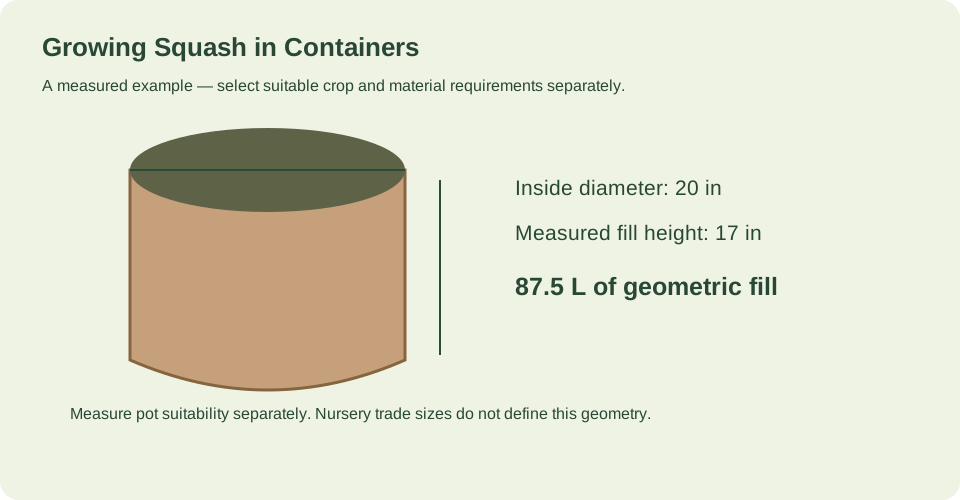
Volume-only illustration: one straight-sided pot with inside diameter 20 in, inside height 18 in and 1 in rim gap. The resulting fill capacity is not a minimum pot size for squash; confirm a suitable container separately.
| Quantity | Calculated result |
|---|---|
| inside diameter in | 20 |
| fill height in | 17 |
| volume cuft | 3.0907 |
| volume liters | 87.5185 |
| US liquid gallons | 23.1199 |
The rendered example is a volume-only illustration: a straight-sided pot with a 20-inch inside diameter, 18-inch inside height and a 1-inch rim gap, filled to 17 inches. It calculates fill capacity, not a squash pot minimum. Confirm a suitable container separately using drainage, shape, root space and top-growth needs.
Example inputs explain the method. Review the source context, chosen cultivar and actual site before planting or ordering.
Your before-you-plant checklist
- Cultivar identified as bush summer squash or spreading winter squash.
- Pot has open drainage holes and a shape that supports the root system.
- Actual fill volume measured rather than read from a trade-gallon label.
- Growing medium is soilless mix or an equal-volume soilless-mix and compost blend.
- Vine travel area outside the pot reserved for vining types.
- Mulch timing checked against the source temperature guidance.
Questions that come up while planning
What pot size should I use for squash in a container?
Maryland's reference list gives 10 US gallons as its named example for summer squash. That is a guide example, not a guarantee for every cultivar. For winter squash, the source does not provide a container minimum, so confirm a suitable pot separately and reserve space for vine travel outside the crown.
Can I use the 4-foot mound spacing or 2-foot transplant spacing to choose a pot?
No. Those figures describe in-ground planting arrangements. They do not set a container diameter or plant count. Use them as context for field spacing, then check the container's root space, top-growth space and drainage separately.
How should I handle vining winter squash in a pot?
Treat the pot as the space for the crown and roots, and reserve an area outside it for runners. Plan where vines will travel and how you will keep them clear of paths and other plants. The source does not give a container capacity for winter squash, so do not convert a row spacing figure into a pot minimum.
Sources & method
Horticultural guidance is linked to its original source and regional context. Geometry and unit conversions are calculated separately. Read how we prepare and check a page.
- How to Grow Summer and Winter Squash in Your GardenUtah State University Extension
- Growing Vegetables in Containers and Salad TablesUniversity of Maryland Extension
- Growing Media (Potting Soil) for ContainersUniversity of Maryland Extension