
Start with the source range, then choose one scenario
USU gives an initial in-row spacing range of 18–24 inches and a between-row range of 36–48 inches for June-bearing matted-row strawberries. Those are ranges, not a single prescription for every bed. For a clearly labeled planning scenario, this guide uses 24-inch centers within one row. That choice sits at the wide end of the range and leaves more room between initial crowns; it is a worked example, not a claim that 24 inches is best for every garden.
The 36–48 inch row spacing is separate from the in-row centers. A raised bed, path layout, or adjacent planting may require choices this source range does not settle. Decide access, supports, adjacent-row clearance, and mature plant habit separately rather than treating one row as the whole garden layout.
- Write down the source range you are working from: 18–24 inches between initial crowns and 36–48 inches between rows.
- Label your chosen scenario, such as a single measured row using 24-inch centers.
- Record any access, support, adjacent-row, or mature-habit decisions separately from the in-row spacing.
Source context: Utah State University Extension
Mark initial crowns in one measured row
Initial planting is not the same as sowing, thinning, or the established mat. The counted item here is initial crowns, not the total number of plants after runners and daughter plants spread. Mark crown positions along the measured row, keeping the selected end margins clear. The linked row calculator can count this exact length, center interval, and both end margins in inches or centimeters.
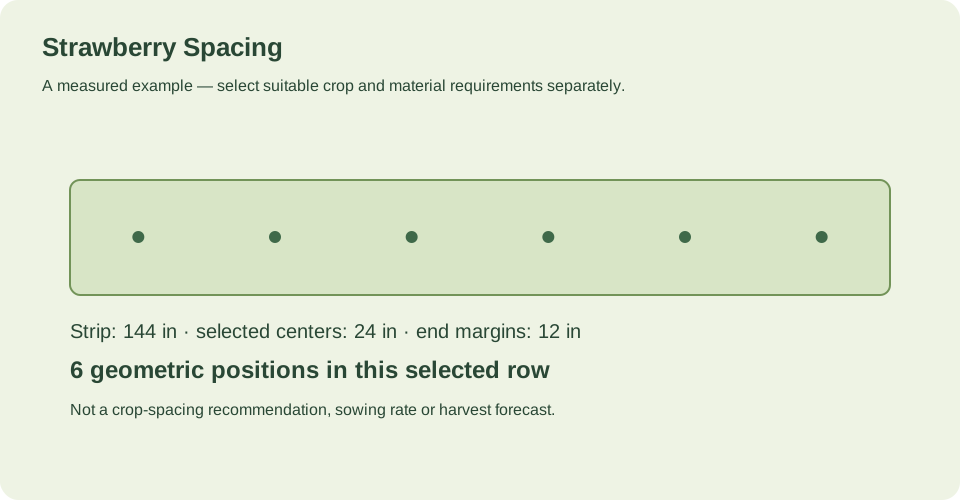
In the worked example, the row is 144 inches long, centers are 24 inches apart, and both end margins are 12 inches. The first center falls at 12 inches and the last at 132 inches, giving 6 initial crown positions. This is a geometrical count for that measured row, not a crop-performance or yield prediction.
- Measure the full row length before placing any marks.
- Set the same end margin at both ends and mark the first center after that margin.
- Continue at the chosen center interval until the last center fits before the far margin.
- Count the marked centers as initial crowns, not as the later runner-filled plant total.
Source context: Utah State University Extension
Check the count and keep the layout honest
A count of 6 initial crowns follows from the 144-inch row, 24-inch centers, and 12-inch margins at both ends. Check that the first and last centers sit inside the margins and that the interval between neighboring centers is consistent. If you change the row length, center spacing, or either margin, the count changes; do not carry the example count into a different layout without recalculating.
One marked row is not an entire garden layout. The source's 36–48 inch between-row range still needs to be applied to the wider plan, and access, supports, adjacent rows, and mature habit must be chosen separately. Keep the initial-crown count distinct from any later estimate of the mat.
- Verify the first center equals the end margin and the last center leaves the same margin at the far end.
- Confirm every counted position is an initial crown, not a runner or daughter plant.
- Keep the single-row example separate from the full garden layout and its between-row decisions.
Source context: Utah State University Extension
Check your measured example
One measured 144-inch row, with selected 24-inch centers and 12-inch margins at both ends. Count 6 initial crowns.
Reference and growing system: USU describes June-bearing matted-row strawberries initially 18–24 inches apart in rows 36–48 inches apart. Runners and daughter plants change the later mat; initial crowns are not the later plant total.
| Quantity | Calculated result |
|---|---|
| Usable row length (in) | 144 |
| Selected center spacing (in) | 24 |
| Margin at each row end (in) | 12 |
| Positions in this row | 6 |
| First center from row start (in) | 12 |
| Last center from row start (in) | 132 |
| What is being counted | initial crowns |
The worked example uses one 144-inch row, 24-inch centers, and 12-inch margins at both ends. The first center is at 12 inches, the last at 132 inches, and the result is 6 initial crowns. This is a geometrical count for that labeled row only; it does not predict later runner spread, plant performance, or a full garden layout.
Count this row in the spacing calculator ↗Example inputs explain the method. Review the source context, chosen cultivar and actual site before planting or ordering.
Your before-you-plant checklist
- The chosen in-row spacing is labeled and falls within the 18–24 inch range.
- The row length, center interval, and both end margins are recorded.
- The first and last centers are checked against the end margins.
- The count is described as initial crowns, not the later runner-filled plant total.
- The single row is kept separate from the full garden layout and between-row decisions.
Questions that come up while planning
How far apart should June-bearing strawberry crowns be initially?
USU describes June-bearing matted-row strawberries initially 18–24 inches apart in rows 36–48 inches apart. Choose a point within that range for your labeled scenario and record it.
Does the initial crown count equal the final number of strawberry plants?
No. Runners and daughter plants change the later mat, so the initial crowns are not the later plant total.
Why does the example count 6 crowns in a 144-inch row?
With 24-inch centers and 12-inch margins at both ends, the first center is at 12 inches and the last at 132 inches, producing 6 initial crown positions.
Sources & method
Horticultural guidance is linked to its original source and regional context. Geometry and unit conversions are calculated separately. Read how we prepare and check a page.
- How to Grow Strawberries in Your GardenUtah State University Extension