
Choose the culture before the container
June-bearers form flower buds in autumn short days, bloom the following spring, and ripen fruit in late May to June. In a matted-row system, runners and daughter plants fill space between rows over time, so the eventual mat is wider than the initial crown spacing. Day-neutrals form buds regardless of day length when temperatures are below about 70°F; in cool climates they can crop lightly through summer, but warm summers usually limit season-long production. Everbearers and day-neutrals often behave similarly at home, and many newer everbearers are actually day-neutrals.
Annual hill culture uses day-neutral plants set at close spacing and removed after the season, avoiding the runner-filled mat. For containers, that is often the simpler structure to plan: you control spacing, replace plants, and do not depend on runners to fill a bed. Matted-row culture suits a larger container or bed where you intend daughter plants to root and widen the planting. Decide which system you are using before measuring anything, because the two systems imply different spacing and different pot shapes.
- Pick June-bearing matted-row culture or annual hill culture with day-neutral plants.
- Write down whether runners will be allowed to root or removed.
- Choose a cultivar suited to your climate and disease resistance; consult local variety information rather than a generic list.
Source context: Utah State University Extension · University of Maryland Extension
Measure fill volume, not trade-gallon labels
Container volume alone does not define a suitable shape; match both mature top growth and root space. Measure the inside diameter and the usable fill height, leaving a rim gap for watering. For a straight-sided pot, fill volume is the cylinder volume of that inside space. Nursery trade-gallon labels are not reliable fill measurements, so measure actual capacity.
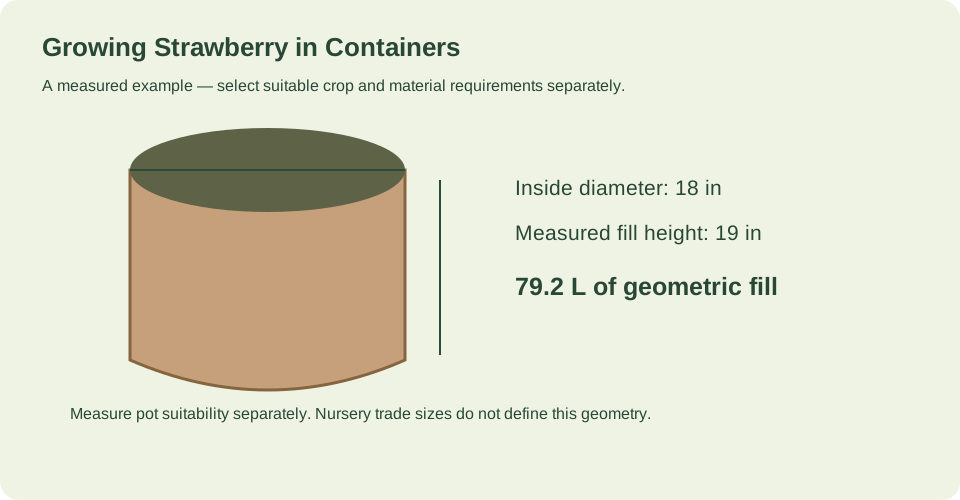
The supplied example is one straight-sided pot with an 18-inch inside diameter, 20-inch inside height and a 1-inch rim gap, giving a 19-inch fill height. Its computed fill capacity is about 2.80 cubic feet, 79.23 liters or 20.93 US liquid gallons. That is a geometrical illustration only. It is not a minimum pot size for strawberry, and it should not be converted from an in-ground row figure into a pot requirement. Confirm a suitable container separately using crop and cultivar needs.
- Measure inside diameter and usable fill height.
- Subtract the rim gap from the inside height before calculating.
- Record fill volume in cubic feet or liters and keep the calculation with your plan.
Source context: University of Maryland Extension
Medium, drainage and planting checks
Use a growing medium that supports roots while holding appropriate water and air. Dense garden soil behaves differently from container mix. The container guide lists commercial soilless mix and an equal-volume soilless-mix and compost blend among options for container vegetables. If reusing medium, remove plant residue and do not save medium associated with root disease; blend old and fresh material rather than assuming old mix is unchanged.
Drainage holes must stay open. Stones or gravel under the mix do not improve drainage, and saucers should be emptied so roots are not left saturated. Strawberries are sensitive to salt; the source notes that high salinity can stunt plants and scorch leaves, and that over-fertilizing is a risk. A soil test can inform salinity and initial fertilizer needs. Set crowns at the medium surface rather than burying them, and keep the pot where late frosts can be managed, since blossoms are susceptible to late spring frosts.
- Confirm drainage holes are open and empty saucers after watering.
- Fill with soilless mix or an equal-volume soilless-mix and compost blend.
- Set crowns at the surface and firm medium around roots without burying crowns.
- Keep frost protection ready for blooming plants on cold nights.
Source context: University of Maryland Extension · University of Maryland Extension · Utah State University Extension
Setup and monitoring plan
Write a one-page plan: culture, cultivar, container dimensions and fill volume, medium choice, crown spacing, runner policy, and frost response. For matted-row culture, record initial crown spacing separately from the eventual row mat so the plan does not confuse the two. For annual hill culture, record the close spacing and the removal date at season end.
Monitor medium moisture, drainage, crown depth, runner rooting, and blossom frost risk. Avoid keeping strawberry beds in the same place for more than five years, and avoid areas where peppers, tomatoes, potatoes, eggplant or okra have grown recently because those harbor the Verticillium wilt pathogen. Chilling hours matter for fruit bud development, but in Maryland hardiness, bloom time and extreme weather are usually more important; treat regional dates as examples for that location only.
- Record culture, cultivar, container dimensions and fill volume.
- Note initial crown spacing and, for matted rows, the intended eventual mat width.
- Check crowns, drainage and runners weekly during establishment.
- Review frost protection before bloom and after any cold forecast.
Source context: Utah State University Extension · University of Maryland Extension · University of Maryland Extension
Check your measured example
Volume-only illustration: one straight-sided pot with inside diameter 18 in, inside height 20 in and 1 in rim gap. The resulting fill capacity is not a minimum pot size for strawberry; confirm a suitable container separately.
| Quantity | Calculated result |
|---|---|
| inside diameter in | 18 |
| fill height in | 19 |
| volume cuft | 2.798 |
| volume liters | 79.23 |
| US liquid gallons | 20.9304 |
The example table shows one straight-sided pot with an 18-inch inside diameter, 20-inch inside height and 1-inch rim gap, so fill height is 19 inches. The computed fill capacity is about 2.80 cubic feet, 79.23 liters or 20.93 US liquid gallons. This is a geometrical illustration of fill volume only; it is not a strawberry pot minimum and does not add any crop-specific capacity recommendation.
Example inputs explain the method. Review the source context, chosen cultivar and actual site before planting or ordering.
Your before-you-plant checklist
- Culture chosen and written down: June-bearing matted row or annual hill with day-neutrals.
- Container inside diameter and usable fill height measured, with rim gap subtracted.
- Fill volume recorded separately from any pot minimum claim.
- Medium is soilless mix or an equal-volume soilless-mix and compost blend, with open drainage.
- Crowns set at the surface, runner policy noted, and frost protection ready for bloom.
Questions that come up while planning
Can I use the 18-inch by 20-inch pot example as a strawberry pot minimum?
No. The example is a volume-only geometry illustration for one straight-sided pot. It is not a minimum pot size for strawberry, and an in-ground row figure should not be converted into a pot minimum.
What is the difference between initial crown spacing and the eventual row mat?
Initial crown spacing is where you set plants. In matted-row culture, runners and daughter plants root between rows over time, so the eventual mat is wider than the initial spacing. Annual hill culture avoids that widening by using close-set day-neutral plants removed after the season.
Should I grow June-bearing or day-neutral strawberries in a container?
June-bearers fit a matted-row plan where runners fill space and fruit ripens in late May to June. Day-neutrals fit annual hill culture and can crop in cool conditions below about 70°F, though warm summers usually limit season-long production. Choose based on your climate and whether you want runners.
Sources & method
Horticultural guidance is linked to its original source and regional context. Geometry and unit conversions are calculated separately. Read how we prepare and check a page.
- How to Grow Strawberries in Your GardenUtah State University Extension
- Growing Vegetables in Containers and Salad TablesUniversity of Maryland Extension
- Growing Media (Potting Soil) for ContainersUniversity of Maryland Extension
- Starting a Home Fruit GardenUniversity of Maryland Extension