
Start with the source range, then choose one point
Treat 20–30 cm (about 8–12 inches) as the provided range for thyme plant spacing. It is a range, not a single rule, because creeping and upright types differ. Before marking anything, check the habit of the cultivar you are actually growing and use that to decide where in the range your layout should sit.
For the worked scenario below, the selected center spacing is 12 inches. That choice is labeled as an example only. It does not mean every thyme variety should be planted at 12 inches, and it is not a recommendation for creeping or upright types in general. Record the spacing you choose, and why, next to your row plan so the number is not mistaken for a universal figure.
- Note the RHS range of 20–30 cm (about 8–12 inches) for thyme.
- Check the habit of your chosen cultivar before selecting a spacing point.
- Write your selected center spacing on the plan and label it as your scenario.
Source context: Royal Horticultural Society
Separate initial planting from established plants
Spacing at sowing, thinning, or initial planting is a layout decision made before plants fill the space. It sets where each plant starts. It is not the same as the room an established thyme plant may eventually occupy, and it is not a pruning or division instruction.
Keep those stages distinct on your plan. Mark the initial planting positions first, then review the layout against the mature habit of your chosen cultivar. If the habit suggests the plants will need more room than your marked centers allow, adjust the plan rather than assuming the initial spacing settles everything.
- Mark initial planting positions before considering mature spread.
- Review the marked layout against your cultivar’s habit.
- Revise the plan if the mature habit calls for a different arrangement.
Source context: Royal Horticultural Society
Worked example: one 96-inch row
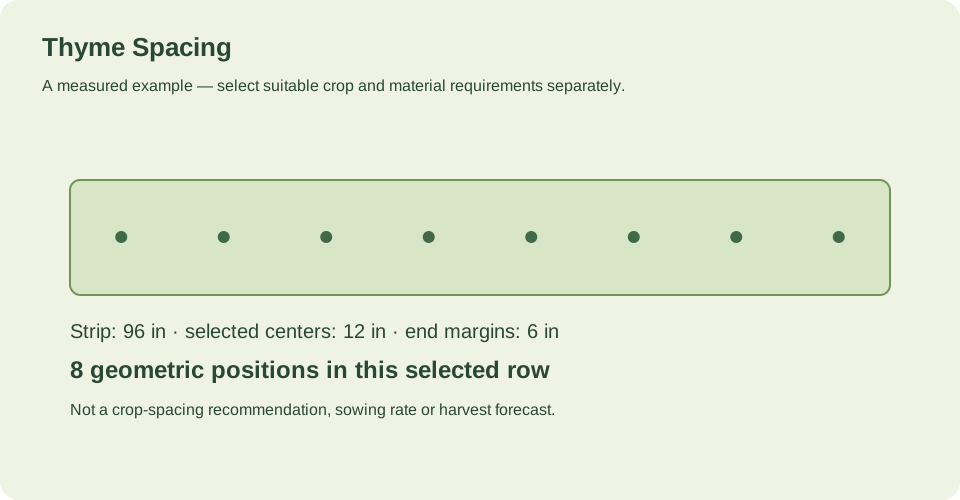
The worked example is a single measured row 96 inches long, with selected 12-inch centers and 6-inch margins at both ends. The counted item is plants, not seeds, seedlings, or gaps. With those inputs, the row holds 8 plants. The first center sits at 6 inches and the last center at 90 inches.
This is a geometrical example, not crop advice. It shows how a row length, a center interval, and end margins produce a count. It does not establish that 12 inches suits your thyme variety, and it does not describe a full garden layout. One row is only one row; access, supports, adjacent rows, and mature habit must each be chosen separately, and this brief supplies no distances for them.
- Confirm the row length in inches or centimeters.
- Enter the selected center spacing and both end margins.
- Read the result as a count of plants along that one row.
Source context: Royal Horticultural Society
Check the count and the layout
The linked row calculator can count this exact length, center interval, and both end margins, in inches or centimeters. Use it to check the arithmetic of your own measured row. The count describes positions along that row only.
Before finalizing, confirm that the counted item is plants, that the margins are applied at both ends, and that the spacing you entered matches the labeled scenario you intend to use. Then review the row in context: how you will reach the plants, whether any support is needed, how adjacent rows relate, and whether the mature habit of your cultivar fits the plan. Those choices are separate from the row count and are not provided by the example.
- Verify the calculator inputs match your measured row.
- Confirm the output is a plant count for that row.
- Review access, supports, adjacent rows, and mature habit separately.
Source context: Royal Horticultural Society
Check your measured example
One measured 96-inch row, with selected 12-inch centers and 6-inch margins at both ends. Count 8 plants.
Reference and growing system: RHS gives thyme plants 20–30 cm, approximately 8–12 inches, apart depending on variety. Creeping and upright types differ; use the chosen cultivar’s habit when reviewing the layout.
| Quantity | Calculated result |
|---|---|
| Usable row length (in) | 96 |
| Selected center spacing (in) | 12 |
| Margin at each row end (in) | 6 |
| Positions in this row | 8 |
| First center from row start (in) | 6 |
| Last center from row start (in) | 90 |
| What is being counted | plants |
The worked example uses a 96-inch row, 12-inch selected centers, and 6-inch margins at both ends, producing 8 counted plants with the first center at 6 inches and the last at 90 inches. It is a geometrical illustration of one row, not a spacing recommendation for thyme varieties or a complete garden layout.
Count this row in the spacing calculator ↗Example inputs explain the method. Review the source context, chosen cultivar and actual site before planting or ordering.
Your before-you-plant checklist
- RHS range of 20–30 cm (about 8–12 inches) noted for thyme.
- Selected spacing point written down and labeled as your scenario.
- Cultivar habit checked before finalizing the layout.
- Initial planting positions kept distinct from established plant space.
- Row calculator inputs match the measured row length, center interval, and both end margins.
Questions that come up while planning
What spacing does the RHS give for thyme?
The RHS gives thyme plants 20–30 cm, approximately 8–12 inches, apart depending on variety. Creeping and upright types differ, so use the chosen cultivar’s habit when reviewing the layout.
Does the 96-inch example recommend 12-inch spacing for all thyme?
No. The 96-inch row with 12-inch centers and 6-inch end margins is a labeled geometrical example that counts 8 plants. It is not crop advice and does not replace checking your cultivar’s habit against the RHS range.
Does one counted row describe my whole garden layout?
No. The count applies to one measured row only. Access, supports, adjacent rows, and mature habit must be chosen separately, and the worked example gives no distances for those.
Sources & method
Horticultural guidance is linked to its original source and regional context. Geometry and unit conversions are calculated separately. Read how we prepare and check a page.
- How to grow ThymeRoyal Horticultural Society