
Choose a thyme type that fits container use
Thyme varieties differ in flavour, leaf colour and growth habit. Upright, mounded forms such as common thyme (Thymus vulgaris) are generally easier to harvest and more practical for culinary use. Low, creeping forms such as T. serpyllum spread sideways and suit different planting situations, but they are less convenient to pick from.
Mature spread matters more than a generic spacing figure. A creeping thyme will fill and spill beyond its starting footprint, while an upright form grows as a small mound. Check the label or supplier description for the habit and expected spread of the specific variety, then choose a pot whose top opening can accommodate that spread without the plant being crammed against the rim. Do not apply a square-foot grid allocation to a container; a grid is a garden-bed geometry tool, not a thyme planting recommendation.
- Decide whether you need an upright culinary thyme or a creeping ornamental form.
- Read the variety label for growth habit, mature height and spread.
- Choose a pot with a top opening wide enough for the expected spread and room to trim.
Source context: Royal Horticultural Society · University of Maryland Extension
Check drainage, shape and growing medium
Drainage holes must stay open. Stones or gravel placed under the mix do not improve drainage, so do not rely on a gravel layer to compensate for a pot with poor drainage. Empty any saucer so the roots are not left sitting in saturated water.
Volume alone does not define a suitable pot shape. Match both the mature top growth and the root space the plant needs. Maryland's named guide examples put smaller herbs including thyme in the 2–5 gallon group, but that is a named group reference, not a guaranteed crop-specific minimum for every thyme variety or pot shape. Measure the actual fill volume of your pot rather than trusting a nursery trade-gallon label.
For the growing medium, use a commercial soilless mix or an equal-volume soilless-mix and compost blend. Dense garden soil behaves differently in a container and is not the same as a container mix. If reusing medium, remove plant residue and do not save medium associated with root disease; blend old and fresh material rather than assuming old mix is unchanged.
- Confirm the drainage holes are open and remove any saucer water.
- Measure the pot's actual fill volume with a known quantity of mix or water.
- Fill with soilless mix or an equal-volume soilless-mix and compost blend.
- If reusing mix, remove residue and discard any medium linked to root disease.
Source context: University of Maryland Extension · University of Maryland Extension
Set up and monitor the container
Thyme thrives in full sun, so place the container where it receives direct light. Because thyme is evergreen, sprigs can be picked through the year, though new spring and summer growth has the best flavour. Water newly planted thyme, and check containers during hot, dry weather. Otherwise, thyme is drought tolerant and rarely needs watering; overwatering and damp conditions, especially in winter, are the greater risk because roots can rot.
Plan to trim the plant to keep the growth you want and to remove spent or crowded stems. For creeping forms, trimming helps contain sideways spread; for upright culinary forms, regular picking and light trimming keeps the mound manageable. Monitor the pot after rain and in winter, when drainage matters most.
- Place the container in full sun.
- Water after planting and during hot, dry spells, then let the mix drain.
- Check drainage after heavy rain and empty the saucer.
- Trim according to the variety's habit and harvest sprigs as needed.
Source context: Royal Horticultural Society · University of Maryland Extension
Check your measured example
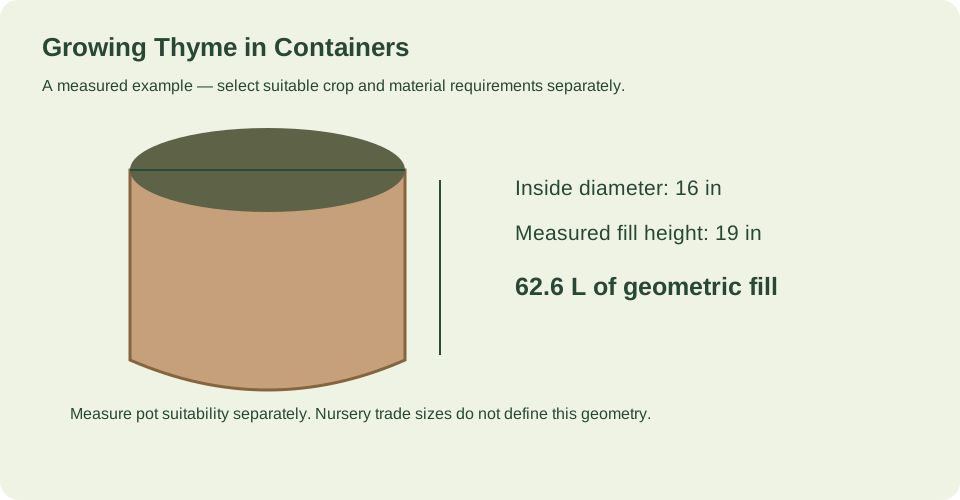
Volume-only illustration: one straight-sided pot with inside diameter 16 in, inside height 20 in and 1 in rim gap. The resulting fill capacity is not a minimum pot size for thyme; confirm a suitable container separately.
| Quantity | Calculated result |
|---|---|
| inside diameter in | 16 |
| fill height in | 19 |
| volume cuft | 2.2108 |
| volume liters | 62.6015 |
| US liquid gallons | 16.5376 |
The worked example is a volume-only illustration: a straight-sided pot with a 16-inch inside diameter, 20-inch inside height and a 1-inch rim gap, giving a fill height of 19 inches. Its calculated fill capacity is about 2.21 cubic feet, 62.6 liters or 16.54 US liquid gallons. That figure describes this particular pot's fill volume; it is not a minimum pot size for thyme and does not replace checking drainage, shape and the variety's mature spread.
Example inputs explain the method. Review the source context, chosen cultivar and actual site before planting or ordering.
Your before-you-plant checklist
- Variety habit and expected spread checked before choosing the pot.
- Pot top opening wide enough for the mature spread and trimming.
- Drainage holes open; no gravel layer relied on for drainage.
- Actual fill volume measured rather than trusting a trade-gallon label.
- Soilless mix or equal-volume soilless-mix and compost blend used.
- Container placed in full sun and saucer kept empty.
Questions that come up while planning
What pot size does thyme need?
There is no single universal pot size for thyme. Maryland's named guide examples place smaller herbs including thyme in the 2–5 gallon group, but that is a group reference, not a guaranteed minimum for every variety. Match pot shape to the plant's mature spread and root space, and measure actual fill volume rather than relying on trade-gallon labels.
Can I use garden soil in a thyme container?
Dense garden soil behaves differently from a container mix. Use a commercial soilless mix or an equal-volume soilless-mix and compost blend, and make sure the pot drains freely.
How often should I water container thyme?
Water newly planted thyme and check containers in hot, dry weather. Thyme is drought tolerant and rarely needs watering otherwise; too much water, especially in winter, is more likely to cause root rot. Empty saucers so roots are not left saturated.
Sources & method
Horticultural guidance is linked to its original source and regional context. Geometry and unit conversions are calculated separately. Read how we prepare and check a page.
- How to grow ThymeRoyal Horticultural Society
- Growing Vegetables in Containers and Salad TablesUniversity of Maryland Extension
- Growing Media (Potting Soil) for ContainersUniversity of Maryland Extension