
Read the source range before marking hills
The linked guide gives two separate measurements. Hills are spaced 24–36 inches apart within a row, and rows are 36 inches apart. Those are the only spacing quantities used here. The in-row range allows a gardener to choose a center interval for a particular plan, but the source does not say which end of the range fits every bed, support system, or walkway.
A hill is a planting position, not a final plant count. The source says hills are later thinned to 1–2 plants per hill. So a marked hill can represent one position that may hold one or two retained plants after thinning. Keep that distinction visible on the plan so the hill count is not mistaken for a seedling count or a harvest estimate.
- Write the source range on the plan: hills 24–36 inches apart within rows, rows 36 inches apart.
- Label the chosen in-row interval and state that it is a planning choice within that range.
- Mark each position as a hill, then note separately that thinning may leave 1–2 plants per hill.
Source context: Utah State University Extension
Worked example: one 144-inch row
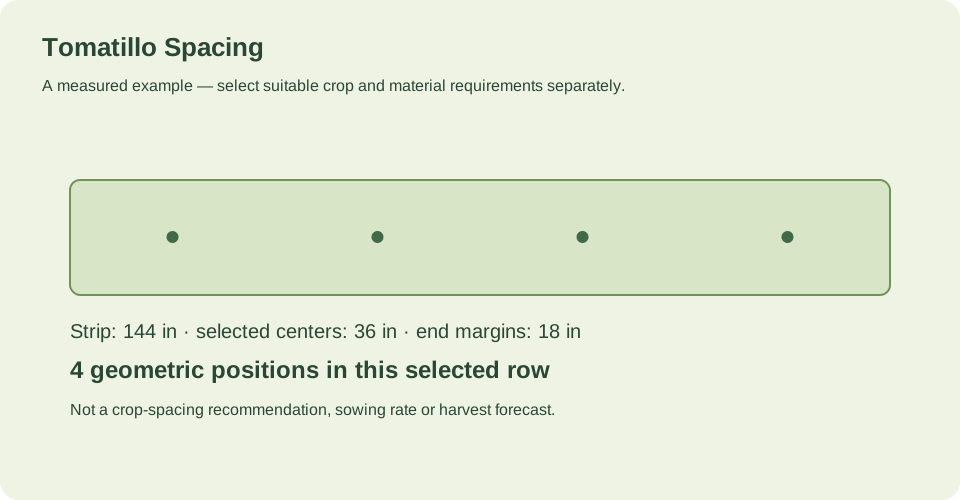
The verified example uses a 144-inch row, 36-inch selected centers, and 18-inch margins at both ends. The first center falls at 18 inches and the last at 126 inches. The result is 4 hill positions. This is a geometrical count for the stated row length, center interval, and end margins. It is not a recommendation to use 36-inch centers everywhere, and it does not establish a whole-garden layout.
The example counts hills only. It does not count seeds, seedlings, or retained plants. If every hill were eventually thinned to two plants, the plant count would differ from the hill count, but the worked example does not calculate that number. Keep the counted item named as hill positions whenever the result is recorded.
- Measure the actual row length before calculating.
- Choose and record the center interval and both end margins.
- Count hill positions, then label the result as hills rather than plants or seeds.
Source context: Utah State University Extension
Separate one row from the rest of the layout
One calculated row is not an entire garden plan. The source also gives 36 inches between rows, but that figure does not by itself settle access paths, support placement, adjacent-row clearance, or the space needed as plants mature. Those choices must be made separately for the actual site. Do not invent a distance for them or treat the row example as a complete bed design.
If the garden has more than one row, plan each row and the space between rows as separate decisions. The source notes support the within-row range and the 36-inch row spacing, but they do not supply a raised-bed width, a path width, or a support clearance. Record those as site decisions rather than spacing facts from the source.
- Draw the measured row and mark its hill positions.
- Add adjacent rows only after deciding row-to-row spacing from the linked guide.
- Record access, support, and mature-habit choices separately instead of assigning them invented distances.
Source context: Utah State University Extension
Use the row calculator for this exact count
The linked row calculator can count this exact row length, center interval, and both end margins in inches or centimeters. Use it to check the arithmetic for the labeled example or for another measured row that uses the same provided spacing facts. The calculator counts positions along the row; it does not decide whether a hill should be thinned to one or two plants.
Before relying on a result, confirm that the entered length, center interval, and end margins match the plan. Then check that the output is described as hill positions. A count for one row should not be presented as a complete garden layout or as a plant or seed count.
- Enter the measured row length in inches or centimeters.
- Enter the selected center interval and both end margins.
- Confirm the output is a hill-position count and keep it labeled that way.
Source context: Utah State University Extension
Check your measured example
One measured 144-inch row, with selected 36-inch centers and 18-inch margins at both ends. Count 4 hill positions.
Reference and growing system: USU describes tomatillo hills 24–36 inches apart within rows 36 inches apart, later thinned to 1–2 plants per hill. The example counts hills, not the number of retained plants or seeds.
| Quantity | Calculated result |
|---|---|
| Usable row length (in) | 144 |
| Selected center spacing (in) | 36 |
| Margin at each row end (in) | 18 |
| Positions in this row | 4 |
| First center from row start (in) | 18 |
| Last center from row start (in) | 126 |
| What is being counted | hill positions |
The worked example is a geometrical count for one 144-inch row with 36-inch selected centers and 18-inch margins at both ends. It places the first center at 18 inches and the last at 126 inches, giving 4 hill positions. The 36-inch center interval is a labeled scenario within the source's 24–36 inch in-row range. The example counts hills only; it does not calculate seeds, seedlings, or the 1–2 plants per hill that may remain after thinning, and it is not a complete garden layout.
Count this row in the spacing calculator ↗Example inputs explain the method. Review the source context, chosen cultivar and actual site before planting or ordering.
Your before-you-plant checklist
- The source range is recorded as hills 24–36 inches apart within rows and rows 36 inches apart.
- The chosen center interval is labeled as a planning choice within the provided range.
- The result is labeled as hill positions, not seeds, seedlings, or retained plants.
- The 144-inch example uses 36-inch centers and 18-inch margins at both ends and yields 4 hills.
- One calculated row is kept separate from the full garden layout and site-specific access or support decisions.
Questions that come up while planning
How far apart should tomatillo hills be?
The linked guide describes hills 24–36 inches apart within rows, with rows 36 inches apart. The 36-inch center interval in the example is a labeled planning choice within that in-row range, not a universal requirement.
Does the example count plants or seeds?
Neither. It counts 4 hill positions in a 144-inch row with 36-inch centers and 18-inch end margins. The source says hills are later thinned to 1–2 plants per hill, so retained plants are a separate count.
Can I use the 4-hill result as my whole garden layout?
No. It is a geometrical count for one measured row. Adjacent rows, access, supports, and mature habit must be planned separately, and the source notes do not provide distances for those choices.
Sources & method
Horticultural guidance is linked to its original source and regional context. Geometry and unit conversions are calculated separately. Read how we prepare and check a page.
- How to Grow Tomatillos in Your GardenUtah State University Extension