
Decide whether a container suits your space
The source says tomatillos prefer full sun and well-drained soil and do poorly in heavy, wet soils, and it notes they also do very well in containers. That makes a container a reasonable choice where drainage and sun can be controlled. The harder constraint is space: plan for the mature top growth as well as root room, because volume alone does not define a suitable pot shape.
Pollination is a planning requirement, not a detail. The source states that at least two tomatillo plants are needed for proper fertilization and fruit production. One geometric pot position is not a complete fruiting plan; reserve room for multiple compatible flowering plants and for the sprawling growth and support they will need.
- Confirm the site receives full sun and that you can keep drainage holes open.
- Mark out the mature footprint for each plant, allowing for a 3 to 4 foot tall and wide habit.
- Plan at least two tomatillo plants, checking that the varieties you choose can flower together for pollination.
- Decide whether you will pinch growing tips to limit spread if space is tight.
Source context: Utah State University Extension · University of Maryland Extension
Choose and measure the container
The container source gives reference minimum volumes for named crops such as bush beans, cabbage, peppers and standard tomatoes, but tomatillo is not among those named examples. Do not convert an in-ground row spacing figure into a pot minimum. Instead, choose a pot suited to the crop and cultivar, with adequate drainage and enough root space, and confirm the shape can hold the top growth you expect.
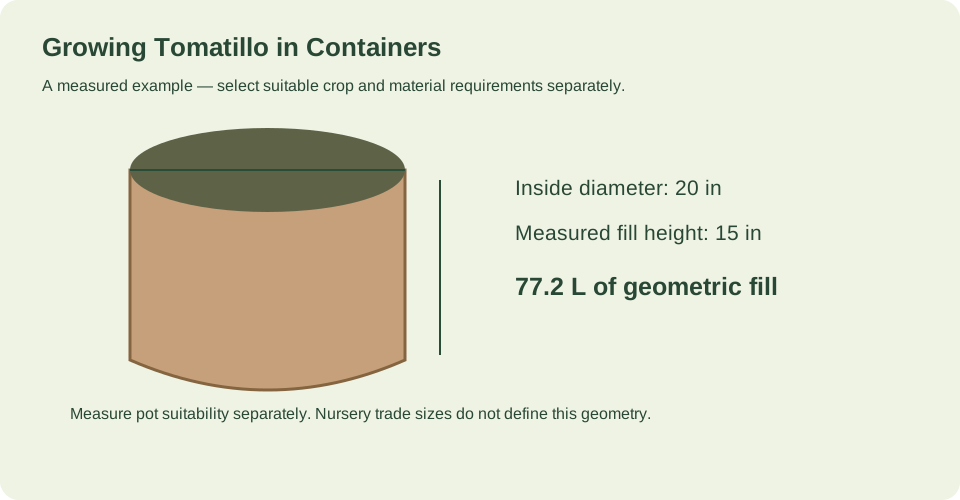
Measure actual fill volume rather than trusting nursery trade-gallon labels. The supplied example is a straight-sided pot with a 20 inch inside diameter, 16 inch inside height and a 1 inch rim gap, giving a fill height of 15 inches. Its calculated fill capacity is about 2.73 cubic feet, 77.2 liters or 20.4 US liquid gallons. That number describes this pot's geometry only; it is not a tomatillo minimum and does not by itself make the pot suitable.
- Check that drainage holes are open and that no saucer is left holding water.
- Measure inside diameter and the fill height you will actually use, allowing a rim gap.
- Calculate fill volume from those measurements and compare it with the bag or mix label, using the label's units.
- Confirm the pot's shape and root space suit the plant, not just its volume.
Source context: University of Maryland Extension · Utah State University Extension
Set up the growing medium and support
A container medium must support roots while holding appropriate water and air; dense garden soil behaves differently from a container mix. The mix source lists commercial soilless mix and an equal-volume soilless-mix and compost blend among options for container vegetables. If you reuse medium, remove plant residue and do not save medium associated with root disease; blend old and fresh material rather than assuming old mix is unchanged.
The source says additional support aids harvesting, limits the sprawling habit and hinders voluntary rooting where stems touch the ground. Build that support into the setup before the plant spreads. Water needs are given as 1 to 2 inches per week, with the plants described as semi-drought tolerant; check the medium rather than assuming a fixed schedule.
- Fill with a free-draining container mix or the equal-volume mix and compost blend.
- Set the support structure in place at planting so stems can be guided as they grow.
- Keep drainage holes clear and empty saucers after watering.
- Monitor moisture against the 1 to 2 inches per week figure and adjust for your pot and weather.
Source context: University of Maryland Extension · Utah State University Extension · University of Maryland Extension
Planting and a monitoring plan
The source says to transplant or seed directly after danger of frost has passed, and that seeds can be planted directly two weeks before the last frost; those dates are examples for the source location, so use your own local frost timing. It also notes that stocky, dark green transplants with five to seven leaves and 6 to 10 inches tall grow most rapidly, while plants with flowers or fruits establish slowly. Expect harvest to begin about 60 to 75 days from transplanting.
Keep a simple record: planting date, variety, number of plants, support setup and watering observations. Because tomatillos are indeterminate and continue flowering and fruiting until frost, the plan should include ongoing support checks and confirmation that multiple plants are flowering together.
- Record the transplant date and the varieties used.
- Check support and stem placement regularly as plants spread.
- Confirm that at least two plants are present and flowering for pollination.
- Note harvest start against the 60 to 75 day figure from transplanting.
Source context: Utah State University Extension
Check your measured example
Volume-only illustration: one straight-sided pot with inside diameter 20 in, inside height 16 in and 1 in rim gap. The resulting fill capacity is not a minimum pot size for tomatillo; confirm a suitable container separately.
| Quantity | Calculated result |
|---|---|
| inside diameter in | 20 |
| fill height in | 15 |
| volume cuft | 2.7271 |
| volume liters | 77.2222 |
| US liquid gallons | 20.4 |
The example pot has a 20 inch inside diameter, 16 inch inside height and 1 inch rim gap, so fill height is 15 inches. Its calculated fill capacity is about 2.73 cubic feet, 77.2 liters or 20.4 US liquid gallons. This is a volume-only illustration of one pot's geometry, not a minimum pot size for tomatillo and not evidence that the pot suits the crop.
Example inputs explain the method. Review the source context, chosen cultivar and actual site before planting or ordering.
Your before-you-plant checklist
- Site receives full sun and drainage holes stay open.
- At least two tomatillo plants planned, with compatible flowering confirmed.
- Mature footprint of 3 to 4 feet tall and wide reserved per plant.
- Fill volume measured from inside dimensions, not trade-gallon labels.
- Support in place at planting and saucers emptied after watering.
Questions that come up while planning
How big a pot does a tomatillo need?
The supplied sources do not name a tomatillo container minimum. Choose a pot with adequate drainage, root space and a shape that matches a plant described as 3 to 4 feet tall and wide. The worked example's 20.4 US liquid gallons is a geometry result for that pot, not a tomatillo recommendation.
Can I grow just one tomatillo plant in a container?
The source states that at least two tomatillo plants are needed for proper fertilization and fruit production. Plan for multiple compatible flowering plants and the space and support they require.
What growing medium should I use in a tomatillo container?
The mix source lists commercial soilless mix and an equal-volume soilless-mix and compost blend among container options. Avoid dense garden soil, keep drainage open, and do not reuse medium associated with root disease.
Sources & method
Horticultural guidance is linked to its original source and regional context. Geometry and unit conversions are calculated separately. Read how we prepare and check a page.
- How to Grow Tomatillos in Your GardenUtah State University Extension
- Growing Vegetables in Containers and Salad TablesUniversity of Maryland Extension
- Growing Media (Potting Soil) for ContainersUniversity of Maryland Extension