
Build a bed-by-season family record
Start with a simple table: one row per bed and one row per recorded season. For each entry, note the crop family, the crop name, and any disease or pest observation you actually saw. Group related crops by family so you can see repeats, such as tomatoes, peppers, and eggplants sharing a family. Keep the record factual; write what you observed rather than what you assume caused it.
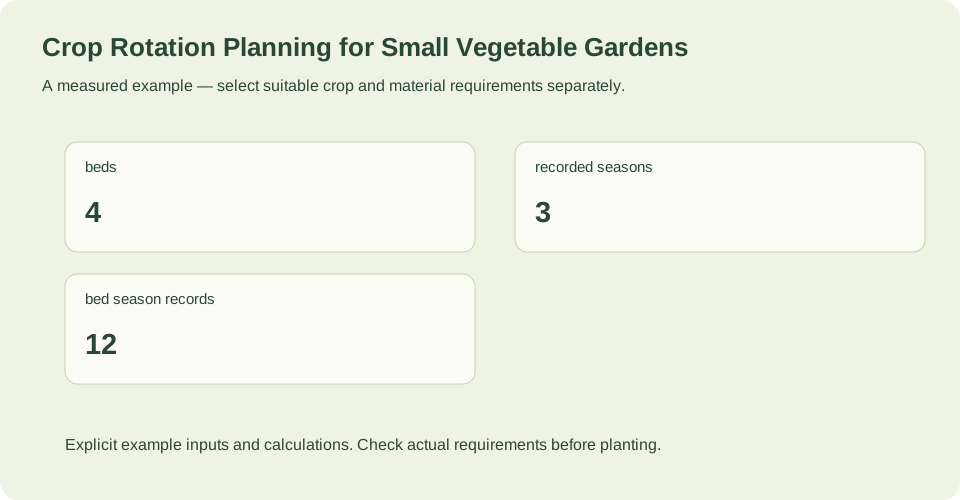
The supplied illustration uses four named beds and three recorded seasons, which produces twelve bed-season records. That is a count of entries needed to keep the history complete, not a recommended disease-break interval. A small garden may not have enough separate beds to avoid every family repeat, so the record helps you see tradeoffs rather than promise control.
- List each bed with a stable name or number.
- Add one row for every season you can document.
- Record crop family, crop name, and observed problems for each bed-season.
- Mark gaps where you do not remember the history instead of guessing.
Source context: University of Maryland Extension
Separate rotation across years from succession within one year
Rotation across years means changing which crop family occupies a bed from one season to the next. Succession within one year means replanting a space as one crop finishes and another begins. These are different planning questions, and mixing them up makes the record hard to read. Keep a year-to-year family history and a within-year planting sequence as separate notes.
Succession planting uses spots vacated by spent plants to keep production going. The source describes planting several small groups of a vegetable over time for a continuous harvest, and planning the total space for that vegetable before planting portions every two weeks. It also describes transitioning space between seasons, such as sowing Swiss chard after spring peas finish. Those are within-year or between-round decisions, not proof that rotation will prevent disease.
- Keep a year-to-year family history for each bed.
- Keep a separate within-year sequence of what was planted and when it finished.
- Note when a crop was replaced by another crop in the same bed.
- Review both records before planning the next round.
Source context: University of Maryland Extension
Use seasonal maps to plan rounds
The source suggests listing planned crops on paper and drawing a map showing spacing and location. It also suggests spring, summer, and fall maps for each round of crops. Cool-season crops such as broccoli, lettuce, and peas can be followed by warm-season crops such as beans, tomatoes, and peppers, then by more cool-season plants or a winter cover crop. These are examples from the source, not a universal schedule for every garden.
For a small garden, the map is where rotation and succession meet. You can see which bed is free, which family is due to move, and where a quick replant fits. The source notes that starting seeds indoors or in a protected area and using transplants can help when planting into vacated areas, because direct sowing may struggle against established plants. It also notes that sowing outdoors as soon as soil can be prepared, or using transplants of cold-hardy crops, can reduce germination risks. Regional dates in any source are examples for that location, so check your own local timing.
- Draw a base map of beds with spacing and location.
- Make spring, summer, and fall versions for each round.
- Mark which family is planned for each bed in each round.
- Check the year-to-year record before assigning a family to a bed.
Source context: University of Maryland Extension
Interpret limits honestly
A small backyard rotation may offer limited pest control because beds are close together and families may repeat. No fixed universal disease-break interval applies to every crop, soil, and climate. Use the record to spot repeated problems in the same bed, then decide what to change. The source material supports planning and recordkeeping, not a guarantee that a particular rotation will prevent disease.
Keep observations specific: date, bed, crop, and what you saw. If a problem recurs, the history shows whether the same family was planted there before. That is more useful than assuming a set number of years will solve it. The example table is rendered separately; use it to check that your own record has one entry per bed per recorded season, without adding numerical results beyond what it shows.
- Review repeated observations by bed and family.
- Note where family repeats were unavoidable.
- Adjust the next map based on the record, not on a fixed interval.
- Keep the record updated after each season.
Source context: University of Maryland Extension
Check your measured example
Recordkeeping illustration: four named beds and three recorded seasons require one crop-family history record per bed per season. This is a record count, not a recommended disease-break duration.
| Quantity | Calculated result |
|---|---|
| beds | 4 |
| recorded seasons | 3 |
| bed season records | 12 |
The worked example counts four named beds across three recorded seasons, giving twelve bed-season records. It illustrates how many history entries are needed to keep the record complete. It does not recommend a disease-break duration or predict pest control.
Example inputs explain the method. Review the source context, chosen cultivar and actual site before planting or ordering.
Your before-you-plant checklist
- Each bed has a stable name or number.
- Every recorded season has one entry per bed.
- Crop family is noted for each entry.
- Disease or pest observations are dated and tied to a bed.
- Year-to-year rotation notes are separate from within-year succession notes.
- Seasonal maps show spacing and location for each round.
Questions that come up while planning
How many years should I wait before growing the same crop family in a bed?
There is no fixed universal disease-break interval. The source material supports recording bed histories and observations, not a set number of years. A small garden may have limited options, so use your record to see repeats and problems rather than relying on a standard wait time.
Is succession planting the same as crop rotation?
No. Rotation across years changes which family occupies a bed between seasons. Succession within one year replants a space as crops finish, such as sowing Swiss chard after spring peas. Keep separate records for each so the plan stays clear.
What should a bed history record include?
Record one entry per bed per season with the crop family, crop name, and any disease or pest observation you actually saw. The supplied illustration of four beds and three seasons requires twelve bed-season records; that is a record count, not a recommended break duration.
Sources & method
Horticultural guidance is linked to its original source and regional context. Geometry and unit conversions are calculated separately. Read how we prepare and check a page.
- Vegetable Succession and Companion PlantingUniversity of Maryland Extension