
Tell the insects and debris apart
Fungus gnats are tiny, dark-colored flies often seen near lamps and windows. The adults are a nuisance rather than a serious threat to indoor plants. Their larvae live in damp soil and feed on fungi there, which is why consistently wet potting media supports them.
Not every small moving thing in a pot is a pest. Before acting, look at where the insect is and what it looks like. Aphids are small and soft-bodied and gather on leaves, stems and flower buds. Spider mites are minute, feed on lower leaf surfaces, and may leave visible webbing. Mealybugs look like white cottony insects. Whiteflies are tiny white adults that fly up when the plant is disturbed, with immature stages on lower leaf surfaces. Brown soft scale and hemispherical scale appear as raised black or brown bumps on leaves and stems.
Also check roots when a plant looks unhealthy. Pull the plant from its pot and look for discolored roots; diseased roots appear dark and soft, which points to root rot rather than an insect problem.
- Look first at where the insect is: flying near lights, resting on leaves, or in the soil surface.
- Compare what you see against the descriptions above before choosing any treatment.
- Lift a declining plant from its pot and inspect roots for dark, soft tissue.
Source context: University of Maryland Extension · University of Maryland Extension
Monitor to find the source: plant or drain
The practical question is whether gnats are coming from a particular potted plant or from a drain. You can answer it by covering the suspected plant or drain with screen or cheesecloth and checking over the next several days for evidence of flies. This turns a guess into an observation.
Run the check one location at a time so the result is clear. If flies appear under the cover on a plant, that pot is the source. If they appear at a covered drain, the drain is the source. If neither shows activity, move the cover to the next suspect.
- Cover one suspected plant or drain with screen or cheesecloth.
- Check under the cover over the next several days for flies.
- Repeat at other pots or drains until the source is identified.
- Record which location produced flies so you treat only that spot.
Source context: University of Maryland Extension
Reduce breeding conditions and treat carefully
Overwatering indoor plants contributes to the growth of the fungi that larvae feed on, so review watering habits alongside any treatment. Use a well-drained, soilless potting media labeled for houseplants, and make sure water can drain from the bottom of containers. For drains, the source fact is a buildup of moist debris, so cleaning that debris addresses the breeding site.
For other houseplant pests, regularly rinsing plants with water helps keep problems down. A registered houseplant spray may be used to control pests, but only according to its product label; this guide does not prescribe doses. Plants already damaged by heavy insect or mite feeding can be injured by insecticidal sprays, so weigh that before spraying. Severely damaged plants should be discarded.
For root rot, remove the plant from its pot, cut out the rotten portions, and replant the remaining healthy sections. Cuttings can be rooted in sterile potting mix.
- Check that containers drain and that the potting media is labeled for houseplants.
- Clean moist debris from drains identified as a source.
- If using a registered houseplant spray, follow the product label exactly.
- Discard severely damaged plants rather than treating them indefinitely.
Source context: University of Maryland Extension · University of Maryland Extension
Check your measured example
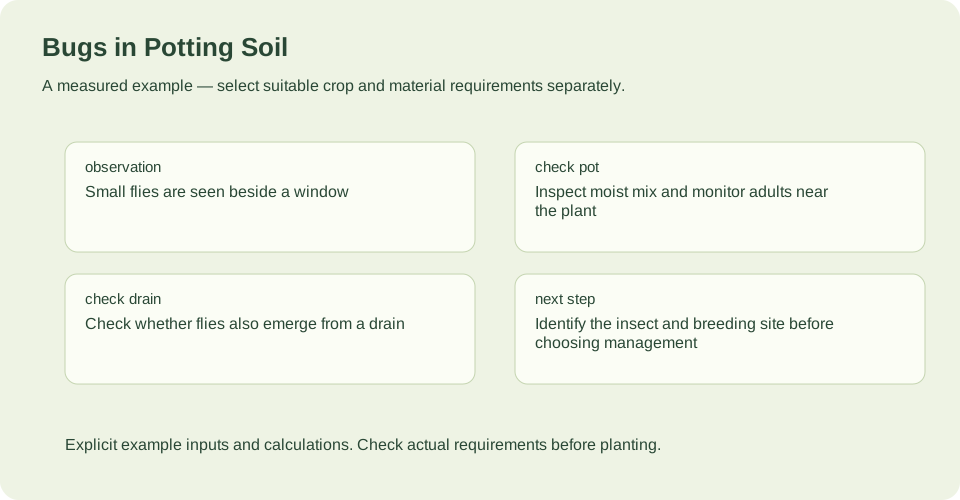
A hypothetical monitoring record separates the place where adults are seen from a confirmed breeding source. No insect count here is a treatment threshold.
| Quantity | Calculated result |
|---|---|
| observation | Small flies are seen beside a window |
| check pot | Inspect moist mix and monitor adults near the plant |
| check drain | Check whether flies also emerge from a drain |
| next step | Identify the insect and breeding site before choosing management |
Adults beside a window do not by themselves prove which pot or drain is the breeding source. Confirm both identification and location before treating.
Example inputs explain the method. Review the source context, chosen cultivar and actual site before planting or ordering.
Your before-you-plant checklist
- Identified the insect before choosing a treatment.
- Checked roots for dark, soft tissue if the plant is declining.
- Covered one suspect plant or drain and checked it over several days.
- Confirmed containers drain and the media is labeled for houseplants.
- Read the product label before using any registered spray.
Questions that come up while planning
Are fungus gnats harmful to my indoor plants?
They are annoying but generally harmless and do not significantly damage indoor plants. The larvae live in moist soil and feed on fungi, so the practical concern is usually the wet conditions that support them.
How do I know if gnats are coming from a plant or a drain?
Cover the suspected plant or drain with screen or cheesecloth and check over the next several days for evidence of flies. Test locations one at a time so you can tell which one is producing them.
Can I just spray to get rid of them?
A registered houseplant spray may be used for houseplant pests, but only according to its product label, and this guide does not give doses. Because overwatering supports the fungi larvae feed on, review watering and drainage as well.
Sources & method
Horticultural guidance is linked to its original source and regional context. Geometry and unit conversions are calculated separately. Read how we prepare and check a page.
- Fungus GnatsUniversity of Maryland Extension
- Diagnose Indoor Plant ProblemsUniversity of Maryland Extension