
Print or save your planning sheet
Print the page, or save the original SVG worksheet. The drawing supports planning; it is not a full-size planting template.
Liquid quarts versus dry quarts
A US liquid quart is 0.946352946 liters. A US dry quart is approximately 1.101221 liters. Because these are different quantities, a label that says only qt does not give you enough information to convert it reliably.
Treat the package label as the authority for what qt means on that product. If the label also states liters or cubic feet, use the stated metric or cubic-foot figure rather than guessing which quart was intended.
- Look for liters or cubic feet on the same label as the quart figure.
- If only qt appears, do not assume it is a dry quart or a liquid quart.
- Record the exact unit wording when noting a package size.
Source context: National Institute of Standards and Technology
Conversion table for one cubic foot
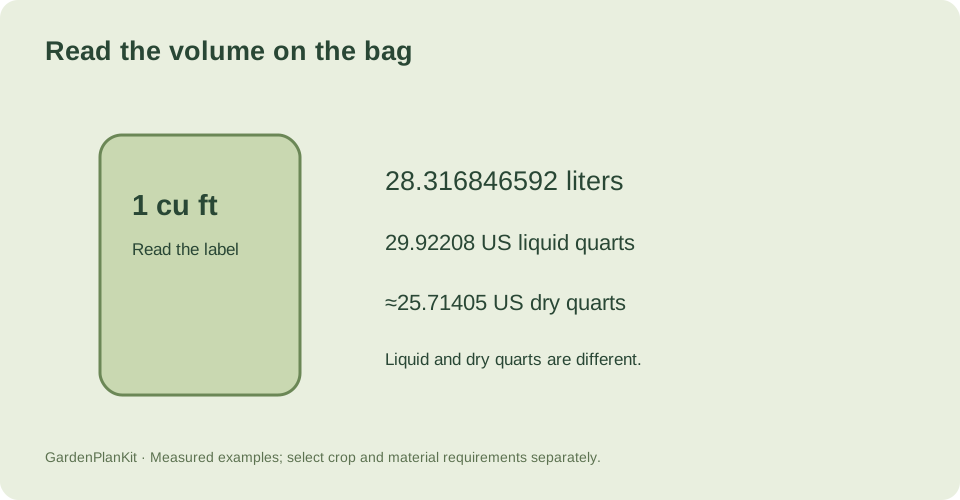
The supplied example expresses one cubic foot in explicitly named units. One cubic foot is 28.316846592 liters. In US liquid quarts, that is 29.92207792207792 quarts. In US dry quarts, it is approximately 25.714046558346745 quarts.
This is a geometrical volume conversion, not a recommendation for how much soil a particular crop or container needs. The numbers show why the quart type must be named before a conversion is meaningful.
- Use 28.316846592 liters when converting one cubic foot to liters.
- Use 29.92207792207792 when the quart unit is explicitly US liquid quarts.
- Use approximately 25.714046558346745 when the quart unit is explicitly US dry quarts.
Source context: National Institute of Standards and Technology
Normalize package sizes before comparing prices
Price comparisons need a common, clearly identified unit of quantity. Different package sizes should be normalized before their unit prices are compared.
Choose one unit, such as liters or cubic feet, and convert each package to that unit using the label's stated figures. Keep the original label wording alongside your converted value so the basis of the comparison stays visible.
- List each package's stated size and exact unit.
- Convert each size to one common unit.
- Divide price by the normalized quantity to compare unit prices.
- Note any package whose qt type is not specified and avoid treating it as a confirmed conversion.
Source context: National Institute of Standards and Technology · National Institute of Standards and Technology
Check your measured example
One cubic foot expressed in explicitly named volume units; package labels govern what qt means.
| Quantity | Calculated result |
|---|---|
| cubic feet | 1 |
| liters | 28.3168 |
| US liquid quarts | 29.9221 |
| US dry quarts approx | 25.714 |
The supplied example converts one cubic foot into explicitly named units: 28.316846592 liters, 29.92207792207792 US liquid quarts and approximately 25.714046558346745 US dry quarts. It is a geometrical conversion only; the package label governs what qt means on a product.
Example inputs explain the method. Review the source context, chosen cultivar and actual site before planting or ordering.
Your before-you-plant checklist
- Confirm whether the label says liquid quarts, dry quarts, liters or cubic feet.
- Use the label's liters or cubic feet figure when qt is ambiguous.
- Convert each package to one common unit before comparing prices.
- Keep the original unit wording with your converted values.
- Treat the one-cubic-foot figures as a volume example, not crop or container advice.
Questions that come up while planning
How many quarts are in a cubic foot of potting soil?
It depends on which quart is meant. One cubic foot is 29.92207792207792 US liquid quarts or approximately 25.714046558346745 US dry quarts. If a bag label says only qt, check for liters or cubic feet before converting.
Is a dry quart the same as a liquid quart?
No. A US liquid quart is 0.946352946 liters, while a US dry quart is approximately 1.101221 liters. The unit name must be explicit.
How should I compare the price of two soil bags?
Normalize both package sizes to a common, clearly identified unit of quantity, then compare price per unit. Use the label's stated liters or cubic feet when the quart type is unclear.
Sources & method
Horticultural guidance is linked to its original source and regional context. Geometry and unit conversions are calculated separately. Read how we prepare and check a page.
- NIST Handbook 44: General Tables of Units of MeasurementNational Institute of Standards and Technology
- Unit Pricing GuideNational Institute of Standards and Technology