
Decide whether a container suits celery
Celery is generally transplanted, and the source describes setting out transplants with three to four mature leaves and a well-established root system. In a container, that means the plant you set out is a young transplant, while the finished cluster is the group of petioles you are growing toward. Plan around the cluster's moisture needs and the container's root space rather than counting individual stalk positions.
The source says celery thrives in full sun with fertile, well-drained soil rich in organic matter. It also notes a small root system and poor nutrient foraging, so the growing medium and feeding plan matter. A container that dries unevenly or holds saturated mix works against the crop's need for consistent moisture.
The container source does not name celery among its reference minimum-volume examples. Do not convert the in-ground spacing figures into a pot minimum. Instead, use the suitability checks below and choose a container whose shape and volume match the mature top growth and root space you expect.
- Confirm the site receives full sun for the crop's main growing period.
- Check that the container has open drainage holes and that no saucer is left full of water.
- Reject any pot whose shape or volume cannot support the mature cluster and its roots, even if a label sounds large.
Source context: Utah State University Extension · University of Maryland Extension
Prepare the growing medium and support checks
Use a growing medium that supports roots while holding appropriate water and air. The container guide lists commercial soilless mix and an equal-volume soilless-mix and compost blend among options for container vegetables. Dense garden soil behaves differently from a container mix, so do not treat it as interchangeable.
Celery needs a good nutrient supply because it forages poorly. The source recommends determining fertilizer needs with a soil test and following the test report, working warranted fertilizer into the top 6 inches of soil. For compost, it limits well-composted organic matter to no more than 1 inch per 100 square feet of garden area. Those are in-ground soil-preparation figures, not a container recipe.
If you reuse medium, remove plant residue and do not save medium associated with root disease. The mix guide describes blending old and fresh material rather than assuming old mix is unchanged. Measure actual fill volume rather than relying on nursery trade-gallon labels, and keep drainage holes clear; stones or gravel under the mix do not improve drainage.
- Choose a soilless mix or an equal-volume soilless-mix and compost blend.
- Measure the actual fill volume of the container instead of trusting a trade-gallon label.
- Keep drainage holes open and empty any saucer after watering.
- Remove old plant residue before reusing medium, and discard medium linked to root disease.
Source context: University of Maryland Extension · University of Maryland Extension · Utah State University Extension
Set up and monitor the planting
Set out a transplant with three to four mature leaves and a well-established root system. The source's in-ground spacing figures, including rows 2 feet apart and plants 12 inches apart in the row, describe garden planting and a tight planting that helps force tall growth and long petioles. They are not a container layout instruction. In a container, treat the planting as one cluster and give it room according to the container you confirmed.
Water consistently to keep the soil moist. The source gives 1 to 2 inches per week for tender, string-free stalks, but that figure is written for garden soil. In a container, use it as a moisture target to check against, not as a fixed pouring rule, because mix volume, drainage and weather change how quickly the medium dries.
The source suggests feeding with nitrogen-rich fertilizer about a month after planting, then stopping once stalks start forming to prevent splitting. It also names Utah and Pascal as varieties that remain green when ready to eat and are considered fine quality. Mulch with compost to control weeds and help retain moisture; black plastic mulch is described for warming soil, conserving water and controlling weeds, but it is a garden practice, not a required container step.
- Set out only a transplant with three to four mature leaves and a well-established root system.
- Check moisture regularly and keep the medium consistently moist without leaving roots saturated.
- Plan a nitrogen-rich feed about a month after planting, then stop once stalks begin forming.
- Add compost mulch to help retain moisture and control weeds.
- Record the container, medium, planting date and watering checks so the plan can be reviewed.
Source context: Utah State University Extension · University of Maryland Extension · University of Maryland Extension
Check your measured example
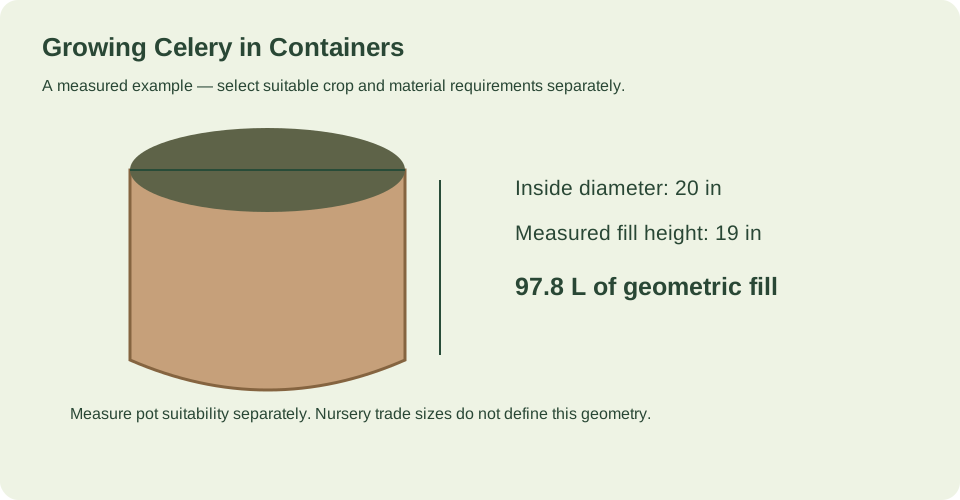
Volume-only illustration: one straight-sided pot with inside diameter 20 in, inside height 20 in and 1 in rim gap. The resulting fill capacity is not a minimum pot size for celery; confirm a suitable container separately.
| Quantity | Calculated result |
|---|---|
| inside diameter in | 20 |
| fill height in | 19 |
| volume cuft | 3.4543 |
| volume liters | 97.8148 |
| US liquid gallons | 25.8399 |
The worked example is a volume-only illustration: a straight-sided pot with a 20-inch inside diameter, a 20-inch inside height and a 1-inch rim gap, giving a fill height of 19 inches. Its calculated fill capacity is about 3.45 cubic feet, 97.8 liters or 25.8 US liquid gallons. That number describes the pot's fill volume only. It is not a minimum pot size for celery and does not establish that this container suits the crop; confirm a suitable container separately using the checks above.
Example inputs explain the method. Review the source context, chosen cultivar and actual site before planting or ordering.
Your before-you-plant checklist
- Container has open drainage holes and no standing water in the saucer.
- Growing medium is a soilless mix or an equal-volume soilless-mix and compost blend.
- Actual fill volume is measured rather than taken from a trade-gallon label.
- Transplant has three to four mature leaves and a well-established root system.
- Moisture is checked regularly and the medium is kept consistently moist.
- Feeding is planned about a month after planting and stopped once stalks form.
Questions that come up while planning
What pot size does celery need in a container?
The supplied sources do not give a crop-specific minimum volume for celery. They do say to match both mature top growth and root space and that volume alone does not define a suitable shape. Confirm a suitable container separately rather than converting the in-ground spacing figures into a pot minimum.
Should I plant individual celery stalks in separate positions?
No. Treat the crop as a group of moisture-dependent petioles that forms a finished cluster. The in-ground spacing figures describe garden planting, not a container layout, so do not use them as stalk positions in a pot.
How should I water and feed celery in a container?
Keep the medium consistently moist and check it regularly. The source's 1 to 2 inches per week is a garden-soil figure, so use it as a moisture target rather than a fixed container rule. Feed with nitrogen-rich fertilizer about a month after planting, then stop once stalks start forming to prevent splitting.
Sources & method
Horticultural guidance is linked to its original source and regional context. Geometry and unit conversions are calculated separately. Read how we prepare and check a page.
- How to Grow Celery in Your GardenUtah State University Extension
- Growing Vegetables in Containers and Salad TablesUniversity of Maryland Extension
- Growing Media (Potting Soil) for ContainersUniversity of Maryland Extension