
Decide whether a container suits your chard plan
Swiss chard is a cool-season vegetable that prefers a sunny location and fertile, well-drained soil. It grows best when temperatures stay below about 75°F, and high summer heat can reduce growth and quality and bring bitter or off flavors. Young plants tolerate temperatures down to 32°F without serious damage, and plants can remain after light frosts. In a container, those temperature limits matter more because the root zone is exposed.
For repeated outside-leaf harvest, plan around retained plants rather than a dense seedling carpet. The source spacing of 6 inches between plants with 12 inches between rows is an in-ground row figure. Do not convert it directly into a pot minimum. Instead, use it as context for how much room each retained plant needs, then confirm the container separately for shape, root space and access.
Maryland lists a reference minimum volume of 2 US gallons for Swiss chard among its named guide examples. Treat that as a starting reference, not a guarantee for every cultivar or harvest style. Match both mature top growth and root space, because volume alone does not define a suitable shape.
- Confirm the site gets sun and that summer heat will not trap the pot against a hot wall.
- Decide whether you want repeated outside-leaf harvest or a dense baby-leaf cut, since the layouts differ.
- Check the container for open drainage holes and enough width to reach the plants you will retain.
Source context: Utah State University Extension · University of Maryland Extension
Check the growing medium and support
A container medium must support roots while holding appropriate water and air. Dense garden soil behaves differently from a container mix, so do not simply fill the pot with garden soil. The container guide lists commercial soilless mix and an equal-volume soilless-mix and compost blend among its options.
Swiss chard prefers fertile, well-drained soil rich in organic matter. A medium that drains and holds air supports the frequent, uniform irrigation the crop needs. If you reuse medium, remove plant residue and do not save medium associated with root disease. Blend old and fresh material rather than assuming old mix is unchanged.
Keep drainage holes open. Stones or gravel under the mix do not improve drainage, and empty saucers so roots are not left saturated. Measure actual fill volume rather than relying on nursery trade-gallon labels.
- Choose a soilless mix or an equal-volume soilless-mix and compost blend.
- Fill the pot and firm lightly, leaving a rim gap for watering.
- Set the pot where it drains freely and empty any saucer after watering.
Source context: University of Maryland Extension · University of Maryland Extension · Utah State University Extension
Set up and monitor the planting
Swiss chard can be grown from seed or transplants. Seeds are planted ½ inch deep, germinate best at 55–75°F and take 7–14 days to emerge; temperatures above 80°F reduce germination. Thin when plants have 3–4 true leaves. Plants removed at thinning can be transplanted if some roots are kept, or eaten.
Transplants go out near the last frost-free date for the area, and seeded chard may be planted 3–4 weeks earlier. These dates are examples for the source location, not rules for every climate. For fall chard, the source suggests early maturing cultivars planted 50–75 days before the anticipated maturity date, about 2–3 weeks before the first fall frost.
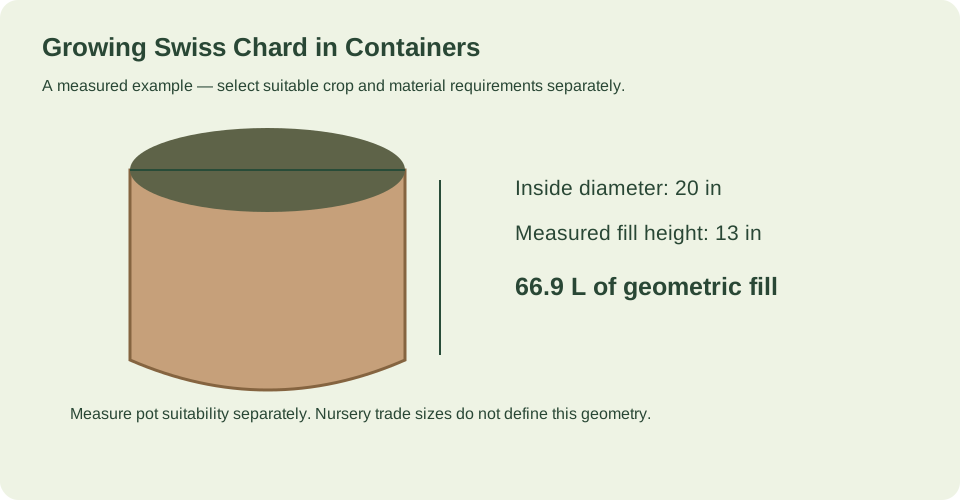
Irrigate frequently and uniformly, and watch for insects and disease through the season. Harvest when leaves reach full size. The geometric example table is rendered separately: it shows the fill volume of one straight-sided pot with a 20-inch inside diameter, 14-inch inside height and 1-inch rim gap. That number describes fill capacity only and is not a minimum pot size for chard.
- Sow seeds ½ inch deep or set transplants at the same depth they grew at.
- Thin to the retained plants when 3–4 true leaves appear, keeping a reachable route to each crown.
- Water frequently and evenly, and check leaves and stems for pests and disease.
- Harvest outer leaves at full size and keep monitoring through heat and frost.
Source context: Utah State University Extension · University of Maryland Extension · University of Maryland Extension
Check your measured example
Volume-only illustration: one straight-sided pot with inside diameter 20 in, inside height 14 in and 1 in rim gap. The resulting fill capacity is not a minimum pot size for chard; confirm a suitable container separately.
| Quantity | Calculated result |
|---|---|
| inside diameter in | 20 |
| fill height in | 13 |
| volume cuft | 2.3635 |
| volume liters | 66.9259 |
| US liquid gallons | 17.68 |
The worked example is a volume-only illustration of one straight-sided pot with a 20-inch inside diameter, 14-inch inside height and 1-inch rim gap. Its fill capacity is not a minimum pot size for chard and does not account for plant room, drainage or access. Confirm a suitable container separately before using the figure.
Example inputs explain the method. Review the source context, chosen cultivar and actual site before planting or ordering.
Your before-you-plant checklist
- Container has open drainage holes and a shape that fits retained plants.
- Site is sunny and not trapped against a hot wall in summer.
- Medium is soilless mix or an equal-volume mix and compost blend.
- Rim gap left for watering; saucer emptied after rain or irrigation.
- Thinning and harvest plan keeps a reachable route to each retained crown.
Questions that come up while planning
Is a 2-gallon pot enough for Swiss chard?
Maryland lists 2 US gallons as a reference minimum volume for Swiss chard among its named examples. It is a guide example, not a guarantee for every variety or harvest style. Check shape, root space, drainage and access to retained plants as well.
Can I use the 6-inch in-row spacing to size a pot?
No. The 6-inch spacing with 12-inch rows is an in-ground row figure. It gives context for plant room but should not be converted directly into a pot minimum. Confirm the container separately.
What growing medium should I use?
Use a commercial soilless mix or an equal-volume soilless-mix and compost blend. Avoid dense garden soil, keep drainage holes open, and do not save medium associated with root disease.
Sources & method
Horticultural guidance is linked to its original source and regional context. Geometry and unit conversions are calculated separately. Read how we prepare and check a page.
- How to Grow Swiss Chard in Your GardenUtah State University Extension
- Growing Vegetables in Containers and Salad TablesUniversity of Maryland Extension
- Growing Media (Potting Soil) for ContainersUniversity of Maryland Extension