
Start with the three jobs of a potting medium
A container medium has to hold roots, hold appropriate water and air, and give plants something to anchor into. Dense garden soil behaves differently from a container mix, so do not assume a garden bed soil is a drop-in substitute. A potting-medium formulation balances water retention, nutrients and aeration, and those three jobs are the frame for every measurement you make.
Compost is not a guaranteed quality label. Compost-based media vary with their ingredients, so a recipe name alone is not a quality test. Before you commit a whole batch, look at what you are actually combining and whether the blend still leaves room for air and drainage.
- Write down the three jobs: aeration, water retention, support.
- Confirm each ingredient is a container-appropriate material, not dense garden soil.
- Check what the compost is made from rather than relying on the word compost.
Source context: University of Maryland Extension · Penn State Extension
Measure the example batch by volume
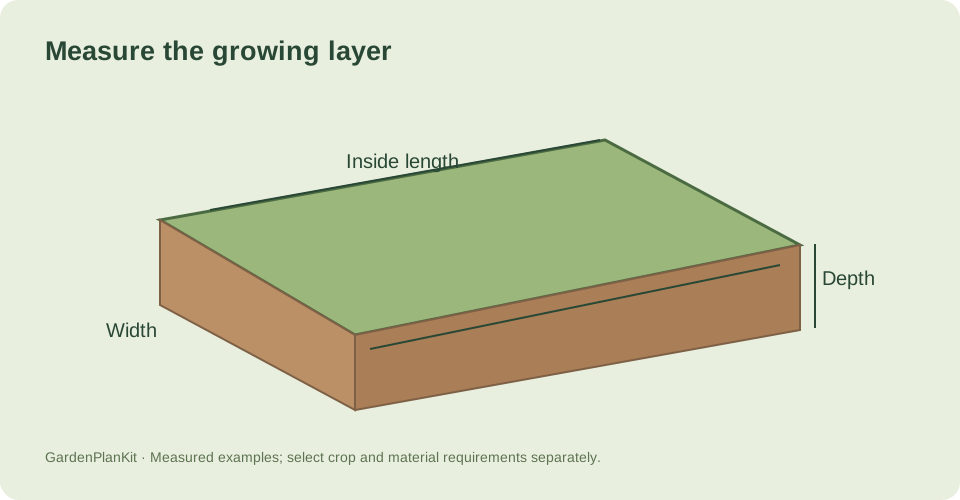
The supplied example is a 20 cubic foot batch made of equal volumes: 10 cubic feet of commercial soilless medium and 10 cubic feet of compost. That is a geometrical illustration of equal-volume measuring, not a universal prescription and not an invented homemade formula. The same 1:1 volume relationship could be scaled to a smaller batch, but the example itself fixes only the 20 cubic foot total.
Volume is the working unit here. Package label units govern any conversion you do, so read the bag or label before you translate a batch size into scoops, buckets or partial bags. Keep the measuring container consistent across ingredients so equal volumes really are equal.
- Set a total batch volume before measuring anything.
- Measure 10 cubic feet of soilless medium and 10 cubic feet of compost for the example batch.
- Use one consistent measuring container and record each volume.
- Convert package units only according to the label.
Source context: University of Maryland Extension · Penn State Extension
Blend, check and adjust the plan
Combine the measured parts and assess the result against the three jobs. If the blend looks or feels too dense, the plan needs more aeration, not a guessed extra ingredient. If it seems to shed water too quickly, water retention is the job to revisit. These are checks on the balance, not new recipes.
Record what you actually measured, including the source and volume of each part. That record lets you repeat a batch or change one variable at a time instead of rebuilding from memory.
- Blend the measured parts thoroughly.
- Check the blend against aeration, water retention and support.
- Note the measured volumes and ingredient sources for the next batch.
Source context: University of Maryland Extension · Penn State Extension
Handle reused medium carefully
Reuse is a separate decision from mixing a fresh batch. Remove plant residue before reusing medium, and do not save medium associated with root disease. The Maryland guide describes blending old and fresh material rather than assuming old mix is unchanged.
If you blend old and fresh material, measure both by volume and log the proportions, so the reused portion is a known part of the batch rather than an unmeasured addition.
- Remove plant residue from medium you intend to reuse.
- Discard medium associated with root disease.
- Measure old and fresh material by volume if you blend them.
- Record the blend proportions.
Source context: University of Maryland Extension
Check your measured example
Illustrative 20 cu ft batch, equal volumes of commercial soilless medium and compost; not a universal crop recipe.
| Quantity | Calculated result |
|---|---|
| soilless cuft | 10 |
| compost cuft | 10 |
The supplied example is a 20 cubic foot batch built from equal volumes: 10 cubic feet of commercial soilless medium and 10 cubic feet of compost. It demonstrates equal-volume measuring and batch organization only. It is not a universal prescription, not an invented homemade formula, and not a crop-specific recommendation; no additional numerical results are implied.
Example inputs explain the method. Review the source context, chosen cultivar and actual site before planting or ordering.
Your before-you-plant checklist
- Total batch volume is written down before measuring.
- Each ingredient is measured with the same container.
- The example batch is recorded as 10 cubic feet soilless medium plus 10 cubic feet compost.
- Package label units are checked before any conversion.
- Reused medium has plant residue removed and is not from a root-disease situation.
Questions that come up while planning
Is the 10 cubic feet soilless mix plus 10 cubic feet compost batch a recommended recipe?
No. It is an illustrative equal-volume batch of 20 cubic feet, used to show how to organize and measure ingredients. The Maryland guide lists an equal-volume soilless-mix/compost blend among container vegetable options, but the example is not a universal crop recipe.
Why measure potting mix by volume instead of weight?
Volume keeps the batch easy to scale and repeat with consistent containers. Package label units govern any conversion, so check the label before translating a batch size into partial bags or scoops.
Can I reuse old potting medium in a new batch?
Remove plant residue first, and do not save medium associated with root disease. If you blend old and fresh material, measure both by volume and record the proportions rather than assuming old mix is unchanged.
Sources & method
Horticultural guidance is linked to its original source and regional context. Geometry and unit conversions are calculated separately. Read how we prepare and check a page.
- Growing Media (Potting Soil) for ContainersUniversity of Maryland Extension
- Organic Transplant Production NotesPenn State Extension