
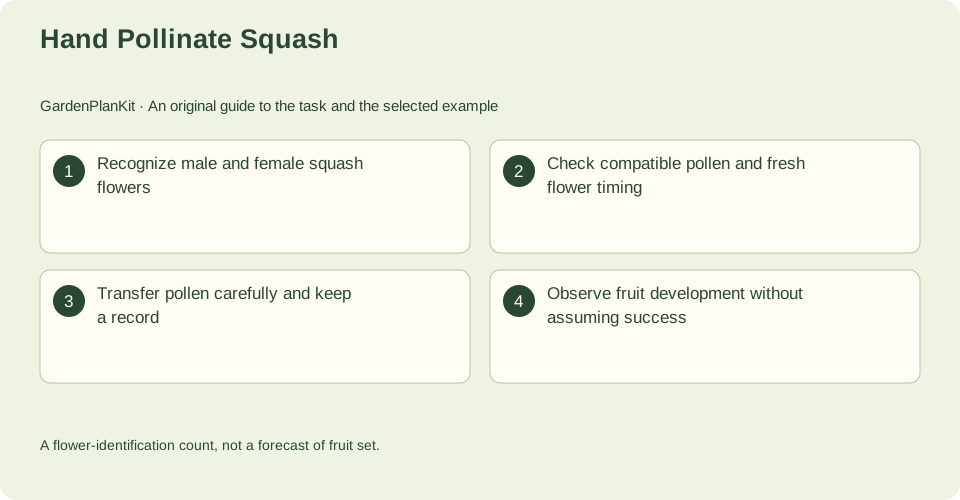
Recognize male and female squash flowers
Maryland describes separate male and female flowers on squash and some related cucurbits. Look at the base of the flower, where it meets the stem. A female squash flower has the immature fruit at its base. A male flower has a narrower stem without that swelling. Check several open flowers before you decide which is which, and note that male flowers may appear first and drop naturally.
Not every lost early flower indicates a pollination failure. A dropped male flower is expected. A dropped or misshapen young fruit can point to a pollination problem, but not every fruit problem is caused by failed pollination, so treat flower loss as a clue to investigate rather than a verdict.
- Inspect the base of each open flower for an immature fruit or a narrow stem.
- Count and label the male and female flowers you find.
- Note any flowers that have already dropped before you begin.
Source context: University of Maryland Extension · University of California Statewide IPM
Check compatible pollen and fresh flower timing
UC IPM says hand pollination with an artist's paint brush is possible when pollinator visits are insufficient. Use open flowers, and transfer compatible male pollen to the receptive female flower identified in the Maryland reference. Freshness matters: work with flowers that are open now rather than buds or flowers that have closed.
Use a compatible squash pollen source. Do not assume every cucurbit species can pollinate every other one. Keep the pollen source within the same squash type you are growing unless you have a specific reason to cross them, and remember that current fruit shape does not prove next-generation seed purity. Preserve bee visits and avoid insecticides that kill pollinators, since hand pollination supplements rather than replaces them.
- Confirm both the male and female flowers are open before transferring pollen.
- Match the pollen source to a compatible squash type.
- Avoid spraying insecticides that kill pollinators around flowering squash.
Source context: University of Maryland Extension · University of California Statewide IPM
Transfer pollen carefully and keep a record
With an artist's paint brush, pick up pollen from the male flower and carry it to the receptive female flower. Work gently and keep the brush clean between flowers if you are moving between squash types. Record which fresh female flowers received compatible pollen, along with the date and the male flower used.
A record lets you compare handled flowers with what happens next. It also keeps you from treating a flower count as a result. The supplied example is a flower-identification count, not a forecast of fruit set: two male flowers and three female flowers were identified among five inspected, and the follow-up was to record which fresh female flowers received compatible pollen. That example shows the record-keeping step only; it does not predict how many fruits will set.
- Use an artist's paint brush to move pollen from a fresh male flower to a fresh female flower.
- Write down the date, the female flower, and the male flower used.
- Keep the record separate from any guess about expected fruit.
Source context: University of Maryland Extension · University of California Statewide IPM
Observe fruit development without assuming success
After pollination, watch the immature fruit at the base of the female flower. Note whether it enlarges, holds, or drops. Compare handled flowers with unhandled ones nearby so you can see whether your work made a difference. Do not promise fruit set from a count of handled flowers.
If young fruit is misshapen or drops, review your notes: was the female flower fresh, was the male flower open, and was the pollen source compatible? Those checks help you decide what to change next time. Keep supporting pollinator access, because hand pollination is a supplement when visits are insufficient, not a replacement for bees.
- Check the base of each pollinated female flower over the following days.
- Compare handled flowers with unhandled flowers nearby.
- Review your notes before changing your method.
Source context: University of Maryland Extension · University of California Statewide IPM
Work through this example
A flower-identification count, not a forecast of fruit set.
| Example detail | Selected value or observation |
|---|---|
| male flowers identified | 2 |
| female flowers identified | 3 |
| flowers inspected total | 5 |
| follow up | Record which fresh female flowers received compatible pollen. |
The supplied example is hypothetical and is a flower-identification count, not a forecast of fruit set. It lists two male flowers and three female flowers identified among five inspected, with a follow-up to record which fresh female flowers received compatible pollen. It does not add any expected fruit count or success rate.
Use this example to structure your own notes. Check the source conditions for the crop, method and setting.
Your action checklist
- Check the base of each open flower for an immature fruit or a narrow stem.
- Confirm both male and female flowers are open before transferring pollen.
- Use a compatible squash pollen source and a clean artist's paint brush.
- Record the date, female flower, and male flower used.
- Compare handled flowers with unhandled ones as fruit develops.
Questions that come up while planning
How do I tell a male squash flower from a female one?
Look at the base where the flower meets the stem. A female squash flower has the immature fruit at its base; a male flower has a narrower stem without that swelling.
Can I use pollen from any cucurbit on a squash flower?
No. Use a compatible squash pollen source. Do not assume every cucurbit species can pollinate every other one.
Does a handled flower mean I will get fruit?
Not necessarily. Pollination problems can cause misshapen or dropped young fruit, but not every fruit problem is caused by failed pollination. Watch fruit development rather than counting handled flowers.
Sources & method
Horticultural guidance is linked to its original source and regional context. Geometry and unit conversions are calculated separately. Read how we prepare and check a page.
- Pollination Problems of VegetablesUniversity of Maryland Extension
- Blossom Drop in CucurbitsUniversity of California Statewide IPM