
Match the cover to the job
An empty bed mainly needs its soil protected, so a flat panel laid over the surface can be enough, provided it is secured. Living plants need growing room and light, and the cover must suit the crop beneath it. Pest exclusion is a third job: a light insect barrier is not interchangeable with a heavier cover, because row-cover fabrics differ in weight, light transmission and protection.
Covers can float directly on suitable crops, or they can sit on a frame. Frames are particularly useful with heavier covers and where clearance matters, but living plants do not always require one. Treat cover weights and product ratings as context, not as guaranteed survival temperatures.
- Write down the cover's main job before comparing products.
- Check whether the crop can tolerate fabric floating on it or needs clearance.
- Confirm the fabric suits that job rather than assuming heavier is better.
Source context: University of Maryland Extension
Measure a flat cover over an empty bed
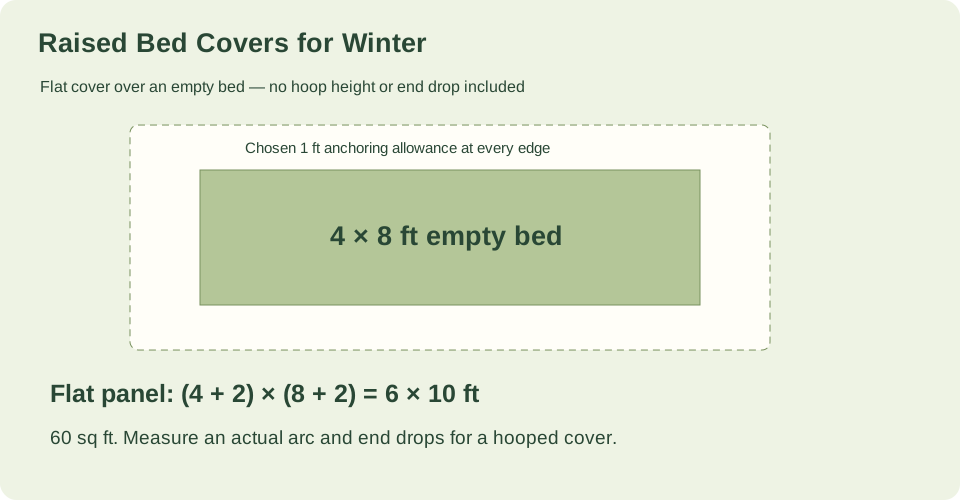
For a flat panel over an empty bed, measure the bed and add a chosen anchoring allowance on every side. The supplied example is only a flat rectangle over an empty 4 by 8 ft bed with a 1 ft allowance on all four sides. Adding 2 ft to each dimension gives a 6 by 10 ft panel, or 60 square feet.
That figure is a geometrical example, not crop advice. The allowance is a choice you make for securing the edges, and a different allowance changes the panel size.
- Measure the empty bed's width and length.
- Choose an anchoring allowance for each edge and add twice that allowance to each dimension.
- Record the resulting panel size and area before ordering.
Source context: University of Maryland Extension
Measure hoops and frame-supported covers separately
A hooped or frame-supported cover does not use the flat-bed dimensions. Measure the actual arc over the plants and the end drops down to the anchoring points, because the fabric must follow the curve and reach the ground at both ends. Do not reuse the flat 6 by 10 ft example for a hooped cover, and do not assume a universal frame material list.
Wind and snow set structural limits on any cover and frame. This guide makes no structural engineering or snow-load claim, so check that the frame and anchoring suit your site before relying on them.
- Measure the arc height and width the cover must clear.
- Measure the end drops from the arc down to the anchoring points.
- Check the frame and anchoring against expected wind and snow at your site.
Source context: University of Maryland Extension
Manage light, air, access and pollinators
Covers change the growing environment. Cold frames can warm in sunlight, so their management differs from a flat cover over an empty bed. Plan for ventilation on warm days and for access when you need to check or harvest.
Crops that require insect pollination need pollinator access when flowering, so a cover that stays sealed through bloom can work against the crop. Periodic checks let you catch overheating, poor ventilation or loose anchoring before they become problems.
- Plan how you will open or vent the cover on warm days.
- Plan how you will reach the plants for checks and harvest.
- Open or remove covers for pollinator access when flowering crops need insects.
- Check the cover periodically for ventilation, anchoring and plant clearance.
Source context: University of Minnesota Extension · University of Maryland Extension
Check your measured example
Flat cover over an empty bed only. A chosen 1 ft allowance on every side adds 2 ft to each dimension. A hooped cover needs separately measured arcs and end drops.
| Quantity | Calculated result |
|---|---|
| empty bed width ft | 4 |
| empty bed length ft | 8 |
| selected allowance each edge ft | 1 |
| flat panel width ft | 6 |
| flat panel length ft | 10 |
| flat panel area sq ft | 60 |
The supplied example covers only a flat rectangle over an empty 4 by 8 ft bed with a chosen 1 ft anchoring allowance on all four sides. Adding 2 ft to each dimension gives a 6 by 10 ft panel, or 60 square feet. It is a geometrical example, not crop advice, and it does not apply to hooped covers, which need separately measured arcs and end drops.
Example inputs explain the method. Review the source context, chosen cultivar and actual site before planting or ordering.
Your before-you-plant checklist
- The cover's main job is written down: bare soil, living plants or pest exclusion.
- The flat panel size includes a chosen anchoring allowance on all four sides.
- Hooped covers are measured by actual arc and end drops, not flat-bed dimensions.
- Ventilation, access and pollinator needs at flowering are planned.
- Frame and anchoring are checked against expected wind and snow at the site.
Questions that come up while planning
Do living plants always need a frame under a winter cover?
No. A suitable lightweight cover can float directly on some crops. Frames are useful for clearance and are particularly helpful with heavier covers, so the choice depends on the crop and the cover.
Can I use the 6 by 10 ft example for a hooped cover?
No. That example is only a flat rectangle over an empty 4 by 8 ft bed with a 1 ft anchoring allowance on all four sides. A hooped cover needs its actual arc and end drops measured separately.
Does a heavier cover guarantee plants will survive freezing?
No. Cover weights and product ratings are context, not guaranteed survival temperatures. Row-cover fabrics also differ in light transmission and protection, so match the fabric to the job.
Sources & method
Horticultural guidance is linked to its original source and regional context. Geometry and unit conversions are calculated separately. Read how we prepare and check a page.
- Vegetable Garden Weather and Pest ProtectionUniversity of Maryland Extension
- Extending the growing season: start early, end laterUniversity of Minnesota Extension