
Use the cultivar and planting record as a starting point
Start with two pieces of information: what the cultivar is described as, and when you sowed it. Utah State recommends checking crop-specific maturity rather than relying only on calendar days, and for carrots specifically it advises checking the cultivar's desired root size and inspecting a sample rather than applying one maturity-day figure to all carrots. Your sowing date plus any packet interval gives you a date to begin looking, not a date to harvest the whole row.
Write down the cultivar name, sowing date, and the size or use you have in mind, such as small roots for fresh eating or larger roots for storage. Those notes keep the inspection honest: you are comparing an actual root to a stated intention, not guessing from foliage alone.
- Record the cultivar name and sowing date where you can find them at harvest time.
- Note the root size and use you want before you go out to inspect.
- Use any packet interval only to set the first inspection date.
Source context: Utah State University Extension · Utah State University Extension
Inspect a sample root for the intended harvest size
Loosen the soil beside a representative carrot and ease one root free rather than pulling the whole row. Compare that sample with the size and condition you noted. Root size, quality, and intended use govern harvest decisions rather than a universal day count, so a sample that looks right for fresh eating may be smaller than what you want for storage.
If the sample is below your target, leave the row and check again later. If it meets your target, harvest what you need. Handle produce carefully and protect it from heat as you work, and separate damaged material before storage rather than mixing it with sound roots.
- Ease out one representative root with a fork or trowel.
- Compare its size and condition with your stated target.
- Leave the row if the sample is short of target; harvest only what you need if it meets it.
- Set damaged roots aside from sound ones.
Source context: Utah State University Extension · Utah State University Extension
Lift carefully and remove tops for storage
For roots headed to storage, lift them carefully to avoid breaking or bruising them, and keep them out of heat. Utah State's root-crop guide distinguishes bunched carrots with tops from bagged roots without tops: attached leaves increase water loss, so remove tops for the storage-root task. Twist or cut the tops off rather than leaving foliage attached to roots you intend to keep.
This is a storage decision, not a rule for every carrot you pull. Carrots you will eat right away can keep their tops until you use them; the point is to match handling to the job.
- Lift storage roots carefully and keep them shaded from heat.
- Remove tops from roots intended for storage.
- Keep damaged roots separate from sound storage roots.
Source context: Utah State University Extension · Utah State University Extension
Match the storage environment to roots
Carrots need a different storage regime from cured onions. Utah State advises keeping carrot roots suitably cool and moist, and warns against applying an onion's dry-storage conditions indiscriminately to roots or potatoes. A suggested storage regime is not a guaranteed household shelf life, and the commercial storage targets in the root-crop guide are not a promise of months of storage in a home refrigerator.
Decide where your roots will go before you harvest more than you can handle, and check that the spot is cool and moist rather than dry like an onion cure. Root size, quality, and intended use should guide how much you lift at once.
- Choose a cool, moist storage spot suited to roots, not a dry onion-cure setup.
- Harvest only as many roots as your storage can reasonably hold.
- Check stored roots periodically and remove any that spoil.
Source context: Utah State University Extension · Utah State University Extension
Work through this example
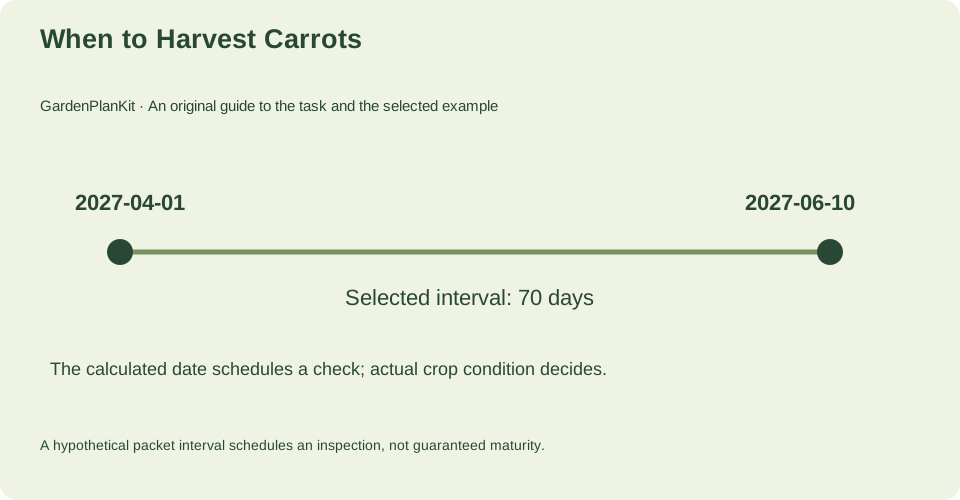
A hypothetical packet interval schedules an inspection, not guaranteed maturity.
| Example detail | Selected value or observation |
|---|---|
| chosen sowing date | 2027-04-01 |
| example packet days | 70 |
| calculated check date | 2027-06-10 |
| decision | Inspect the actual cultivar and root before harvesting the whole row. |
The supplied example is hypothetical. A sowing date of 2027-04-01 plus a packet interval of 70 days gives a calculated check date of 2027-06-10. That date schedules an inspection, not guaranteed maturity; the decision is to inspect the actual cultivar and root before harvesting the whole row. No additional timing or yield results are implied.
Use this example to structure your own notes. Check the source conditions for the crop, method and setting.
Your action checklist
- Cultivar name and sowing date recorded before inspection.
- Target root size and intended use written down.
- One representative root eased out and compared with the target.
- Storage roots lifted carefully, kept from heat, and tops removed.
- Storage spot confirmed cool and moist, not a dry onion-cure setup.
Questions that come up while planning
Can I harvest carrots on the packet's day count alone?
No. Utah State recommends checking crop-specific maturity rather than relying only on calendar days, and for carrots it advises inspecting a sample against the cultivar's desired root size. The packet interval is a prompt to start checking.
Should I remove carrot tops before storing them?
For roots intended for storage, yes. The root-crop guide notes that attached leaves increase water loss, so remove tops for the storage-root task. Carrots eaten right away can keep their tops until use.
Can I store carrots like cured onions?
No. Utah State warns against applying an onion's dry-storage conditions indiscriminately to roots or potatoes. Carrot roots should be kept suitably cool and moist, and a suggested regime is not a guaranteed household shelf life.
Sources & method
Horticultural guidance is linked to its original source and regional context. Geometry and unit conversions are calculated separately. Read how we prepare and check a page.
- Harvest and Storage of Vegetables and FruitsUtah State University Extension
- Harvest and Storage: Carrot and ParsnipUtah State University Extension