
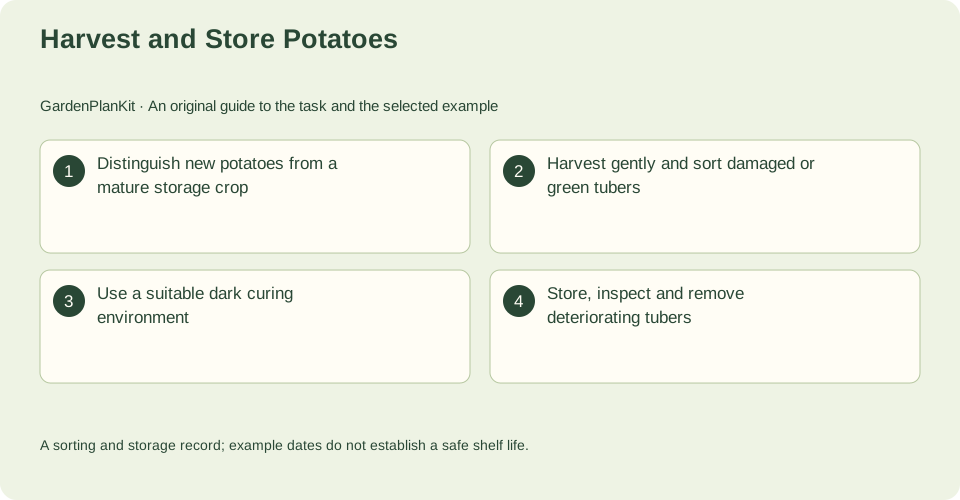
Decide whether you are picking new potatoes or a storage crop
Check the crop itself rather than counting calendar days. Utah State recommends crop-specific maturity checks, and for mature storage potatoes that means allowing vines to die back and harvesting carefully when soil conditions suit. New potatoes are not the same as a mature storage crop, so decide which harvest you are taking before you lift plants.
If the soil is workable and vines have died back, lift gently with a fork placed away from the tubers to reduce skewering. Work in conditions that let you separate tubers without tearing them, and keep harvested potatoes out of heat while you sort.
- Confirm vines have died back before treating the lift as a mature storage harvest.
- Choose a fork position outside the tuber cluster and lift slowly.
- Keep lifted potatoes shaded and protected from heat until sorting.
Source context: Utah State University Extension
Harvest gently and sort the lot at the edge of the bed
Handle every tuber as if it will be stored, because bruises and cuts create problems later. Utah State advises careful handling, protection from heat and separation of damaged material before storage. Sort as you harvest: firm, sound mature tubers go into the storage candidate lot; green, soft, damaged or rotting tubers stay out.
Do not treat curing or cooking as a way to make questionable potatoes safe. The potato quality guidance is to choose firm sound tubers without soft or green areas and to sort damaged, rotting or green potatoes out of the sound storage lot. Keep the two lots physically separate so a bad tuber is not buried in the keep pile.
- Set out two containers before lifting: sound storage candidates and a reject lot.
- Reject green, soft, cut, bruised or rotting tubers from the storage lot.
- Record harvest conditions and the sorting decision for each lot.
Source context: Utah State University Extension · Utah State University Extension
Cure sound tubers in a suitable dark environment
For mature storage potatoes, Utah describes curing sound tubers in darkness at 45–60 F for about two weeks, then storing in darkness near 40 F. Darkness is part of the handling regime, not an optional detail. Use a location you can actually keep dark and within that range, and check it rather than assuming a garage corner qualifies.
Do not borrow an onion's dry-storage cure for potatoes. Utah notes that onion curing uses ventilation out of direct sun for 2–3 weeks and that dry-storage conditions should not be applied indiscriminately to roots or potatoes. A suggested storage regime is not a guaranteed household shelf life, so treat the cure as a handling step you monitor.
- Confirm the curing spot is dark and can be held at 45–60 F.
- Place only the sound mature lot into curing; keep rejects out.
- Record the curing location and temperature readings.
Source context: Utah State University Extension
Store dark, inspect and remove deteriorating tubers
After curing, move the sound lot to dark storage near 40 F. Utah's potato food guidance also recommends storing potatoes appropriately protected from light. Light exposure is a reason to check the actual storage spot, not just the room label.
Inspect stored potatoes on a regular schedule and remove anything soft, rotting, green or otherwise deteriorating. Removing a bad tuber protects the sound lot from contact and spread. Keep your record current: harvest conditions, curing location, storage temperature and inspection findings give you something concrete to compare at the next check.
- Move cured sound tubers to dark storage near 40 F.
- Inspect on a set schedule and pull deteriorating tubers immediately.
- Update the record with each inspection finding.
Source context: Utah State University Extension · Utah State University Extension
Work through this example
A sorting and storage record; example dates do not establish a safe shelf life.
| Example detail | Selected value or observation |
|---|---|
| lot A | Mature, sound tubers: evaluate for curing and dark storage. |
| lot B | Green, soft, damaged or rotting tubers: keep out of the sound storage lot. |
| record | Harvest conditions, curing location, storage temperature and inspection findings. |
The supplied example is hypothetical. Lot A holds mature, sound tubers evaluated for curing and dark storage; Lot B holds green, soft, damaged or rotting tubers kept out of the sound lot. The record captures harvest conditions, curing location, storage temperature and inspection findings. The example dates do not establish a safe shelf life.
Use this example to structure your own notes. Check the source conditions for the crop, method and setting.
Your action checklist
- Vines have died back before a mature storage harvest.
- Sound and reject lots are kept physically separate.
- Curing location is dark and held at 45–60 F.
- Storage is dark and near 40 F.
- Each inspection removes deteriorating tubers and updates the record.
Questions that come up while planning
Can I cure and store potatoes that are green or damaged?
No. Sort green, soft, damaged or rotting tubers out of the sound storage lot. Curing or cooking does not automatically make questionable potatoes safe.
What temperature should I use for curing and storage?
Utah describes curing sound mature tubers in darkness at 45–60 F for about two weeks, then storing in darkness near 40 F. These are handling targets, not a guaranteed household shelf life.
Can I use the same dry cure as onions?
No. Utah notes that an onion's dry-storage conditions should not be applied indiscriminately to roots or potatoes. Follow the potato curing and storage regime instead.
Sources & method
Horticultural guidance is linked to its original source and regional context. Geometry and unit conversions are calculated separately. Read how we prepare and check a page.
- Harvest and Storage of Vegetables and FruitsUtah State University Extension
- Fruit and Vegetable Guide: PotatoesUtah State University Extension