
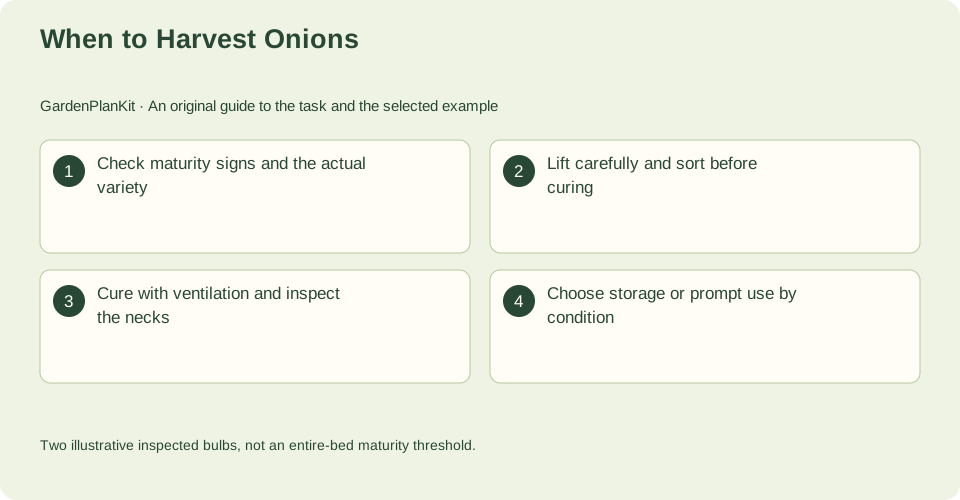
Check maturity signs and the actual variety
For onions, watch for foliage turning yellowish and beginning to fall. Those are the visible maturity signs to look for, but they describe the crop generally, not a promise about your specific planting date or region. Check the variety you actually planted, because suitability for long storage varies by variety and condition. A variety described as a good keeper and one meant for early fresh use call for different decisions after lifting.
Walk the bed and look at tops and necks together. Yellowing foliage alone is not the whole picture; note whether tops are beginning to fall and whether necks look firm or soft. Record the variety name and the date you observe these signs so later curing and storage decisions have context.
- Confirm the variety name from your seed packet or plant label.
- Observe whether foliage is turning yellowish and beginning to fall.
- Note neck condition and any visible bulb damage before lifting anything.
- Write down variety, observation date and the maturity signs you saw.
Source context: Utah State University Extension
Lift carefully and sort before curing
Handle produce carefully, protect it from heat and separate damaged material before storage. Lift onions rather than pulling roughly, and keep them out of direct heat as you move them. Sorting happens before curing, not after: set aside bulbs with damage so they do not sit in the same lot as sound bulbs.
This is where the supplied example is useful. It describes two illustrative inspected bulbs, not an entire-bed maturity threshold. Bulb A is a sound bulb with a drying neck, so it is evaluated for curing. Bulb B is damaged, so it is separated from the sound storage lot. The example shows the sorting decision, not a rule that two bulbs represent a whole bed.
- Lift onions carefully and keep them protected from heat.
- Inspect each bulb and separate damaged material before curing.
- Keep sound bulbs with drying necks in the curing lot.
- Record variety, harvest date and curing location for the sorted lots.
Source context: Utah State University Extension
Cure with ventilation and inspect the necks
Lift and cure onions in a ventilated place out of direct sun for 2 to 3 weeks. Ventilation and shade are the working conditions named in the source; do not substitute a sealed, sunny spot. Inspect necks during curing, because neck condition is part of what you are evaluating. A drying neck on a sound bulb is the condition to watch for; a damaged bulb belongs in the separate lot you already set aside.
Curing is also a checkpoint, not a formality. If you see damage or softness developing, move that bulb out of the storage lot and decide whether it should be used promptly. Keep your record updated with curing location and subsequent condition so the final storage decision reflects what you actually observed.
- Cure in a ventilated place out of direct sun for 2 to 3 weeks.
- Inspect necks and bulbs during curing rather than only at the end.
- Move any bulb showing damage out of the sound storage lot.
- Update the record with curing location and subsequent condition.
Source context: Utah State University Extension
Choose storage or prompt use by condition
After curing, choose storage or prompt use by condition. Sound bulbs with drying necks are the candidates for the storage lot; damaged bulbs are for prompt use. Suitability for long storage varies by variety and condition, so the variety note you recorded matters here. Do not apply an onion's dry-storage conditions indiscriminately to roots or potatoes, which follow different storage regimes.
A suggested storage regime is not a guaranteed household shelf life. Treat the storage decision as a plan you will check, not a promise. Review the lot periodically and move bulbs that change condition into prompt use. The record of variety, harvest date, curing location and subsequent condition is what lets you compare one season's outcome with the next without inventing results.
- Sort cured bulbs into a storage lot and a prompt-use lot by condition.
- Keep the variety note with the storage lot.
- Do not apply onion dry-storage conditions to roots or potatoes.
- Review stored bulbs periodically and move changed bulbs to prompt use.
Source context: Utah State University Extension
Work through this example
Two illustrative inspected bulbs, not an entire-bed maturity threshold.
| Example detail | Selected value or observation |
|---|---|
| bulb A | Sound bulb and drying neck: evaluate for curing. |
| bulb B | Damaged bulb: separate from the sound storage lot. |
| record | Variety, harvest date, curing location and subsequent condition. |
The supplied example is hypothetical: two illustrative inspected bulbs, not an entire-bed maturity threshold. Bulb A is sound with a drying neck and is evaluated for curing; Bulb B is damaged and separated from the sound storage lot. The record lists variety, harvest date, curing location and subsequent condition. The example demonstrates the sorting decision only and adds no new numerical results.
Use this example to structure your own notes. Check the source conditions for the crop, method and setting.
Your action checklist
- Variety name recorded from the seed packet or label.
- Foliage yellowing and beginning to fall observed and dated.
- Bulbs lifted carefully and kept protected from heat.
- Damaged bulbs separated before curing begins.
- Curing location ventilated and out of direct sun, with necks inspected.
- Storage lot and prompt-use lot sorted by condition after curing.
Questions that come up while planning
When are onions ready to harvest?
Watch for foliage turning yellowish and beginning to fall, and check the variety you planted. Utah State recommends crop-specific maturity checks rather than relying only on calendar days, so confirm the visible signs on your own plants before lifting.
How long should onions cure?
The supplied guidance is to lift and cure onions in a ventilated place out of direct sun for 2 to 3 weeks. Inspect necks during that period and separate damaged bulbs from the sound storage lot.
Can I store every cured onion long term?
No. Suitability for long storage varies by variety and condition, and a suggested storage regime is not a guaranteed household shelf life. Keep sound bulbs with drying necks for storage and route damaged bulbs to prompt use.
Sources & method
Horticultural guidance is linked to its original source and regional context. Geometry and unit conversions are calculated separately. Read how we prepare and check a page.
- Harvest and Storage of Vegetables and FruitsUtah State University Extension