
Inspect foliage and a sample bulb
Start with the tops. Utah State's regional garlic guidance describes foliage beginning to yellow and falling, and it says to harvest before all foliage is completely dry. Completely dry, collapsed tops are a sign you may have waited too long, because the protective wrappers can begin to break down.
Calendar days alone are a weak signal. Utah State recommends checking crop-specific maturity rather than relying only on calendar days, so treat any date as a prompt to go look, not a decision. Dig one sample bulb from a representative spot and check whether the cloves have filled out and the wrappers still hold together. If the sample looks immature, note what you saw and check again later rather than lifting the whole patch.
- Walk the patch and note how much foliage is yellowing and falling versus still green.
- Dig one sample bulb with a fork, keeping some distance from the stem.
- Check clove fill and wrapper condition before deciding to lift the crop.
Source context: Utah State University Extension
Lift without damaging the protective wrappers
The wrappers are the papery layers that protect the cloves, and they matter most during curing and storage. Utah State's general handling guidance is to handle produce carefully and protect it from heat. For garlic, loosen the soil beside the bulb with a fork and lift from below rather than pulling the stem, which can tear the wrappers or separate the bulb.
Work in conditions that suit the soil. Lifting in wet, heavy soil risks a messy pull and more damage; if the soil is very wet, wait for it to dry somewhat before lifting. Set lifted bulbs in a shaded spot rather than leaving them in direct sun, and keep damaged bulbs separate from sound ones as you go.
- Loosen soil beside each bulb with a fork before lifting.
- Lift by the bulb base, not by pulling the stem.
- Keep lifted bulbs shaded and set damaged bulbs aside immediately.
Source context: Utah State University Extension
Cure with shade and ventilation
Utah State's garlic guidance is to cure with ventilation out of the sun for 2 to 3 weeks, then store appropriately dry. Shade and airflow are the working conditions: direct sun can overheat bulbs, and still, humid air slows drying. Spread bulbs in a single layer or hang them so air moves around each one, and keep the area out of direct sun.
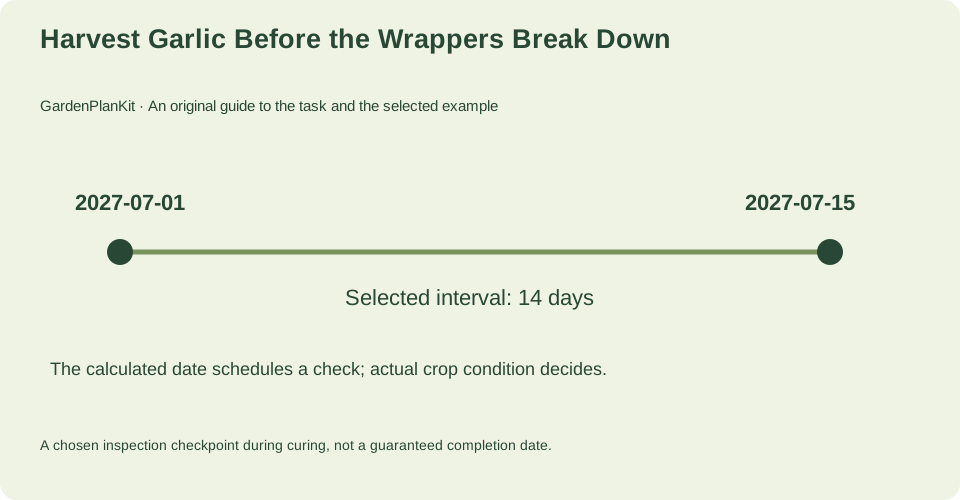
The supplied example is hypothetical: a harvest date of July 1, 2027, with a chosen inspection checkpoint 14 days later on July 15, 2027. That date is a chosen checkpoint during curing, not a guaranteed completion date. Actual drying condition, cultivar and source guidance determine readiness, so inspect the bulbs at the checkpoint rather than assuming curing is finished.
- Move cured bulbs to a shaded, ventilated place out of direct sun.
- Space bulbs so air reaches each one, and check them at your chosen checkpoint.
- At the checkpoint, feel and inspect the bulbs and keep curing if they are not yet dry.
Source context: Utah State University Extension
Label and sort the storage lot
Sort before storage. Utah State advises separating damaged material before storage, so set aside bulbs with torn wrappers, soft spots or other damage and keep them apart from the sound lot. Label each lot with the cultivar and the lift date so you can compare how different garlic performs in your own conditions.
Suitability for long storage varies by variety and condition, and a suggested storage regime is not a guaranteed household shelf life. Store garlic appropriately dry, and do not apply an onion's dry-storage conditions to other crops; Utah State notes that roots and potatoes need different regimes. Check stored bulbs periodically and remove any that soften or spoil.
- Separate damaged bulbs from sound ones before storage.
- Label each lot with cultivar and lift date.
- Check stored bulbs periodically and remove spoiled ones.
Source context: Utah State University Extension
Work through this example
A chosen inspection checkpoint during curing, not a guaranteed completion date.
| Example detail | Selected value or observation |
|---|---|
| example harvest date | 2027-07-01 |
| selected days to check | 14 |
| example first check date | 2027-07-15 |
| decision | Actual drying condition, cultivar and source guidance determine readiness. |
The example uses a hypothetical harvest date of July 1, 2027, and a chosen inspection checkpoint 14 days later, July 15, 2027. The checkpoint is a prompt to inspect curing bulbs, not a guaranteed completion date; actual drying condition, cultivar and source guidance determine readiness.
Use this example to structure your own notes. Check the source conditions for the crop, method and setting.
Your action checklist
- Foliage is yellowing and falling but not completely dry.
- A sample bulb shows filled cloves and intact wrappers.
- Bulbs were lifted with a fork, not pulled by the stem.
- Cured bulbs are shaded, ventilated and checked at your chosen checkpoint.
- Damaged bulbs are separated and lots are labeled with cultivar and lift date.
Questions that come up while planning
Can I harvest garlic when the tops are completely dry?
Utah State's regional garlic guidance says to harvest before all foliage is completely dry, when tops begin to yellow and fall. Completely dry tops can mean the protective wrappers are breaking down, so inspect a sample bulb rather than waiting for full dieback.
How long should garlic cure?
Utah State's garlic guidance describes curing with ventilation out of the sun for 2 to 3 weeks, then storing appropriately dry. Treat that as a range to check against actual bulb condition, not a guaranteed finish date.
Is July always garlic harvest time?
No. The July timing in the Utah regional guide is regional, not a universal harvest date. Use crop-specific maturity signs, such as yellowing and falling tops plus a sample bulb check, rather than a fixed calendar date.
Sources & method
Horticultural guidance is linked to its original source and regional context. Geometry and unit conversions are calculated separately. Read how we prepare and check a page.
- Harvest and Storage of Vegetables and FruitsUtah State University Extension