
Group herbs by light and moisture before choosing pots
A shared planter only works when its plants tolerate the same light and watering routine. Group herbs with similar needs, then decide whether each group gets its own pot or shares one. A mixed pot is limited by its most space-demanding plant, so one large or vigorous herb can crowd smaller companions even if the pot looks roomy at planting.
The supplied container reference names two broad size groups rather than a single capacity for every herb. Large herbs including rosemary, sage, parsley, dill and fennel are described with 5-gallon-or-larger pots. Smaller herbs including basil, thyme, mint, oregano and tarragon are described with 2–5 gallon pots. Treat these as named guide examples, not guarantees for every cultivar. Match both mature top growth and root space; volume alone does not define a suitable shape.
- List each herb you plan to grow and note its light and moisture preference from a reliable source.
- Sort the list into groups that can share the same watering routine.
- Decide whether each group needs a separate pot or can share one planter.
- For a shared planter, identify the most space-demanding plant and check that the pot suits it first.
Source context: Iowa State University Extension · University of Maryland Extension
Check the container, drainage and growing medium
Choose a pot with adequate drainage and a growing medium that supports roots while holding appropriate water and air. Dense garden soil behaves differently from a container mix, so use a mix intended for containers. The supplied guide lists commercial soilless mix and an equal-volume soilless-mix and compost blend among its options.
Drainage holes must remain open. Stones or gravel under the mix do not improve drainage. Measure actual fill volume rather than relying on nursery trade-gallon labels, and empty saucers so roots are not left saturated. If you reuse medium, remove plant residue and do not save medium associated with root disease; the guide describes blending old and fresh material rather than assuming old mix is unchanged.
- Confirm the pot has open drainage holes before filling.
- Measure the inside diameter and the usable fill height, allowing a rim gap.
- Calculate fill volume from those measurements and compare it with the named size group for your herbs.
- Fill with a container-appropriate mix and water to check that drainage runs freely.
Source context: University of Maryland Extension · University of Maryland Extension
Set up and monitor the planting
Most herbs, particularly annuals and biennials, can be grown from seed, with germination times varying from approximately 12 to 30 days. Seeds can be sown directly outdoors or started indoors and transplanted after the danger of frost has passed. Perennial herbs are propagated by cuttings or division, and established plants can be divided every three or four years in early spring.
After planting, watch the shared planter for crowding and adjust before one plant shades or outcompetes its companions. Keep the watering routine consistent with the group's moisture needs, and check drainage after heavy watering. Regional dates in any source are examples for that source location, so confirm timing for your own area.
- Label each pot with the herb group and planting date.
- Check soil moisture before watering rather than watering on a fixed schedule.
- Inspect the shared planter for crowding and remove or reposition plants if one dominates.
- Review drainage and saucers after watering and correct any standing water.
Source context: Iowa State University Extension · University of Maryland Extension · University of Maryland Extension
Compare separate pots with a shared planter
Separate pots give each herb group its own light, moisture and space conditions, which is simpler when needs differ. A shared planter saves space and watering effort but ties the plants to one medium, one watering routine and one size limit. Because the shared pot is limited by its most space-demanding plant, compare the largest plant's needs with the pot before adding smaller companions.
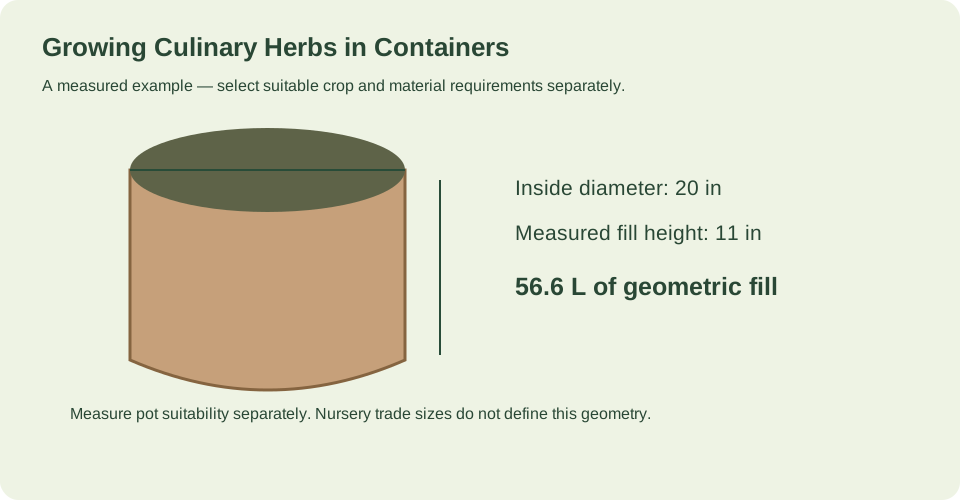
The worked example is a volume-only illustration: a straight-sided pot with a 20-inch inside diameter, 12-inch inside height and 1-inch rim gap gives a fill capacity of about 2 cubic feet, 56.6 liters or 15 US liquid gallons. That figure is not a minimum pot size for any herb. Confirm a suitable container separately using the named crop group and the plant's mature top growth and root space.
- For each herb group, note whether separate pots or a shared planter better matches its light and moisture needs.
- If sharing, compare the most space-demanding plant with the pot's shape and volume.
- Use the worked example only to practice measuring fill volume, not to set a herb pot minimum.
- Record your final pot choice and the reason for it.
Source context: University of Maryland Extension · University of Maryland Extension
Check your measured example
Volume-only illustration: one straight-sided pot with inside diameter 20 in, inside height 12 in and 1 in rim gap. The resulting fill capacity is not a minimum pot size for herb; confirm a suitable container separately.
| Quantity | Calculated result |
|---|---|
| inside diameter in | 20 |
| fill height in | 11 |
| volume cuft | 1.9999 |
| volume liters | 56.6296 |
| US liquid gallons | 14.96 |
The worked example uses a straight-sided pot with a 20-inch inside diameter, 12-inch inside height and 1-inch rim gap, giving a fill capacity of about 2 cubic feet, 56.6 liters or 15 US liquid gallons. It is a volume-only illustration and does not establish a minimum pot size for any herb; confirm a suitable container separately using the named crop group and the plant's mature top growth and root space.
Example inputs explain the method. Review the source context, chosen cultivar and actual site before planting or ordering.
Your before-you-plant checklist
- Herbs are grouped by compatible light and moisture needs.
- The pot has open drainage holes and no gravel layer under the mix.
- Fill volume is measured from inside dimensions, not a trade-gallon label.
- The shared planter is checked against its most space-demanding plant.
- The worked example is treated as a volume illustration, not a herb pot minimum.
Questions that come up while planning
Can I plant all my culinary herbs in one shared container?
Only if the herbs tolerate the same light and moisture routine and the pot suits the most space-demanding plant. A mixed pot is limited by that plant, so group compatible herbs and check the named size group before combining them.
Does a larger pot volume alone make a container suitable for herbs?
No. Volume alone does not define a suitable shape. Match both mature top growth and root space, and use the named herb size groups as guide examples rather than guarantees for every cultivar.
How should I measure how much mix a pot holds?
Measure the inside diameter and usable fill height, allowing a rim gap, then calculate fill volume. Measure actual fill volume rather than relying on nursery trade-gallon labels, and confirm the pot suits your herb group separately.
Sources & method
Horticultural guidance is linked to its original source and regional context. Geometry and unit conversions are calculated separately. Read how we prepare and check a page.
- Growing, Harvesting, and Drying HerbsIowa State University Extension
- Growing Vegetables in Containers and Salad TablesUniversity of Maryland Extension
- Growing Media (Potting Soil) for ContainersUniversity of Maryland Extension