
Decide whether a container is the right setting
Start with the limitation rather than the pot. The Saskatchewan source places Jerusalem artichoke outdoors in the ground as the best method and describes outdoor containers as not very practical given the crop's large size. It also rules out indoor containers and alternative growing methods. A container plan should therefore begin with an honest suitability decision: do you have a realistic outdoor site, and can you meet the crop's top-growth and root-space needs there?
Volume alone does not define a suitable container. Match both mature top growth and root space, and remember that a pot's shape matters as much as its stated capacity. The named minimum volumes in the container source cover other vegetables, not Jerusalem artichoke, so do not convert an in-ground row figure or another crop's pot size into a Jerusalem artichoke pot minimum. Confirm a suitable container separately from any volume calculation.
- Confirm the site is outdoors and that ground planting is genuinely unavailable before choosing a container.
- Rule out indoor, hydroponic and straw bale setups for this crop.
- Check that the pot can accommodate both the tall top growth and the root space the plant needs.
Source context: University of Saskatchewan Gardening · University of Maryland Extension
Check drainage, medium and support
Drainage holes must stay open. Stones or gravel under the mix do not improve drainage, and saucers should be emptied so roots are not left saturated. Measure the actual fill volume rather than relying on nursery trade-gallon labels, because labels and real capacity can differ.
Container roots rely on the material inside the pot for physical support and a workable balance of moisture and air. Ordinary garden soil does not behave like a purpose-made container medium. The container guide lists commercial soilless mix and an equal-volume soilless-mix and compost blend among its options. If you reuse medium, remove plant residue and do not save medium associated with root disease; blend old and fresh material rather than assuming old mix is unchanged.
Because the crop is tall, plan support as part of the setup. The sources do not prescribe a specific stake, cage or tie system, so choose support that suits your site and check it as the plant grows.
- Verify drainage holes are open and remove any saucer pooling.
- Choose a soilless mix or an equal-volume soilless-mix and compost blend.
- Measure actual fill volume with the medium in place.
- Set up tall-plant support before or at planting.
Source context: University of Maryland Extension · University of Maryland Extension
Planting and monitoring plan
The Saskatchewan source says tubers should be planted into the garden in early spring and that transplants are not recommended. Those timing notes come from that source location and are examples, not universal climate dates. Named cultivars exist, but suppliers can be hard to find; the source notes that cultivated varieties tend to produce white tubers near the main stem, while wild types tend to be reddish-skinned and more spread out. It also mentions 'Sugar Ball' as nearly knob-free and 'Skorospelka' as having large, fat, knobby tubers concentrated under the plant. Jerusalem artichokes can sometimes be found at farmers markets.
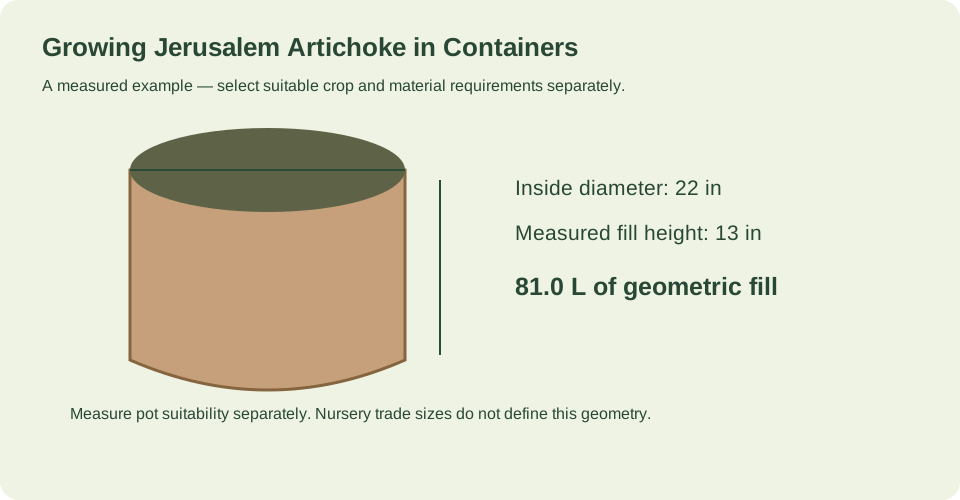
Use the volume example only as geometry. A straight-sided pot with a 22-inch inside diameter, 14-inch inside height and a 1-inch rim gap gives a fill height of 13 inches and the fill capacity shown in the rendered table. That figure is not a minimum pot size for Jerusalem artichoke; confirm a suitable container separately.
- Plant tubers outdoors in early spring, following local timing rather than copying the source location's dates.
- Record the pot's inside diameter, fill height and measured fill volume.
- Monitor drainage, medium moisture and support as the tall growth develops.
Source context: University of Saskatchewan Gardening · University of Maryland Extension · University of Maryland Extension
Check your measured example
Volume-only illustration: one straight-sided pot with inside diameter 22 in, inside height 14 in and 1 in rim gap. The resulting fill capacity is not a minimum pot size for jerusalem artichoke; confirm a suitable container separately.
| Quantity | Calculated result |
|---|---|
| inside diameter in | 22 |
| fill height in | 13 |
| volume cuft | 2.8598 |
| volume liters | 80.9804 |
| US liquid gallons | 21.3927 |
The rendered example is a volume-only illustration of one straight-sided pot: 22-inch inside diameter, 14-inch inside height and a 1-inch rim gap, giving a 13-inch fill height and the fill capacity in the table. It is geometry, not a minimum pot size or crop recommendation for Jerusalem artichoke; confirm a suitable container separately.
Example inputs explain the method. Review the source context, chosen cultivar and actual site before planting or ordering.
Your before-you-plant checklist
- Outdoor site confirmed and ground planting considered first.
- Indoor, hydroponic and straw bale methods ruled out.
- Drainage holes open and saucers emptied.
- Soilless mix or equal-volume soilless-mix and compost blend chosen.
- Actual fill volume measured rather than relying on trade-gallon labels.
- Tall-plant support planned and checked as growth develops.
Questions that come up while planning
Can Jerusalem artichoke be grown in a container?
It can be grown outdoors in containers, but the Saskatchewan source says this is not very practical given the crop's large size. It is not suitable for indoor containers, hydroponics, straw bale or other alternative methods.
What pot size does Jerusalem artichoke need?
The supplied sources do not give a Jerusalem artichoke pot minimum. Match both mature top growth and root space, and confirm suitability separately; do not convert an in-ground row figure or another crop's pot size into a minimum.
What growing medium should I use?
The container guide lists commercial soilless mix and an equal-volume soilless-mix and compost blend among its options. Dense garden soil behaves differently from a container mix, and drainage holes must remain open.
Sources & method
Horticultural guidance is linked to its original source and regional context. Geometry and unit conversions are calculated separately. Read how we prepare and check a page.
- Jerusalem artichokes - Gardening at USask - College of Agriculture and BioresourcesUniversity of Saskatchewan Gardening
- Growing Vegetables in Containers and Salad TablesUniversity of Maryland Extension
- Growing Media (Potting Soil) for ContainersUniversity of Maryland Extension