
Decide whether a container suits your site and season
Lemongrass needs warm, humid conditions, full sunlight and plenty of moisture. A container can work well where you can move the plant outdoors after the last frost and bring it indoors when temperatures cool in fall. If you cannot provide a warm, bright, sunny location for the indoor months, a container may not be the right choice for overwintering.
The source describes lemongrass as growing 3 to 6 feet tall and 3 feet wide under optimal water, fertilizer and growing conditions, and it notes that in-ground divisions are spaced 3 feet apart. That spacing figure is garden guidance, not a pot minimum. For a container, use it only as a reminder that the clump can become large and that both top growth and root space need room.
A starter plant from a nursery or seed company is the usual route; the source says lemongrass is rarely grown from seed. Grocery stalks with roots absent can be rooted in water in about two weeks, but that is a propagation note, not a promise about container performance.
- Confirm you have a warm, full-sun outdoor position and a bright indoor spot for cool months if you plan to overwinter.
- Choose a starter plant or a rooted stalk rather than assuming seed will be practical.
- Decide before planting whether the container will stay outside year-round or move indoors.
Source context: Utah State University Extension
Choose a pot by shape, drainage and root space
The container source does not give a lemongrass-specific minimum volume. It says to match both mature top growth and root space, and that volume alone does not define a suitable shape. Maryland's named reference volumes cover other crops and herb groups, so they should not be converted into a lemongrass pot minimum.
Use the source's practical checks instead: adequate drainage, a root-supporting growing medium, and a pot suited to the crop. Drainage holes must stay open. Stones or gravel under the mix do not improve drainage. Measure actual fill volume rather than trusting nursery trade-gallon labels, and empty saucers so roots are not left saturated.
Because lemongrass can become tall and wide, also consider stability. A broad, heavy base and a pot that is not easily tipped are practical support checks. The source does not specify a pot diameter or capacity for lemongrass, so treat any size decision as your own judgment based on the plant you have and the space you can provide.
- Check that drainage holes are open and that the pot sits stably on its base.
- Measure the pot's actual fill volume with water or a known measure rather than relying on the label.
- Plan a support method such as a heavier pot or a sheltered position if the clump becomes tall.
Source context: University of Maryland Extension · Utah State University Extension
Fill with a suitable growing medium and plant
The mix source says growing medium must support roots while holding appropriate water and air, and that dense garden soil behaves differently from a container mix. For container vegetables, it lists commercial soilless mix and an equal-volume soilless-mix/compost blend among its options. Those are general container options, not a lemongrass-specific recipe.
If you reuse medium, remove plant residue and do not save medium associated with root disease. The source describes blending old and fresh material rather than assuming old mix is unchanged.
Plant after the danger of frost has passed, following the source's timing note. Lemongrass divisions or starter plants should go into a warm, bright, sunny location. Water regularly so the pot does not dry out, and mist in dry conditions as the source suggests for Utah's dry climate.
- Use a commercial soilless mix or an equal-volume soilless-mix and compost blend.
- Remove old plant residue before reusing any medium, and discard medium linked to root disease.
- Plant after frost danger has passed and place the pot in a warm, sunny spot.
- Water regularly and mist in dry conditions.
Source context: University of Maryland Extension · Utah State University Extension
Set up a monitoring plan for the season
The source says lemongrass grows slowly until the heat of summer, then increases in size dramatically. Water and feed regularly from June through September to support that growth. In a container, check moisture often because the source specifically warns that pots should not dry out.
Hand watering or flood irrigation is preferred over sprinklers in the source's Utah context. For a container, the practical point is to water the medium directly and keep the saucer empty. Weeds compete poorly with mature lemongrass, but hand weeding may be needed while plants are small.
Before the first fall frost, the source says to save a 6 inch section of the bulbous shoot base with attached roots for dividing and potting the following year. Small container plants can be overwintered indoors in a warm, bright, sunny location. These are the source's overwintering notes, not a guarantee for every climate.
- Check container moisture regularly and water directly rather than relying on sprinklers.
- Feed regularly from June through September as the source describes.
- Hand weed while the plant is small.
- Before the first fall frost, save a 6 inch section of the bulbous shoot base with roots if you plan to overwinter.
- Move small container plants indoors to a warm, bright, sunny location when temperatures cool.
Source context: Utah State University Extension · University of Maryland Extension
Check your measured example
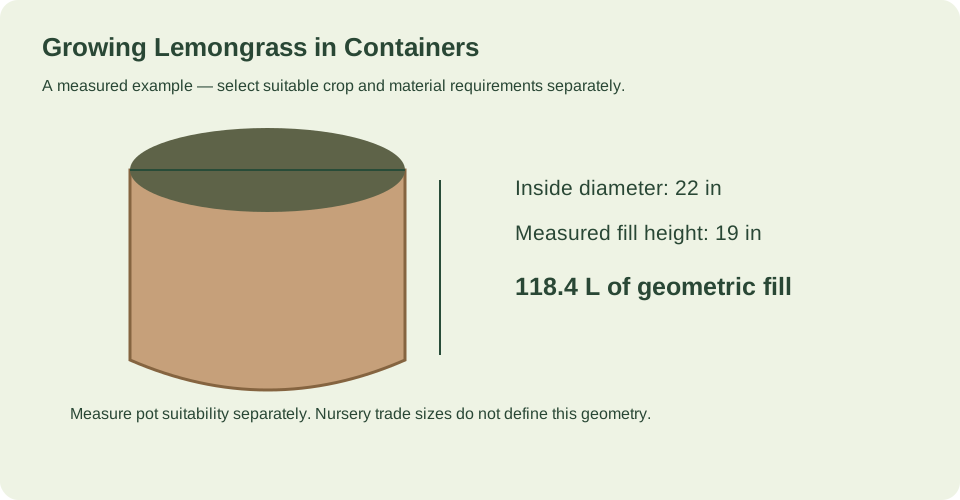
Volume-only illustration: one straight-sided pot with inside diameter 22 in, inside height 20 in and 1 in rim gap. The resulting fill capacity is not a minimum pot size for lemongrass; confirm a suitable container separately.
| Quantity | Calculated result |
|---|---|
| inside diameter in | 22 |
| fill height in | 19 |
| volume cuft | 4.1797 |
| volume liters | 118.3559 |
| US liquid gallons | 31.2663 |
The worked example is a volume-only illustration: a straight-sided pot with a 22 inch inside diameter, 20 inch inside height and a 1 inch rim gap, giving a fill height of 19 inches and a calculated fill capacity of about 4.18 cubic feet, 118.36 liters or 31.27 US liquid gallons. That calculation shows how to measure fill volume; it is not a minimum pot size for lemongrass and does not establish a crop-specific capacity. Confirm a suitable container separately using drainage, root space, shape and stability.
Example inputs explain the method. Review the source context, chosen cultivar and actual site before planting or ordering.
Your before-you-plant checklist
- Warm, full-sun outdoor position confirmed, with a bright indoor spot if overwintering.
- Drainage holes open and saucer kept empty.
- Pot stable enough for a tall, expanding clump.
- Actual fill volume measured rather than relying on the trade-gallon label.
- Soilless mix or equal-volume soilless-mix and compost blend used, with old residue removed if reusing medium.
- Moisture checked regularly and watering done directly.
Questions that come up while planning
What pot size does lemongrass need?
The supplied sources do not give a lemongrass-specific pot volume. The container source says to match mature top growth and root space and that volume alone does not define a suitable shape. Maryland's named volumes cover other crops and herb groups, so they should not be converted into a lemongrass minimum. Choose a pot with open drainage and enough root space for an expanding clump, and check stability for tall growth.
Can I use garden soil in a lemongrass container?
The mix source says dense garden soil behaves differently from a container mix. For container vegetables it lists commercial soilless mix and an equal-volume soilless-mix and compost blend among its options. Those are general options, not a lemongrass-specific recipe.
Can lemongrass stay outside in winter?
The Utah source describes lemongrass as a tender perennial commonly grown as an annual in cooler areas. It says to bring potted plants indoors when temperatures cool in fall and that small container plants can be overwintered indoors in a warm, bright, sunny location. Whether it stays outside depends on your climate and whether you can provide that indoor spot.
Sources & method
Horticultural guidance is linked to its original source and regional context. Geometry and unit conversions are calculated separately. Read how we prepare and check a page.
- How to Grow Lemongrass in Your GardenUtah State University Extension
- Growing Vegetables in Containers and Salad TablesUniversity of Maryland Extension
- Growing Media (Potting Soil) for ContainersUniversity of Maryland Extension