
Decide whether a separate container suits your mint plan
Mint is described as a rapid-growing, invasive perennial that can reach up to 3 feet tall. The source recommends containers or confined roots because mint spreads quickly and can out-compete other garden plants. Treat that as the main reason to give mint its own pot rather than sharing with slower or drier herbs.
Match the container to both the mature top growth and the root space, not volume alone. The named herb group in the container source places mint among smaller herbs listed at 2 to 5 gallons, but that is a named guide example, not a guarantee for every variety. Choose a pot shape and size that can hold the plant you actually have or expect, and keep watering separate from herbs that prefer drier conditions.
- Confirm the mint variety and expected mature size before choosing a pot.
- Set mint apart from drier herbs so watering can be managed separately.
- Check that the chosen pot has open drainage holes and enough room for both roots and top growth.
Source context: Utah State University Extension · University of Maryland Extension
Check the growing medium and container setup
Mint prefers rich, moist, slightly acidic soil and grows best in full sun or partial shade. Variegated types such as pineapple mint may scorch in full sun. For containers, use a growing medium that supports roots while holding appropriate water and air; dense garden soil behaves differently from a container mix. The mix source lists commercial soilless mix or an equal-volume soilless-mix and compost blend as options for container vegetables.
Drainage holes must stay open. Stones or gravel under the mix do not improve drainage, and saucers should be emptied so roots are not left saturated. Excess water can promote root and leaf diseases even though mint likes moist conditions, so aim for moist but not waterlogged. If reusing medium, remove plant residue and do not save medium associated with root disease.
- Fill the pot with a root-supporting mix rather than dense garden soil.
- Keep drainage holes clear and skip gravel layers.
- Empty saucers after watering so the root zone is not left saturated.
- If reusing mix, remove old plant residue and discard any medium linked to root disease.
Source context: Utah State University Extension · University of Maryland Extension · University of Maryland Extension
Plant, position and monitor the container
Mint can be grown from seed or transplants, but seed-grown plants often fail to be true to type because mints readily hybridize. For a specific cultivar, the source suggests buying established plants, taking cuttings from known plants, or dividing an established plant. Divide and replant in spring before growth starts or early in fall. Plant early in the growing season; the source notes mint is generally hardy to -20 degrees Fahrenheit, and its Utah dates and hardiness notes are examples for that location.
Place the pot where it receives full sun to partial shade, with more shade considered for variegated mint. Harvest leaves and stems through the season, or cut back to within an inch of the ground about three times a season just before blooming. Watch for stems escaping the pot or roots appearing at drainage holes, since a container does not eliminate spread. For drying, hang fully grown stems and leaves upside down in a hot shady location until brittle, or spread them on a screen in the shade, then store in an airtight container for up to 1 year.
- Start with a known plant, cutting or division when a specific variety matters.
- Position the pot in full sun to partial shade, with shade for variegated mint.
- Check regularly for stems spreading beyond the pot or roots at drainage holes.
- Harvest through the season or cut back as described, and dry only fully grown stems and leaves.
Source context: Utah State University Extension · University of Maryland Extension
Use the volume example correctly
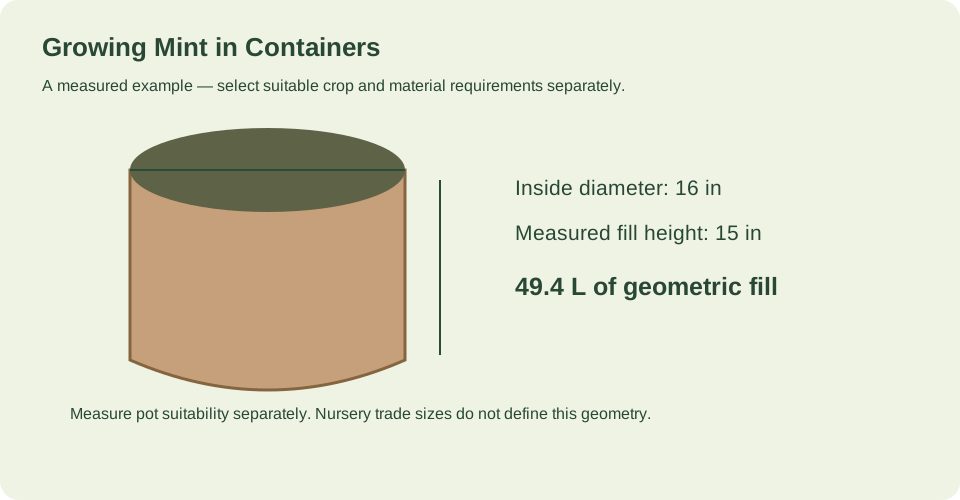
The supplied example is a volume-only illustration: a straight-sided pot with a 16-inch inside diameter, 16-inch inside height and a 1-inch rim gap, giving a fill height of 15 inches. Its calculated fill capacity is about 1.745 cubic feet, 49.42 liters or 13.06 US liquid gallons. That calculation shows how much mix a pot of those inside dimensions could hold; it is not a minimum pot size for mint and does not establish a crop-specific capacity.
Measure actual fill volume rather than relying on nursery trade-gallon labels. Package label units govern any volume conversion you make. Use the geometry result to check whether a container holds the mix you intend to use, then separately confirm that the pot suits mint's roots and top growth.
- Measure inside diameter and usable fill height before calculating volume.
- Treat the example result as fill capacity only, not as mint advice.
- Confirm pot suitability for root and top growth separately from the volume figure.
Source context: University of Maryland Extension
Check your measured example
Volume-only illustration: one straight-sided pot with inside diameter 16 in, inside height 16 in and 1 in rim gap. The resulting fill capacity is not a minimum pot size for mint; confirm a suitable container separately.
| Quantity | Calculated result |
|---|---|
| inside diameter in | 16 |
| fill height in | 15 |
| volume cuft | 1.7453 |
| volume liters | 49.4222 |
| US liquid gallons | 13.056 |
The example uses a straight-sided pot with a 16-inch inside diameter, 16-inch inside height and 1-inch rim gap, so the fill height is 15 inches. Its calculated fill capacity is about 1.745 cubic feet, 49.42 liters or 13.06 US liquid gallons. This is a geometry illustration only; it is not a minimum pot size for mint, and no additional numerical results are implied.
Example inputs explain the method. Review the source context, chosen cultivar and actual site before planting or ordering.
Your before-you-plant checklist
- Mint has its own container with open drainage holes.
- The pot is checked for both root space and mature top growth.
- The mix supports roots and is not dense garden soil.
- Saucers are emptied and drainage holes stay clear.
- Stems and roots are monitored for spread beyond the pot.
Questions that come up while planning
Can I plant mint with drier herbs in one pot?
The brief says to keep watering separate from drier herbs. Mint prefers moist soil, while excess water can still promote root and leaf diseases, so a separate container makes watering easier to manage.
Does a container stop mint from spreading?
A container confines roots, but it does not eliminate spread through stems or drainage holes. Check for escaping stems and roots, and keep the pot where spread can be managed.
Is the 16-inch pot example a recommended mint pot size?
No. It is a volume-only geometry example. The container source lists mint among smaller herbs at 2 to 5 gallons as a named guide example, not a guarantee, and volume alone does not define a suitable shape.
Sources & method
Horticultural guidance is linked to its original source and regional context. Geometry and unit conversions are calculated separately. Read how we prepare and check a page.
- How to Grow Mint in Your GardenUtah State University Extension
- Growing Vegetables in Containers and Salad TablesUniversity of Maryland Extension
- Growing Media (Potting Soil) for ContainersUniversity of Maryland Extension