
What the surface growth can and cannot tell you
On houseplant potting media, algae are single- to multicelled aquatic plants that can grow in moist conditions and form a greenish surface layer. Fungi are usually multicelled organisms that can also grow on moist media surfaces and form a white to grayish layer. Both may grow together or separately. Their growth is not usually detrimental to plants, but appearance alone does not diagnose the organism or rule out a root problem.
Treat the surface layer as a clue about conditions, not a verdict. A white patch is not automatically harmless mold, and it is not automatically a disease. The next step is to inspect the plant and root zone rather than reaching for a blanket bleach or pesticide remedy.
- Note the color and extent of the surface growth without assuming an organism.
- Check whether the growth is a thin film or a thick mat.
- Look at the plant for wilting, stunting or other decline that could point beyond the surface.
Source context: University of Maryland Extension
Inspect the plant, roots and moisture pattern
Excessive surface growth can form a thick mat that dries and crusts, interfering with water absorption and infiltration into the growing media. The mat can also serve as a food source and attract pests such as fungus gnats and shore flies; their larvae feed on plant roots and can cause wilting and stunting, and adults can move disease spores between pots. Those possibilities make plant and root condition worth checking.
Growing medium must support roots while holding appropriate water and air, and dense garden soil behaves differently from a container mix. For reuse, remove plant residue and do not save medium associated with root disease; blending old and fresh material is described rather than assuming old mix is unchanged. If roots look diseased, separate that material from medium you intend to keep.
- Lift the plant or check near the drainage holes to see whether roots look healthy or diseased.
- Review how often the surface stays wet and whether pots sit close together with little air movement.
- Set aside any medium associated with root disease instead of saving it.
Source context: University of Maryland Extension · University of Maryland Extension
Reduce moisture and improve airflow
To prevent algae or fungal growth on the growing media surface, allow the surface to dry between waterings and keep humidity low by ensuring good air circulation between pots. These are management steps for surface growth, not a treatment for a diagnosed root disease. If the plant is declining or roots appear diseased, address that condition separately rather than assuming airflow alone will resolve it.
- Adjust watering so the media surface can dry between waterings.
- Space pots to improve air circulation between them.
- Recheck the surface and the plant after changing the moisture pattern.
Source context: University of Maryland Extension
Remove a mat without overreacting
For a mat on the pot surface, use a small tool to loosen it, or take off the mat with the uppermost medium and discard that material. This is a surface-management action. It does not identify the organism, and it does not replace checking roots when the plant is unwell. Avoid blanket bleach or pesticide remedies and avoid declaring every mold harmless.
- Choose one action: break up the mat with a small tool or remove the upper layer with the mat.
- Discard removed material rather than returning it to the pot.
- Keep checking the plant and roots rather than treating the surface color as a diagnosis.
Source context: University of Maryland Extension
Check your measured example
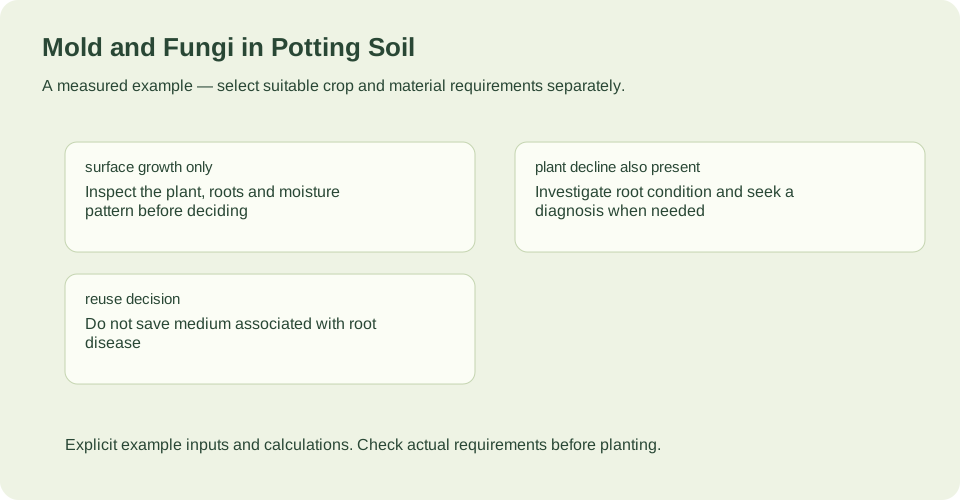
Two hypothetical inspection cases. Surface appearance alone does not identify a pathogen or prove a root disease.
| Quantity | Calculated result |
|---|---|
| surface growth only | Inspect the plant, roots and moisture pattern before deciding |
| plant decline also present | Investigate root condition and seek a diagnosis when needed |
| reuse decision | Do not save medium associated with root disease |
Use the surface observation to begin an inspection. Do not infer the organism or the condition of the roots from color alone.
Example inputs explain the method. Review the source context, chosen cultivar and actual site before planting or ordering.
Your before-you-plant checklist
- Record the surface growth's color and whether it is a thin film or thick mat.
- Inspect roots and plant condition before deciding the growth is harmless.
- Check whether the media surface stays wet and whether pots have air circulation between them.
- Break up or remove a surface mat if one has formed.
- Do not save medium associated with root disease.
Questions that come up while planning
Does white growth on potting soil always mean mold or root disease?
No. White to grayish surface growth can be fungal growth on moist media, but appearance alone cannot identify the organism or diagnose a root disease. Check plant and root condition, moisture and air movement before deciding.
Is surface algae or fungus always harmful to the plant?
Growth on media surfaces is not usually detrimental. Excessive growth can form a thick, crusty mat that interferes with water absorption and infiltration, and it can attract fungus gnats and shore flies whose larvae feed on roots.
Should I use bleach or a pesticide when I see growth on the soil surface?
The supplied management guidance does not call for blanket bleach or pesticide remedies. It recommends letting the surface dry between waterings, improving air circulation, and breaking up or removing a surface mat.
Sources & method
Horticultural guidance is linked to its original source and regional context. Geometry and unit conversions are calculated separately. Read how we prepare and check a page.
- Algae and Fungal Growth on the Soil of Indoor PlantsUniversity of Maryland Extension
- Growing Media (Potting Soil) for ContainersUniversity of Maryland Extension