
Decide whether a container suits your pepper plan
Container growing fits a sunny spot with free drainage, but it is a poor match for heavy, wet conditions or a pot without open drainage holes. Peppers do poorly in heavy, wet soil, so drainage is the first suitability test. Match the container to both the mature top growth and the root space the plant will need; volume alone does not define a suitable shape.
Maryland's reference minimum of 5 US gallons for peppers is a named guide example, not a promise for every cultivar. A compact variety and a large, heavy-fruiting variety can differ in top growth and support needs even when the volume is the same. Choose the variety with your growing environment, primary use and available space in mind, and check the label or catalog for mature size before committing to a pot.
- Confirm the site gets the sun and long season peppers prefer.
- Check that the pot has open drainage holes and that a saucer can be emptied.
- Compare the pot's shape and volume with the mature top growth of your chosen variety.
Source context: Utah State University Extension · University of Maryland Extension
Measure the pot and prepare the growing medium
Measure inside diameter and the usable fill height, stopping below the rim so water can enter. Multiply those measurements to get fill volume, then compare that figure with the 5-gallon reference. Nursery trade-gallon labels are not a reliable substitute for measuring actual fill volume.
Use a growing medium that supports roots while holding appropriate water and air. Dense garden soil behaves differently from a container mix. The container guide lists commercial soilless mix and an equal-volume soilless-mix and compost blend among its options. If reusing medium, remove plant residue and do not save medium associated with root disease; blend old and fresh material rather than assuming old mix is unchanged. Stones or gravel under the mix do not improve drainage, so keep the drainage holes clear instead.
- Measure inside diameter and usable fill height, then calculate fill volume.
- Choose a soilless mix or an equal-volume soilless-mix and compost blend.
- Fill to a working level below the rim and keep drainage holes open.
- Empty any saucer so roots are not left saturated.
Source context: University of Maryland Extension · University of Maryland Extension
Set up support, planting and a monitoring plan
Plan support and harvest access before planting. Peppers can carry heavy fruit, and a pot that is full of top growth needs room for stakes or another support and a clear path to reach ripe fruit. Set the support at planting time so roots are not disturbed later.
The Utah source describes transplants with 6 to 9 mature leaves and a well-developed root system, and stocky, dark green transplants 5 to 8 inches tall growing most rapidly. It also advises removing flowers or fruits before planting because they establish slowly. Those are in-ground transplant descriptions, not a container spacing rule. For container planting, use the same transplant quality checks and set the plant at the depth the medium and pot allow, then water to settle the mix.
Monitor the pot through the season: check that drainage holes stay open, empty saucers, and watch the medium for drying. The Utah source recommends deep, infrequent irrigation and mulches to conserve water, but it also says not to apply organic mulches until soils have warmed to 75 degrees Fahrenheit. Regional dates in that source are examples for its location, not a calendar for yours.
- Place the support before planting so roots stay undisturbed.
- Choose a stocky, dark green transplant with 6 to 9 leaves and a developed root system.
- Remove flowers or fruits before planting.
- Water deeply and infrequently, checking drainage after each watering.
- Inspect the pot regularly for saturated medium and blocked holes.
Source context: Utah State University Extension · University of Maryland Extension · University of Maryland Extension
Check your measured example
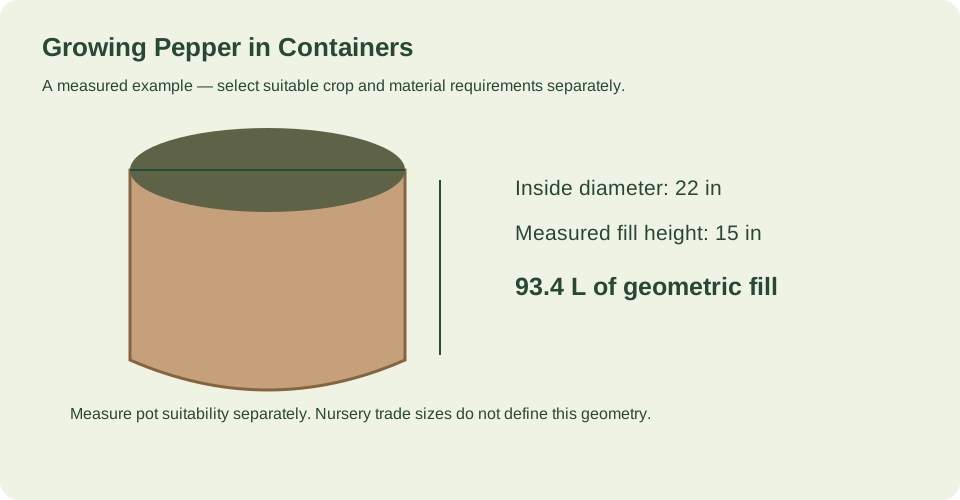
Volume-only illustration: one straight-sided pot with inside diameter 22 in, inside height 16 in and 1 in rim gap. The resulting fill capacity is not a minimum pot size for pepper; confirm a suitable container separately.
| Quantity | Calculated result |
|---|---|
| inside diameter in | 22 |
| fill height in | 15 |
| volume cuft | 3.2998 |
| volume liters | 93.4389 |
| US liquid gallons | 24.6839 |
The worked example is a volume-only illustration: a straight-sided pot with a 22-inch inside diameter, 16-inch inside height and a 1-inch rim gap, giving a 15-inch fill height. Its calculated fill capacity is about 3.30 cubic feet, 93.44 liters or 24.68 US liquid gallons. That figure shows how to measure fill volume; it is not a minimum pot size for peppers, and a suitable container must still be confirmed separately for drainage, shape, root space and top growth.
Example inputs explain the method. Review the source context, chosen cultivar and actual site before planting or ordering.
Your before-you-plant checklist
- Pot has open drainage holes and a saucer that can be emptied.
- Actual fill volume measured and compared with the 5-gallon reference.
- Pot shape and size suit the mature top growth of the chosen variety.
- Soilless mix or equal-volume soilless-mix and compost blend used.
- Support and harvest access planned before planting.
- Transplant checked for 6 to 9 leaves and a developed root system, with flowers or fruits removed.
Questions that come up while planning
Is a 5-gallon pot enough for every pepper variety?
Maryland lists 5 US gallons as a reference minimum volume for peppers, but it is a named guide example, not a guarantee for every variety. Match the pot to both root space and mature top growth, and measure actual fill volume rather than relying on a trade-gallon label.
Can I use garden soil in a pepper container?
Dense garden soil behaves differently from a container mix. The container guide lists commercial soilless mix and an equal-volume soilless-mix and compost blend among its options. Use a medium that supports roots while holding appropriate water and air.
Should I put gravel in the bottom of the pot?
No. Stones or gravel under the mix do not improve drainage. Keep the drainage holes open and empty any saucer so roots are not left saturated.
Sources & method
Horticultural guidance is linked to its original source and regional context. Geometry and unit conversions are calculated separately. Read how we prepare and check a page.
- How to Grow Peppers in Your GardenUtah State University Extension
- Growing Vegetables in Containers and Salad TablesUniversity of Maryland Extension
- Growing Media (Potting Soil) for ContainersUniversity of Maryland Extension