
Why a gallon label is not a fill measurement
Nursery and grow bag sizes are often written in gallons, but that number may describe a nominal trade size rather than the volume you can actually fill. The same label can appear on containers with different shapes and rim heights. Treat the label as an identifier, not as a guaranteed measured capacity.
Unit names also matter. US liquid quarts and US dry quarts have different volumes, so a bare quart figure is ambiguous. Write units explicitly in your plan, and keep package label units in charge when you convert a product's stated volume.
- Record the label exactly as printed, including the unit name.
- Note whether the unit is liquid or dry if the label specifies it.
- Do not assume the label equals the usable fill volume.
Source context: National Institute of Standards and Technology
Measure the inside, not the outside
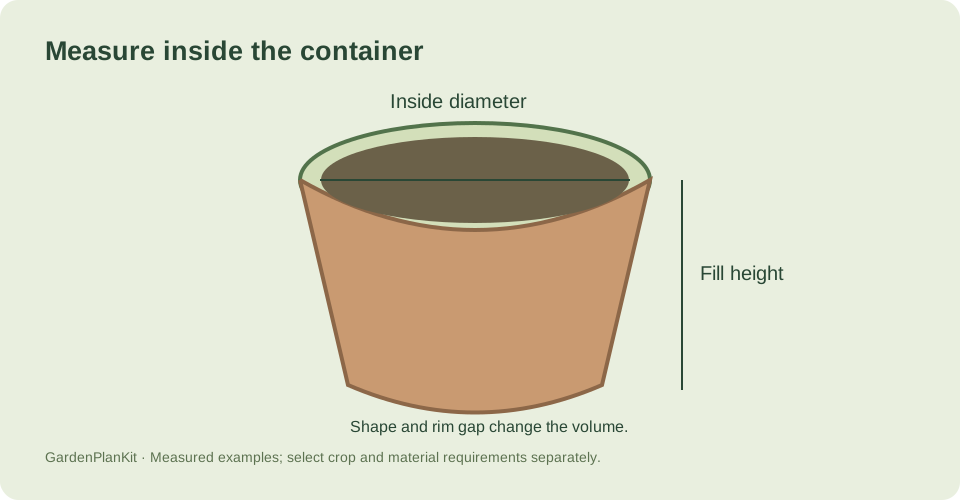
Measure internal dimensions. Outside width includes wall thickness and any rim, so it overstates the space available to roots and growing medium. For a round container, measure the internal diameter across the widest inside point. For a square or rectangular one, measure internal length and width.
Shape matters as much as a single number. Tapered pots narrow toward the base, so a diameter taken at the rim does not describe the whole body. Grow bags may bulge or settle when filled. Record the shape you actually have rather than forcing it into a generic square grid.
- Measure internal diameter or internal length and width.
- Note whether the sides are straight, tapered or flexible.
- Decide the fill depth you intend to use, measured inside the container.
Source context: University of Maryland Extension
Convert with explicit units
For a straight-sided cylinder, volume equals pi times the radius squared times fill depth. Convert the result to the unit you plan with. A cubic foot is 28.316846592 liters, one US liquid quart is 0.946352946 liters, and one US dry quart is approximately 1.101221 liters.
Keep the calculation separate from crop advice. A geometry result tells you how much space a shape holds at a chosen depth; it does not recommend a crop, spacing or soil recipe.
- Convert internal measurements to a consistent unit before calculating.
- Calculate volume from the measured shape and intended fill depth.
- State the unit name alongside every converted figure.
Source context: National Institute of Standards and Technology
Plan watering around the actual container
Watering needs vary with weather, plant growth and growing medium, so a volume figure alone does not set a schedule. Plan for the actual container and growing system you will use. Self-watering designs have different water-reservoir arrangements, so their fill and watering behavior differs from a simple open pot.
Use your measured dimensions and volume as planning inputs, then check the real container as you fill and water it.
- Identify whether the container is open or self-watering.
- Record the measured internal dimensions and calculated volume in your plan.
- Recheck fill depth after the medium settles.
Source context: University of Maryland Extension
Check your measured example
One straight-sided cylinder with internal diameter 16 in and fill depth 12 in; pi geometry, not a nursery trade-size capacity.
| Quantity | Calculated result |
|---|---|
| volume cuft | 1.3963 |
| volume liters | 39.5378 |
The supplied example is a geometry calculation for one straight-sided cylinder with an internal diameter of 16 inches and a fill depth of 12 inches. Using pi, it gives about 1.396 cubic feet, or about 39.54 liters. This is a shape example, not a nursery trade-size capacity and not crop advice.
Example inputs explain the method. Review the source context, chosen cultivar and actual site before planting or ordering.
Your before-you-plant checklist
- Label unit recorded exactly, including liquid or dry where stated
- Internal diameter or internal length and width measured
- Shape noted as straight-sided, tapered or flexible
- Intended fill depth measured inside the container
- Calculated volume written with an explicit unit name
Questions that come up while planning
Is a 5-gallon nursery pot actually 5 gallons of fill?
Not necessarily. The gallon figure is commonly a nominal trade size, not a guaranteed measured fill capacity. Measure internal dimensions and fill depth, then calculate volume with explicit units.
Should I use liquid or dry quarts?
Use whichever unit the package label states, and name it explicitly. US liquid quarts and US dry quarts have different volumes, so an unlabeled quart figure is ambiguous.
Does container volume set my watering schedule?
No. Watering needs vary with weather, plant growth and growing medium, and self-watering designs have different reservoir arrangements. Volume is a planning input, not a schedule.
Sources & method
Horticultural guidance is linked to its original source and regional context. Geometry and unit conversions are calculated separately. Read how we prepare and check a page.
- NIST Handbook 44: General Tables of Units of MeasurementNational Institute of Standards and Technology
- Growing Vegetables in Containers and Salad TablesUniversity of Maryland Extension