
Why container mixes differ from garden soil
A potting medium has to support roots while holding both water and air. Garden soil works in the ground partly because it sits in a deep column that drains; in a container, that depth is gone and many of the larger air-holding pores are lost when soil is dug and placed in a pot. A good container mix is lightweight and porous, holding enough water without leaving roots poorly aerated.
That is why the source guide lists commercial soilless mix, or an equal-volume soilless-mix and compost blend, among its container vegetable options. Compost-based media vary with their ingredients, so a recipe name alone does not tell you how the mix will behave.
- Check whether the product is labeled as a potting or soilless mix rather than a soil amendment.
- Read the full ingredient list and the intended use on the package before buying or blending.
Source context: University of Maryland Extension · Penn State Extension · Iowa State University Extension
What each component contributes
Peat moss has traditionally been the base of most mixes and still often is. Horticulture-grade peat used in potting media differs from the finer, more decomposed peat sold in large bags as a soil amendment; that amendment type generally holds too much moisture and has few air-filled pores for potting use. Coarse or chunk peat is minimally processed, retains water, and the large pores between chunks provide good aeration.
Coir, a co-product of the coconut industry, is available as a peat moss replacement and can be used as one. Neither peat nor coir should be allowed to dry out, because both become hydrophobic; re-wetting is difficult and should begin several days before the material goes into a mix.
Perlite and vermiculite are inorganic, mineral-based components that do not decompose much over time, while peat, coir and bark are organic, carbon-based components that break down over years. Organic components should still form the base of most mixes. The source material does not assign exact replacement ratios, so do not assume one ingredient can be swapped volume-for-volume for another.
- Note whether each listed component is organic or inorganic and how finely or coarsely it is processed.
- Check package handling and storage guidance, especially for peat and coir that may dry out.
Source context: Iowa State University Extension · Penn State Extension
Reading a blend and handling it well
When choosing a medium for seeds or other plants, consider which components you want, how fine or coarse they are processed, how the medium is handled, and what container it will go into. Watering practices will shape much of the outcome, but these factors can make watering less challenging. Uniformity and consistent handling make plant care easier.
Remove plant debris before assessing old medium. A history of root disease rules that material out for reuse; otherwise, assess its changed structure and need for fresh ingredients rather than treating it as an unused product. Because compost-based media vary with their ingredients, judge a blend by its full composition and condition, not by its name.
- Remove plant residue before reusing any medium, and discard medium linked to root disease.
- Blend old material with fresh mix instead of treating used mix as identical to new mix.
- Match component coarseness and container type to the watering routine you can actually keep.
Source context: University of Maryland Extension · Penn State Extension · Iowa State University Extension
Check your measured example
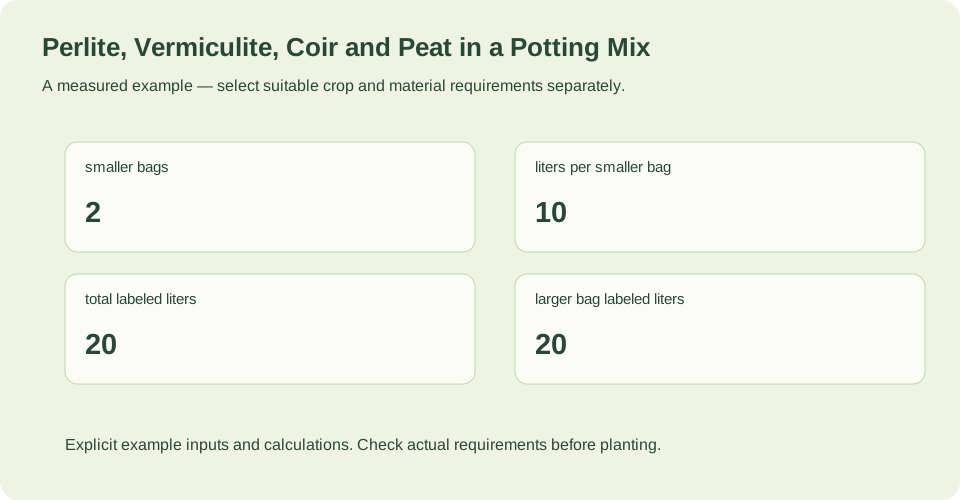
A volume-label comparison only: two 10 L bags contain the same labelled total volume as one 20 L bag. Equal labelled volume does not make different ingredient blends interchangeable.
| Quantity | Calculated result |
|---|---|
| smaller bags | 2 |
| liters per smaller bag | 10 |
| total labeled liters | 20 |
| larger bag labeled liters | 20 |
The label-volume total is 20 L in either purchase. Compare ingredient functions separately; equal volume is not evidence of equal water retention or aeration.
Example inputs explain the method. Review the source context, chosen cultivar and actual site before planting or ordering.
Your before-you-plant checklist
- Confirm the product is labeled for potting use, not as a soil amendment.
- Read the complete ingredient list and note fine versus coarse processing.
- Identify which components are organic and which are inorganic.
- Plan to keep peat or coir from drying out and begin re-wetting days ahead.
- Remove residue and discard diseased medium before reusing or blending old mix.
Questions that come up while planning
Can I replace peat with coir at the same volume?
Coir is described as a peat moss replacement that can be used as such, but the supplied material gives no exact replacement ratios. Read the full blend and product information rather than assuming a one-for-one swap.
Are perlite and vermiculite nutritionally interchangeable with peat and coir?
No. Perlite and vermiculite are inorganic mineral-based components, while peat and coir are organic carbon-based components. They play different structural roles and should not be called nutritionally interchangeable.
Why not just use garden soil in containers?
In a container, the shallow depth limits drainage and destroys many larger air-holding pores. A lightweight, porous potting medium is generally a better choice for containers.
Sources & method
Horticultural guidance is linked to its original source and regional context. Geometry and unit conversions are calculated separately. Read how we prepare and check a page.
- Growing Media (Potting Soil) for ContainersUniversity of Maryland Extension
- Organic Transplant Production NotesPenn State Extension
- Potting Media: Components and HandlingIowa State University Extension