
Separate garden soil from container mix
Mineral garden soil is dense compared with a container mix. In a pot, that density changes how water and air move, which is why the source material treats garden soil and container media as different situations rather than interchangeable fills. A bag labeled potting soil may still be a soilless blend, so the label matters more than the word on the front.
Commercial soilless mix is one listed option for container vegetables. An equal-volume blend of soilless mix and compost is another listed option. Neither is a universal recipe, and this guide does not supply one. Use the label's stated purpose and ingredient list to judge whether a product is intended for containers.
- Turn the bag over and read the ingredient list before the product name.
- Check whether the label describes the contents as mineral soil or as a soilless container medium.
- Confirm the label states a container use rather than only a garden-bed use.
Source context: University of Maryland Extension
Match ingredients to four jobs
A growing medium has to do several jobs at once: support roots, hold appropriate water, allow air, and provide or accept nutrients. Ingredients differ in how they contribute. Some materials hold water, some create pore space, and some add organic matter or nutrients as they break down. The label's ingredient order and stated purpose are your evidence; do not assume a bag performs a job just because a single ingredient is named.
Because these jobs trade off, a mix that stays very wet can leave less air for roots, while a very open mix may dry faster. The source notes that container watering needs vary with weather, plant growth and growing medium. That means the same bag can behave differently across a season, so plan to observe your pot rather than follow a fixed watering schedule.
- List the ingredients named on the label and note which are described as water-holding, air-providing or nutrient-related.
- Check whether the label states a nutrient charge or added fertilizer and what it says about feeding.
- Note the label's stated container use and any warnings before buying.
Source context: University of Maryland Extension · University of Maryland Extension
Choose for an ordinary draining pot
For a standard vegetable pot with drainage holes, start with a product the label identifies for containers. The source lists commercial soilless mix and an equal-volume soilless-mix and compost blend as options; choose between them using the label, not a claim that one is universally better. A pot without drainage is a different situation and is outside this guide.
Plan around the actual container and growing system. Self-watering designs use a water reservoir and behave differently from a pot you water from the top, so read the pot's instructions alongside the mix label. Watering frequency will depend on weather, plant size and the medium, so check the pot rather than copying a schedule from another container.
- Confirm your pot has drainage holes and note whether it is a self-watering design.
- Select a product whose label states a container use and whose ingredients you can identify.
- Water according to what you observe in that pot, adjusting as weather and plant growth change.
Source context: University of Maryland Extension · University of Maryland Extension
Reusing mix without assuming it is unchanged
Old mix is not the same as fresh mix. The source advises removing plant residue before reuse and not saving medium associated with root disease. It describes blending old and fresh material rather than treating used mix as unchanged. That is a handling note, not a recipe or a rate.
If you reuse, keep the old material separate until you have checked it, discard any medium tied to root disease, and blend only what you intend to use. Record what you blended so you can compare results in your own pots.
- Remove plant residue from the old medium before deciding whether to reuse it.
- Discard medium associated with root disease rather than saving it.
- Blend old and fresh material only as the source describes, without inventing proportions.
Source context: University of Maryland Extension
Check your measured example
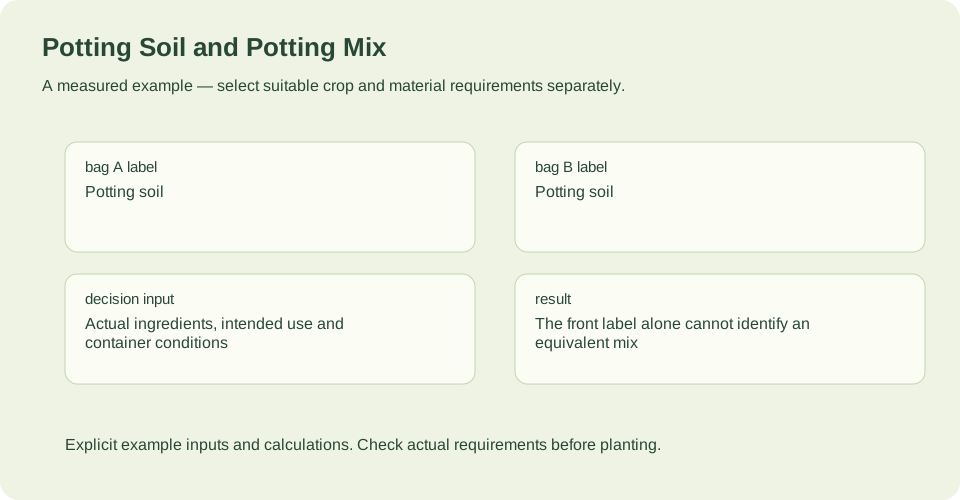
A label-reading scenario, not a product test: two bags are both called potting soil. Their labels and ingredient lists still have to be checked before choosing one for a container.
| Quantity | Calculated result |
|---|---|
| bag A label | Potting soil |
| bag B label | Potting soil |
| decision input | Actual ingredients, intended use and container conditions |
| result | The front label alone cannot identify an equivalent mix |
Compare the ingredient list, intended use and container requirements before choosing between bags. The shared front label does not establish equivalent composition.
Example inputs explain the method. Review the source context, chosen cultivar and actual site before planting or ordering.
Your before-you-plant checklist
- Read the ingredient list and stated container use on the bag.
- Confirm the pot has drainage holes or follow its self-watering instructions.
- Identify which ingredients are described as water-holding, air-providing or nutrient-related.
- Remove plant residue before reusing any medium.
- Discard medium associated with root disease.
Questions that come up while planning
Is potting soil the same as potting mix?
Not necessarily. Garden soil is mineral soil, while most bagged container products are soilless mixes. A bag called potting soil may still be a soilless blend, so read the ingredient list and stated use.
What mix should I use for a vegetable pot?
The source lists commercial soilless mix and an equal-volume soilless-mix and compost blend as options for container vegetables. It does not give a universal recipe, so choose using the label and your pot's drainage and watering setup.
Can I reuse old potting mix?
Remove plant residue and do not save medium associated with root disease. The source describes blending old and fresh material rather than assuming old mix is unchanged; it gives no proportions.
Sources & method
Horticultural guidance is linked to its original source and regional context. Geometry and unit conversions are calculated separately. Read how we prepare and check a page.
- Growing Media (Potting Soil) for ContainersUniversity of Maryland Extension
- Growing Vegetables in Containers and Salad TablesUniversity of Maryland Extension