
Know what you are testing
Garden mineral soil and bagged soilless mix are not interchangeable materials. Mineral soil is dense and structured by its mineral particles and organic content; a container mix is formulated to support roots while holding appropriate water and air in a pot. Because they differ in density, texture and chemistry, a test method or interpretation built for one may mislead you on the other.
Before testing, confirm which material you have. A raised bed filled with garden soil is mineral soil. A pot filled from a bag of commercial soilless mix is a soilless medium, and a blend of equal volumes of soilless mix and compost is still a container medium rather than garden soil. Record what is in each area or container so the reading stays attached to the right material.
- List each bed, pot or container and note whether it holds mineral soil, soilless mix or a labeled blend.
- Choose a pH test method whose instructions match that material type.
- Label the sample with its location and material before sending or reading it.
Source context: University of Maryland Extension · University of Maryland Extension
Read the number in context
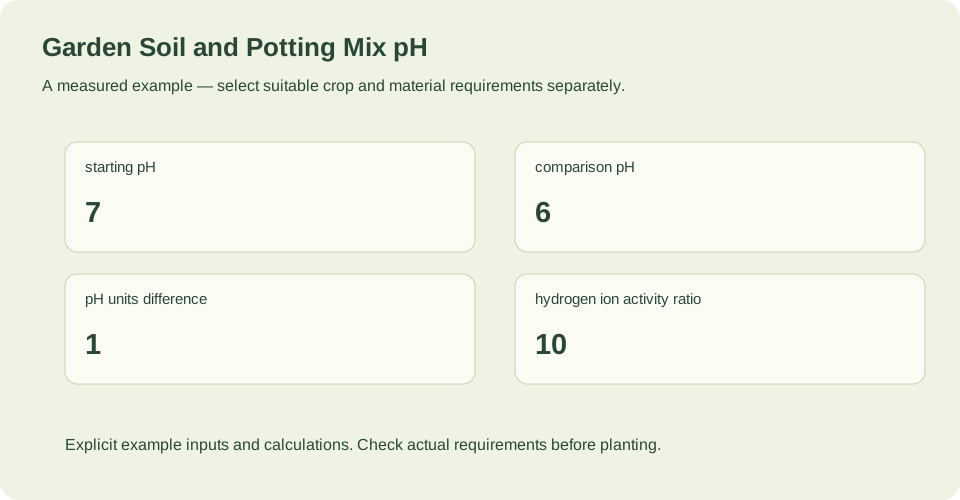
A pH value describes acidity or alkalinity on a logarithmic scale. The supplied example compares pH 7 with pH 6: that is a difference of one pH unit, which represents a tenfold change in hydrogen-ion activity. The example is a way to understand the scale, not a calculation of how much amendment to add.
A pH result is one piece of information about a growing medium. It does not by itself explain every yellow leaf, poor growth or watering problem. Nutrient supply, moisture, drainage, root health and the medium's condition all matter, so use pH alongside other observations and any soil test guidance rather than treating it as a complete diagnosis.
- Write down the measured pH and the material it came from.
- Compare the reading with a target range appropriate to the crop and the medium.
- Check other likely causes before assuming pH is the problem.
Source context: University of Maryland Extension · University of Maryland Extension
Set crop-appropriate targets and adjust carefully
Different crops tolerate different pH ranges, and the appropriate target can also depend on whether you are growing in mineral soil or in a container medium. Use a crop-appropriate target range as your reference point, then decide whether the measured value falls inside it.
Do not apply an amendment dose based on pH alone. Any adjustment should follow the test result and the product's own instructions, because products differ in strength and intended use. If you are unsure, gather more information before changing the medium. For container media, remember that reuse requires removing plant residue and discarding medium associated with root disease; blending old and fresh material is described as a way to refresh a mix, not as proof that old mix is unchanged.
- Identify the crop and the medium before selecting a target range.
- Compare the measured pH with that range and note whether adjustment is warranted.
- Follow the test guidance and product label for any amendment, and do not invent a dose.
- For reused container mix, remove plant residue and do not save medium linked to root disease.
Source context: University of Maryland Extension · University of Maryland Extension
Plan the site before ordering material
pH testing fits into a broader plan. Choose a level, draining growing site and assess the existing soil before ordering new material. Soil testing guides nutrient and amendment decisions, and a geometric volume calculation does not establish soil quality.
That means a pH reading should be paired with a realistic look at the site and the material already present. If you are filling new containers, the medium choice matters as much as the pH number, because a soilless mix is designed for container root conditions in a way dense garden soil is not.
- Check that the growing site is level and drains.
- Assess existing soil before ordering replacements or additions.
- Keep pH results with your site notes so later decisions have context.
Source context: University of Maryland Extension · University of Maryland Extension
Check your measured example
Understanding a pH reading: a measured change from pH 7 to pH 6 is one pH unit and represents a tenfold change in hydrogen-ion activity. This does not calculate a soil-amendment quantity.
| Quantity | Calculated result |
|---|---|
| starting pH | 7 |
| comparison pH | 6 |
| pH units difference | 1 |
| hydrogen ion activity ratio | 10 |
The worked example compares a starting pH of 7 with a comparison pH of 6. The difference is one pH unit, which represents a tenfold change in hydrogen-ion activity. This example explains the scale only; it does not calculate a soil-amendment quantity or predict a crop result.
Example inputs explain the method. Review the source context, chosen cultivar and actual site before planting or ordering.
Your before-you-plant checklist
- Each sample is labeled with its bed, pot or container and material type.
- The pH test method matches mineral soil or soilless mix as appropriate.
- The measured pH is compared with a crop-appropriate target range.
- No amendment dose is applied without test guidance and product instructions.
- Reused container mix has plant residue removed, and medium linked to root disease is not saved.
Questions that come up while planning
Should I use the same pH test for garden soil and potting mix?
Use a method whose instructions match the material. Garden mineral soil and soilless container mix differ in density and behavior, so a test or interpretation designed for one may not suit the other.
Does a pH change of one unit mean the soil is ten times more acidic?
The supplied example shows pH 7 to pH 6 as one pH unit and a tenfold change in hydrogen-ion activity. That illustrates the logarithmic scale; it does not calculate an amendment quantity.
Can pH explain every yellow leaf?
No. pH is one factor among nutrient supply, moisture, drainage, root health and medium condition. Use the reading with other observations and test guidance rather than as a complete diagnosis.
Sources & method
Horticultural guidance is linked to its original source and regional context. Geometry and unit conversions are calculated separately. Read how we prepare and check a page.
- Growing Media (Potting Soil) for ContainersUniversity of Maryland Extension
- Soil to Fill Raised BedsUniversity of Maryland Extension