
Why density and drainage decide the choice
A growing medium has to support roots while holding appropriate water and air. Dense garden soil packs down in a container, leaving less pore space for air and water movement than a container mix provides. That is a physical difference, not a matter of brand or price.
For container vegetables, the supplied guide lists commercial soilless mix and an equal-volume soilless-mix and compost blend among its options. Treat those as container options, not as a formula for every crop. Seed-starting and mature-container requirements also differ, so check the medium label and the crop before substituting materials.
- Identify where the roots will grow: container, raised bed or seed tray.
- Match the medium type to that system before comparing volumes or cost.
- Read the package label for what the product is intended to support.
Source context: University of Maryland Extension · University of Maryland Extension
Raised beds: mineral soil and compost, planned by volume
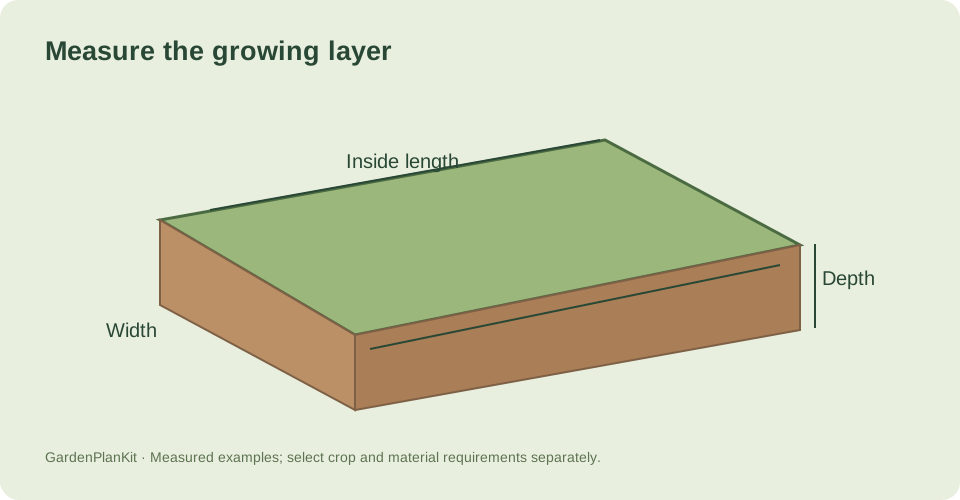
Raised-bed guidance discusses topsoil and plant-based compost, with bulk material bought by cubic yard. Frame volume and growing-layer volume are different planning quantities, so decide the depth of the growing layer separately from the size of the frame.
Large woody fill decomposes and can change the level over time, so a bed planned once may need topping up. That is a reason to record what went in and in what quantity, not a reason to assume any specific settling rate.
- Measure frame volume and growing-layer volume as separate numbers.
- Note the topsoil and compost quantities you plan to buy in cubic yards.
- Record any large woody fill so you can track level changes over time.
Source context: University of Minnesota Extension
Reusing medium without assuming it is unchanged
For reuse, remove plant residue and do not save medium associated with root disease. The supplied guide describes blending old and fresh material rather than assuming old mix is unchanged. Reuse is a handling decision, not a guarantee that the old material still performs like new.
Keep seed-starting medium separate in your planning from mature-container medium. The requirements differ, and the label is the place to confirm what a product is meant for.
- Remove plant residue before storing or blending used medium.
- Discard medium associated with root disease rather than saving it.
- Blend old and fresh material instead of treating old mix as unchanged.
- Keep seed-starting medium planned separately from mature-container medium.
Source context: University of Maryland Extension · University of Maryland Extension
Worked volume example: a 20 cu ft batch
The supplied example is an illustrative 20 cu ft batch made from equal volumes of commercial soilless medium and compost: 10 cu ft of soilless medium plus 10 cu ft of compost. It is a geometrical volume example, not a universal crop recipe, and it does not establish a recommended ratio for any particular vegetable.
Use it to practice the arithmetic of splitting a total volume into parts, then check your own product labels before applying any ratio to a real container or bed. Package label units govern volume conversions.
- Write down the total volume you need.
- Split it into the parts you intend to blend and check the arithmetic.
- Confirm each part against its package label before buying.
Source context: University of Maryland Extension · University of Maryland Extension
Check your measured example
Illustrative 20 cu ft batch, equal volumes of commercial soilless medium and compost; not a universal crop recipe.
| Quantity | Calculated result |
|---|---|
| soilless cuft | 10 |
| compost cuft | 10 |
The 20 cu ft example splits into 10 cu ft soilless medium and 10 cu ft compost at equal volumes. It illustrates volume arithmetic only; it is not a crop recipe, and no further numerical results are implied.
Example inputs explain the method. Review the source context, chosen cultivar and actual site before planting or ordering.
Your before-you-plant checklist
- Root location identified as container, raised bed or seed tray.
- Medium type matched to that system, not to a generic grid.
- Package label checked for intended use and units.
- Frame volume and growing-layer volume recorded separately for raised beds.
- Used medium checked for plant residue and root disease before reuse.
Questions that come up while planning
Can I use garden soil in a container?
Dense garden soil behaves differently from a container mix, and a container medium must support roots while holding appropriate water and air. The supplied guide lists soilless mix and an equal-volume soilless-mix and compost blend among container options. Check the product label and the crop before substituting.
Is raised-bed soil the same as potting soil?
No. Raised-bed guidance discusses topsoil and plant-based compost bought by cubic yard, while container vegetables use a soilless mix or a soilless-mix and compost blend. Frame volume and growing-layer volume are separate planning quantities.
Can I reuse old potting medium?
Remove plant residue and do not save medium associated with root disease. The guide describes blending old and fresh material rather than assuming old mix is unchanged.
Sources & method
Horticultural guidance is linked to its original source and regional context. Geometry and unit conversions are calculated separately. Read how we prepare and check a page.
- Growing Media (Potting Soil) for ContainersUniversity of Maryland Extension
- Starting Vegetable Seeds IndoorsUniversity of Maryland Extension
- Raised Bed GardensUniversity of Minnesota Extension