
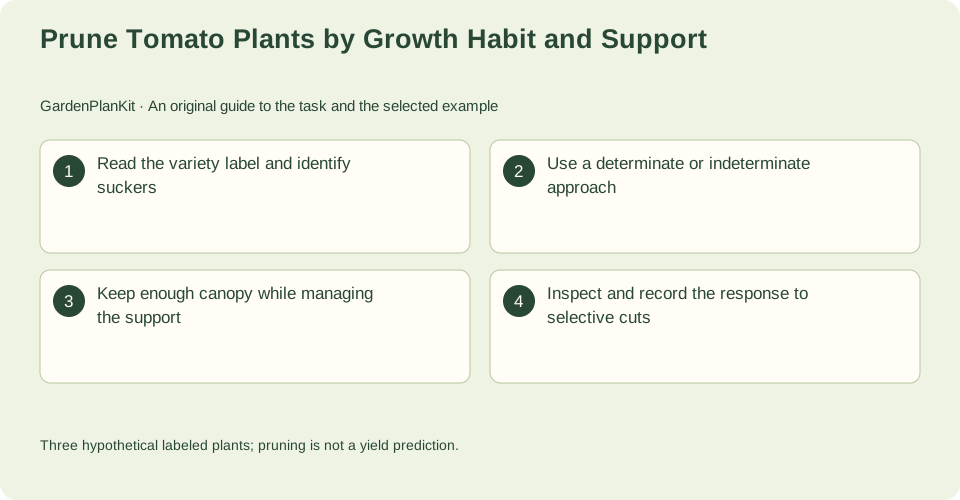
Read the variety label and identify suckers
Find the growth habit on the variety label or seed packet: determinate or indeterminate. That label decides your approach more than the size of the plant on any given day. Next, locate suckers at the junction of a main tomato stem and a leaf. These young shoots sit in the leaf axil, between the stem and the leaf stalk, and they are easiest to manage while small and tender.
Walk the row before cutting anything. Note which plants are labeled determinate and which are indeterminate, and look at how each is supported. Clean hands and clean equipment matter here, and a quick look at the support system belongs in the same pass. If a label is missing or unclear, treat the plant cautiously and remove less rather than more.
- Read the growth habit on each variety label and note it per plant.
- Find the leaf axils and identify young shoots at the stem-and-leaf junction.
- Check that hands and cutting tools are clean before making any cut.
- Look over stakes, cages or trellises before pruning so cuts match the support.
Source context: Iowa State University Extension
Use a determinate or indeterminate approach
For determinate tomatoes, limit sucker removal to shoots below the first flower cluster. Iowa notes that removing suckers beyond that point does not increase yield, so do not strip all suckers from a determinate plant. The first flower cluster is your stopping line: below it, selective removal is the option; above it, leave the shoots alone.
Indeterminate tomatoes can be managed by removing selected suckers as they grow, but removing every one is not necessary. Choose which shoots to take based on the support and the canopy you want to keep, then stop. Pruning is separate from choosing plant spacing, and it does not guarantee a higher total yield. Treat each cut as a decision about this plant, not a promise about harvest.
- On determinate plants, remove only suckers below the first flower cluster.
- On indeterminate plants, select specific suckers to remove rather than clearing all of them.
- Remove young unwanted shoots carefully with clean hands or equipment.
- Stop cutting once the plant has the canopy and support fit you intended.
Source context: Iowa State University Extension
Keep enough canopy while managing the support
Leaf cover shades fruit, and Iowa identifies sunscald as the reason to retain enough canopy. That makes canopy a limit on pruning, not an afterthought. Before removing a shoot, check what leaf area it contributes and whether fruit would be exposed. On a heavily pruned indeterminate plant, the next cut may be the one that opens fruit to direct sun.
Support and pruning work together. Inspect the support system as you go: ties, stakes and cages should hold the remaining stems without letting the plant collapse or flop onto the ground. Adjust the support to the plant you are keeping rather than cutting the plant down to fit a support that no longer suits it.
- Check whether fruit would be exposed before removing a leafy shoot.
- Leave enough leaf canopy to shade developing fruit.
- Inspect ties, stakes and cages and adjust them to the stems you keep.
- Avoid removing shoots just to make the plant match a support that needs adjusting.
Source context: Iowa State University Extension
Inspect and record the response to selective cuts
After a pruning pass, look at the plant again: check the cut sites, the remaining canopy and the support. Record what you removed and what you left, along with the growth habit from the label. A simple note per plant, such as determinate or indeterminate plus which suckers were taken, lets you compare the next inspection with the last one instead of relying on memory.
Use those notes to adjust the next round. If canopy looks thin or fruit seems exposed, hold back on further cuts. If the support is straining, fix the support before removing more stems. The goal is a plant you can inspect and manage, not a fixed number of cuts.
- Inspect cut sites, remaining canopy and support after each pruning pass.
- Record each plant's growth habit and which suckers you removed or kept.
- Compare the next inspection with your notes before cutting again.
- Fix support problems before removing additional stems.
Source context: Iowa State University Extension
Work through this example
Three hypothetical labeled plants; pruning is not a yield prediction.
| Example detail | Selected value or observation |
|---|---|
| indeterminate plants | 2 |
| determinate plants | 1 |
| plants total | 3 |
| decision | Choose the correct approach for each labeled plant and preserve leaf cover. |
The supplied example is hypothetical: three labeled plants, two indeterminate and one determinate, totaling three. It illustrates choosing the correct approach for each label and preserving leaf cover. It is not a yield prediction, and no harvest result should be read from it.
Use this example to structure your own notes. Check the source conditions for the crop, method and setting.
Your action checklist
- Growth habit recorded for every plant from its variety label.
- Suckers identified at the stem-and-leaf junction before cutting.
- Determinate plants pruned only below the first flower cluster.
- Indeterminate plants given selective removal, not complete stripping.
- Enough leaf canopy left to shade fruit, with support inspected and adjusted.
Questions that come up while planning
How do you prune tomato plants?
Identify suckers at the junction of a main stem and leaf, then match your approach to the variety label. Limit determinate sucker removal to below the first flower cluster, and on indeterminate plants remove selected suckers rather than every one. Keep enough canopy to shade fruit and check the support as you go.
Should I remove all suckers from a determinate tomato?
No. Iowa limits determinate sucker removal to below the first flower cluster and notes that removing suckers beyond that point does not increase yield. Do not strip all determinate suckers.
Does pruning guarantee more tomatoes?
No. Pruning is different from choosing plant spacing and does not guarantee higher total yield. It is a management decision tied to growth habit, support and canopy, so judge it by the plant's condition rather than by a promised harvest increase.
Sources & method
Horticultural guidance is linked to its original source and regional context. Geometry and unit conversions are calculated separately. Read how we prepare and check a page.
- Pruning Tomatoes in the Home GardenIowa State University Extension