
Decide habit and support before pot size
Start with the cultivar label. Determinate types stop at a certain height, while indeterminate vines continue growing and need a taller, sturdier support plan. Cherry tomatoes range from dwarf plants to vines around 7 feet, so the category alone does not settle the setup. Midget, patio and dwarf types have very compact vines and are described as suited to hanging baskets or other containers.
Match support to mature top growth, not to seedling size. A cage or stake must be in place at planting so roots are not disturbed later. The in-ground row spacing figure of 18 to 36 inches by 48 to 60 inches is a field spacing reference that depends on habit and staking or caging; do not convert it into a pot minimum.
- Read the cultivar label and record determinate or indeterminate habit and expected mature height.
- Choose stake, cage or basket before potting and confirm it fits the mature top growth.
- Set the support in place at planting rather than adding it after roots establish.
Source context: University of Maryland Extension
Check pot volume, shape and drainage
The Maryland guide lists reference minimum volumes of 5 US gallons for standard tomatoes and 2 US gallons for cherry tomatoes. These are named examples for that guide, not promises of yield and not universal minimums. Check the actual cultivar and growing system, because a compact determinate and a tall indeterminate cherry vine have very different top growth.
Volume alone does not define a suitable shape. Choose a pot with open drainage holes and enough root space for the crop. Measure actual fill volume rather than trusting nursery trade-gallon labels. Stones or gravel under the mix do not improve drainage, and saucers should be emptied so roots are not left saturated.
- Compare the cultivar against the named reference volumes and note any mismatch in habit or top growth.
- Confirm drainage holes are open and the pot shape suits the root system.
- Measure the pot's actual fill volume with water or a known container instead of relying on the trade-gallon label.
- Empty saucers after watering so roots are not left standing in water.
Source context: University of Maryland Extension
Choose a growing medium and set the transplant
Container medium must support roots while holding appropriate water and air. Dense garden soil behaves differently from a container mix. The guide lists commercial soilless mix and an equal-volume soilless-mix and compost blend among its options. If you reuse medium, remove plant residue and do not save medium associated with root disease; the guide describes blending old and fresh material rather than assuming old mix is unchanged.
Transplant after all danger of frost has passed and the soil has warmed. Tomatoes want full sun, defined as direct light at least 6 hours per day, and they prefer 8 to 10 hours. Use starter fertilizer for transplants, then side-dress after the first fruits appear. Additional fertilizer may be needed depending on plant growth, fruit load and soil fertility. Do not add Epsom salts unless a soil test shows a magnesium deficiency.
- Fill the pot with soilless mix or the equal-volume mix and compost blend, leaving a rim gap for watering.
- Transplant after frost danger has passed and the medium has warmed.
- Apply starter fertilizer at transplant and plan a side-dress after first fruits appear.
- Skip Epsom salts unless a soil test shows magnesium deficiency.
Source context: University of Maryland Extension · University of Maryland Extension
Monitor the plan through the season
Track light, moisture, support and fertilizer as the plant grows. Full sun of at least 6 hours is the baseline, with 8 to 10 preferred. Check that the stake or cage still holds the top growth and that drainage holes stay open. Reassess fertilizer as fruit load and growth change rather than following a fixed schedule.
Regional dates in the source are examples for that location only. Use your own frost date and warmed-medium check rather than copying a date from another region.
- Record daily direct light hours at the pot's location.
- Check support stability and drainage holes at each watering.
- Adjust fertilizer only after observing growth, fruit load and medium fertility.
- Note your local last-frost date and warmed-medium timing instead of copying another region's dates.
Source context: University of Maryland Extension · University of Maryland Extension
Check your measured example
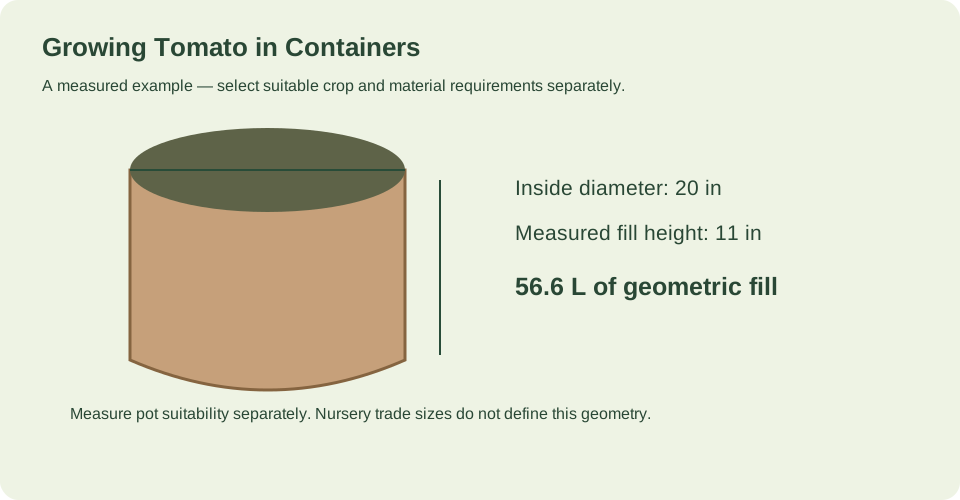
Volume-only illustration: one straight-sided pot with inside diameter 20 in, inside height 12 in and 1 in rim gap. The resulting fill capacity is not a minimum pot size for tomato; confirm a suitable container separately.
| Quantity | Calculated result |
|---|---|
| inside diameter in | 20 |
| fill height in | 11 |
| volume cuft | 1.9999 |
| volume liters | 56.6296 |
| US liquid gallons | 14.96 |
The worked example is a volume-only geometry check: a straight-sided pot with a 20-inch inside diameter, 12-inch inside height and a 1-inch rim gap gives a fill height of 11 inches, about 2.0 cubic feet, 56.6 liters or 15.0 US liquid gallons. That figure describes the pot's fill capacity, not a tomato minimum. Confirm a suitable container separately using the cultivar, support system and named reference volumes.
Example inputs explain the method. Review the source context, chosen cultivar and actual site before planting or ordering.
Your before-you-plant checklist
- Cultivar habit recorded as determinate or indeterminate.
- Support system chosen and installed at planting.
- Pot drainage holes confirmed open and saucer emptied.
- Actual fill volume measured rather than read from a trade-gallon label.
- Medium is soilless mix or the equal-volume mix and compost blend.
- Starter fertilizer applied and side-dress planned for first fruits.
Questions that come up while planning
Is a 5-gallon pot enough for every tomato?
No. The Maryland guide lists 5 US gallons as a reference minimum for standard tomatoes and 2 for cherry tomatoes, but these are named examples, not guarantees for every cultivar. Check the actual cultivar, growing system and mature top growth before deciding.
Can I use garden soil in a container tomato pot?
Dense garden soil behaves differently from a container mix. The guide lists commercial soilless mix and an equal-volume soilless-mix and compost blend among its options for container vegetables.
Should I add Epsom salts when planting container tomatoes?
Do not add Epsom salts unless a soil test shows a magnesium deficiency. Use starter fertilizer for transplants and side-dress after the first fruits appear.
Sources & method
Horticultural guidance is linked to its original source and regional context. Geometry and unit conversions are calculated separately. Read how we prepare and check a page.
- Growing Tomatoes in a Home GardenUniversity of Maryland Extension
- Growing Vegetables in Containers and Salad TablesUniversity of Maryland Extension
- Growing Media (Potting Soil) for ContainersUniversity of Maryland Extension