
Check the roof, intended use and local requirements
Begin at the catchment. Oregon State separates roof catchment, conveyance, debris and first-flush management, storage and delivery, so treat each as its own decision. Its guide warns that runoff from wood shingles, tar, gravel or concrete roof surfaces should not be used for vegetable gardening. If the roof material is unknown or unsuitable, do not assume it is appropriate for edible crops.
Match the intended use to the catchment before sizing anything. Collected roof runoff is not automatically drinking water or safe to spray on edible plant parts. Check local requirements and manufacturer-rated supports, tank installation and connections before building. A volume estimate does not certify water quality, structural loading, plumbing or legal permission.
- Identify the roof surface material and confirm it is acceptable for the intended garden use.
- Confirm local requirements and manufacturer-rated supports, tank installation and connections before building.
- Decide whether the water is for soil-level delivery only or another use, and record that decision.
Source context: Oregon State University Extension
Map collection, first flush, storage and overflow
Draw the route from roof to tank: catchment, conveyance, debris and first-flush management, storage, then delivery. Keep inlets screened and containers covered. Overflow should be directed to an appropriate location, avoiding standing water and mosquito access.
First-flush diversion and tank limits reduce what reaches storage, so map them as separate components rather than folding them into the roof estimate. The delivery route matters too: decide where water leaves the tank and how it reaches the garden without creating standing water along the way.
- Sketch each component from roof to delivery and mark where screening, first flush, covering and overflow occur.
- Choose an appropriate overflow destination that avoids standing water and mosquito access.
- Confirm the delivery route from tank outlet to the garden.
Source context: Oregon State University Extension
Estimate gross collection and available storage
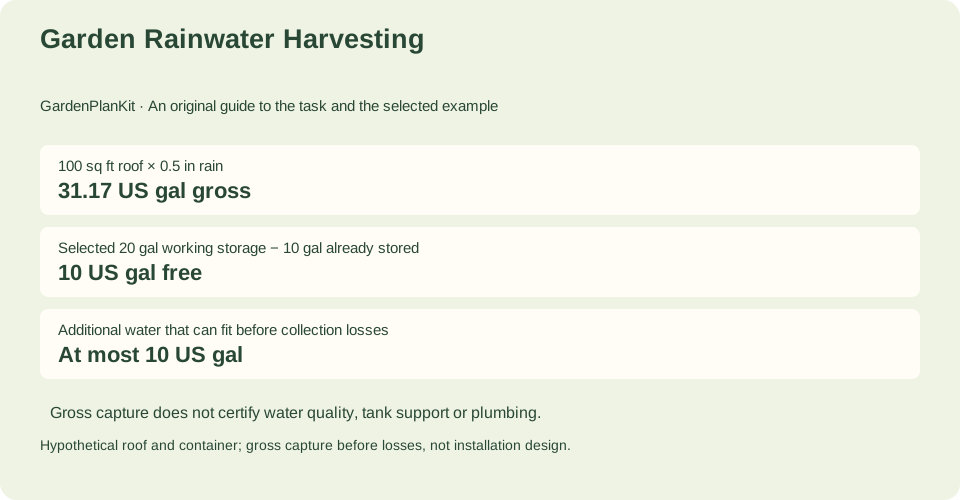
Roof footprint and rainfall estimate gross water before collection losses, tank limits or first-flush diversion. The supplied hypothetical example uses a 100 square foot roof footprint and 0.5 inch of rainfall, with a supplied conversion factor of 7.48051948051948 US liquid gallons per cubic foot. The geometric calculation gives about 31.17 gross US gallons. This is a geometrical example, not crop advice or installation design.
Compare that gross figure with storage you can actually use. In the same hypothetical, selected working storage is 20 US gallons and 10 are already stored, leaving 10 free US gallons. Maximum additional storage before losses is therefore 10 US gallons. Keep water quantities in clearly labeled US liquid gallons, distinct from dry-volume measurements, and use the supplied conversion factor for the worked example.
- Multiply roof footprint by rainfall depth in feet to get cubic feet, then apply the supplied gallons-per-cubic-foot factor.
- Subtract already stored water from selected working storage to find free storage.
- Compare gross capture with free storage and note where first flush, screening losses or tank limits will reduce what is retained.
Source context: Oregon State University Extension · National Institute of Standards and Technology
Inspect screens, covers, overflow and the delivery route
Turn the plan into a routine. Check inlets for screening and clear debris that blocks flow. Confirm containers remain covered and that overflow still reaches its intended location without standing water or mosquito access. Walk the delivery route and look for leaks, blockages or water pooling where it should not.
Recheck manufacturer-rated supports, tank installation and connections as part of the same inspection. If the roof material, intended use or local requirements change, revisit the catchment decision rather than assuming the old plan still applies.
- Inspect inlet screens and remove debris.
- Confirm covers are in place and overflow is directed appropriately.
- Walk the delivery route for leaks, blockages or pooling.
- Recheck supports, installation and connections against manufacturer ratings.
Source context: Oregon State University Extension
Work through this example
Hypothetical roof and container; gross capture before losses, not installation design.
| Example detail | Selected value or observation |
|---|---|
| roof footprint sq ft | 100 |
| rainfall in | 0.5 |
| gross US gallons | 31.1688 |
| selected working storage US gallons | 20 |
| already stored US gallons | 10 |
| free storage US gallons | 10 |
| maximum additional storage before losses US gallons | 10 |
| US liquid gallons per cubic foot | 7.4805 |
The hypothetical example uses a 100 square foot roof footprint and 0.5 inch of rainfall with the supplied factor of 7.48051948051948 US liquid gallons per cubic foot, giving about 31.17 gross US gallons before losses. With 20 US gallons of selected working storage and 10 already stored, free storage is 10 US gallons, so maximum additional storage before losses is 10 US gallons. This is a geometrical illustration, not installation design or crop advice.
Use this example to structure your own notes. Check the source conditions for the crop, method and setting.
Your action checklist
- Roof material identified and judged acceptable for the intended use.
- Local requirements and manufacturer-rated supports, installation and connections checked before building.
- Collection route mapped with screening, first flush, covered storage and an appropriate overflow destination.
- Gross capture compared with free storage using labeled US liquid gallons.
- Screens, covers, overflow and delivery route inspected for debris, leaks and pooling.
Questions that come up while planning
Can I use roof runoff on vegetables?
It depends on the roof. Oregon State warns that runoff from wood shingles, tar, gravel or concrete roof surfaces should not be used for vegetable gardening. Collected roof runoff is not automatically safe to spray on edible plant parts, and an unknown catchment should not be assumed appropriate.
Does the gallon estimate tell me my system is safe?
No. Roof footprint and rainfall estimate gross water before collection losses, tank limits or first-flush diversion. A volume estimate does not certify water quality, structural loading, plumbing or legal permission.
What should overflow do?
Overflow should be directed to an appropriate location, avoiding standing water and mosquito access. Keep inlets screened and containers covered as part of the same routine.
Sources & method
Horticultural guidance is linked to its original source and regional context. Geometry and unit conversions are calculated separately. Read how we prepare and check a page.
- Harvesting Rainwater for Use in the GardenOregon State University Extension
- NIST Handbook 44: General Tables of Units of MeasurementNational Institute of Standards and Technology