
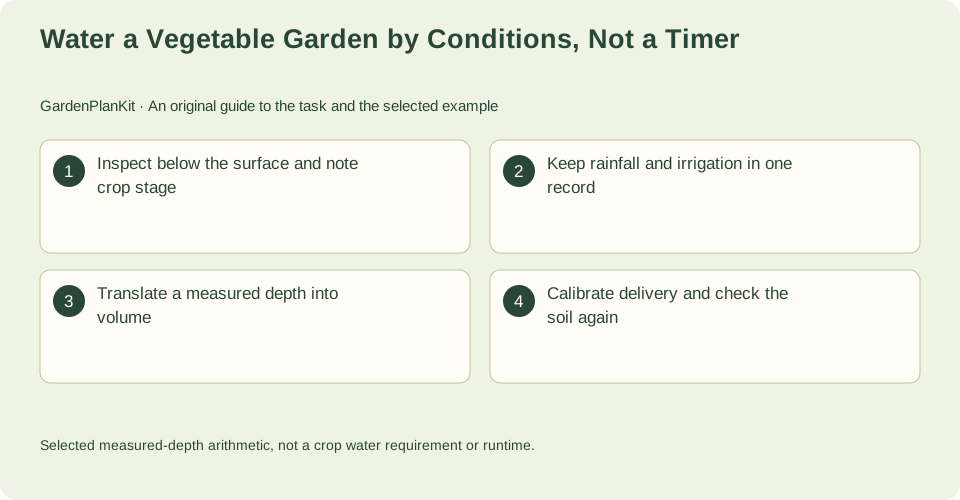
Inspect below the surface and note crop stage
Start each watering decision with a look below the surface, not at the top of the soil. Push a finger, trowel or probe into the root zone and note whether it is dry, moist or wet at the depth where roots are active. Record what you saw and where. Surface dryness alone can mislead after mulch or a light sprinkle.
Note the crop stage at the same time. Seedlings, established plants and crops in a growth or fruiting phase do not share one water pattern, and Colorado State identifies growth stage as an influence on vegetable water use. Write the stage beside the moisture observation so later entries can be compared. Soil preparation, mulch and efficient irrigation can also conserve water, so note whether those are in place.
- Check moisture below the surface at the root zone and record dry, moist or wet.
- Write the crop and its growth stage next to the moisture note.
- Note mulch, soil preparation or irrigation method that affects how water reaches roots.
Source context: Colorado State University Extension
Keep rainfall and irrigation in one record
Use a single log for rain and irrigation so neither is counted twice or forgotten. For each entry, record the date, the source (rain or irrigation), and the amount if you measured it. If you did not measure, say so rather than estimating. Keeping both together shows the actual water history of the bed instead of two separate stories.
Pair each entry with the moisture observation from the first section. A rain event followed by a moist root zone is different from the same rain followed by a dry one, and the log should show that difference. Review the record before changing anything, and keep the units consistent so entries can be compared.
- Log date, source and measured amount for every rain and irrigation event.
- Mark entries where the amount was not measured.
- Add the below-surface moisture observation to the same record.
Source context: Colorado State University Extension · National Institute of Standards and Technology
Translate a measured depth into volume
A depth measurement becomes a volume only when you multiply it by the area it covers. The supplied example is selected measured-depth arithmetic, not a crop water requirement or runtime. It uses a 32 square foot area and a selected depth of 0.5 inch. Convert the depth to feet, multiply by the area to get cubic feet, then multiply by the US liquid gallons per cubic foot factor supplied in the example.
The example gives 1.3333333333333333 cubic feet and 9.974025974025974 US liquid gallons, using 7.48051948051948 US liquid gallons per cubic foot. These are US liquid gallons, distinct from dry-volume measurements. The result describes the volume over that area at that depth; it does not establish emitter runtime, pressure, distribution uniformity, infiltration or a crop-specific water requirement. Treat it as geometry, not as watering advice.
- Measure the area the water will cover in square feet.
- Measure the depth in inches and convert it to feet.
- Multiply depth by area for cubic feet, then by the supplied US liquid gallons per cubic foot factor.
- Label the result as US liquid gallons and as a geometric volume only.
Source context: National Institute of Standards and Technology · Colorado State University Extension
Calibrate delivery and check the soil again
A computed volume does not tell you how long a sprinkler or emitter must run. Straight-sided catch containers can help measure sprinkler application, so place several across the watered area and compare what they catch. Uneven catches point to distribution differences that a single volume figure cannot show. For drip or other emitters, the computed volume still does not establish runtime, pressure or uniformity.
After delivering water, inspect below the surface again and compare with the earlier observation. If the root zone is still dry, the delivery did not reach it; if it is wet, record that. Update the log with what you delivered and what the soil showed. This check closes the loop between the measured depth, the delivery method and the actual root-zone condition.
- Place straight-sided catch containers across a sprinkler area and compare catches.
- Record delivery method and any observed unevenness.
- Recheck moisture below the surface after watering and log the result.
Source context: Colorado State University Extension
Work through this example
Selected measured-depth arithmetic, not a crop water requirement or runtime.
| Example detail | Selected value or observation |
|---|---|
| area sq ft | 32 |
| selected depth in | 0.5 |
| volume cu ft | 1.3333 |
| US liquid gallons | 9.974 |
| US liquid gallons per cubic foot | 7.4805 |
The supplied example is hypothetical selected measured-depth arithmetic, not a crop water requirement or runtime. It multiplies a 32 square foot area by a selected 0.5 inch depth to get 1.3333333333333333 cubic feet, then applies the supplied factor of 7.48051948051948 US liquid gallons per cubic foot to get 9.974025974025974 US liquid gallons. No additional numerical results are implied, and the figure does not establish emitter runtime, pressure, distribution uniformity, infiltration or a crop-specific water requirement.
Use this example to structure your own notes. Check the source conditions for the crop, method and setting.
Your action checklist
- Moisture checked below the surface and crop stage noted.
- Rain and irrigation recorded together with dates and measured amounts.
- Unmeasured entries marked as unmeasured.
- Area and depth measured before any volume calculation.
- Volume labeled as US liquid gallons and as geometry, not a requirement.
- Catch containers compared and root-zone moisture rechecked after delivery.
Questions that come up while planning
Can I set a timer and stop checking the soil?
No. Weather, wind, soil and crop growth stage influence vegetable water use, so a fixed schedule can miss actual conditions. Inspect below the surface and keep rain and irrigation in one record before deciding.
Does the 32 square foot example tell me how long to run my sprinkler?
No. It is selected measured-depth arithmetic only. A computed volume does not establish emitter runtime, pressure, distribution uniformity, infiltration or a crop-specific water requirement.
Why are the example results in US liquid gallons?
The example uses US liquid volume, which must be distinguished from dry-volume measurements. The conversion factor and geometric inputs are supplied explicitly, and the result is a volume over an area at a depth, not a watering recommendation.
Sources & method
Horticultural guidance is linked to its original source and regional context. Geometry and unit conversions are calculated separately. Read how we prepare and check a page.
- Irrigating the Vegetable GardenColorado State University Extension
- NIST Handbook 44: General Tables of Units of MeasurementNational Institute of Standards and Technology