
Decide whether a container suits sage
Sage is grown for culinary use, and it is not the same as ornamental plants also called salvia. Before buying a pot, decide where the container will sit and how much top growth the plant will eventually need. The container guide says to match both mature top growth and root space, so a tall or spreading sage may need more room above and around the rim than a compact plant.
Perennial herbs should be planted where they can remain undisturbed, according to the herb source. That makes a container a longer commitment than a single-season pot. Choose a site you can reach for watering and checking, and one where the pot will not be moved often once the plant is established.
- Confirm the plant is a culinary sage, not an ornamental salvia.
- Check the expected mature top growth and choose a pot shape that leaves room for it.
- Pick a final position you can reach for routine watering and inspection.
Source context: Iowa State University Extension · University of Maryland Extension
Check drainage and growing medium
Drainage holes must stay open. The container guide notes that stones or gravel under the mix do not improve drainage, so do not rely on a gravel layer. Empty saucers so roots are not left saturated.
Use a growing medium that supports roots while holding appropriate water and air. The mix guide lists commercial soilless mix and an equal-volume soilless-mix and compost blend among options for container vegetables. Dense garden soil behaves differently from a container mix. If you reuse medium, remove plant residue and do not save medium associated with root disease; the guide describes blending old and fresh material rather than assuming old mix is unchanged.
- Check that drainage holes are open before filling.
- Choose a soilless mix or an equal-volume soilless-mix and compost blend.
- If reusing medium, remove plant residue and discard medium associated with root disease.
Source context: University of Maryland Extension · University of Maryland Extension
Measure the pot and set up the plant
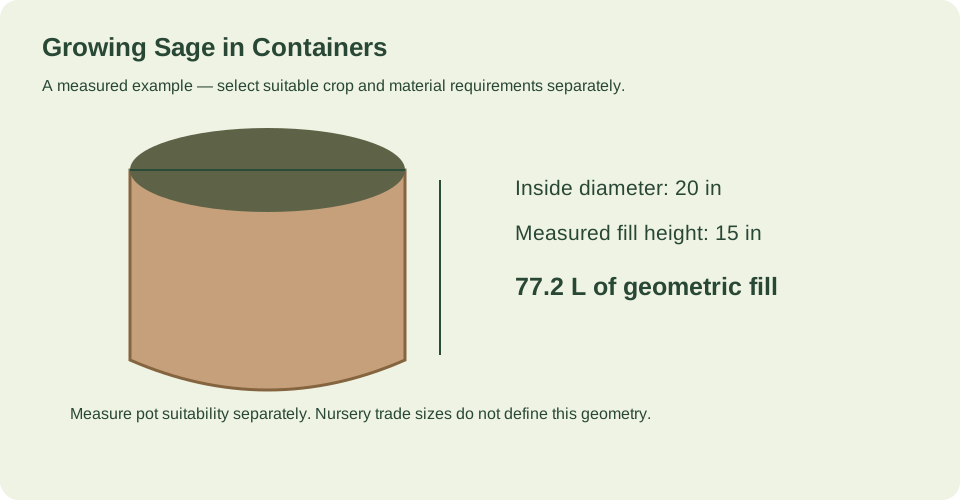
Measure actual fill volume rather than relying on nursery trade-gallon labels. The supplied example is a volume-only illustration: a straight-sided pot with a 20-inch inside diameter, 16-inch inside height and a 1-inch rim gap gives a fill height of 15 inches. The rendered table reports the resulting fill capacity. That figure is not a minimum pot size for sage; confirm a suitable container separately using the named large-herb group and the shape and top-growth checks.
For propagation context, the herb source says perennial herbs are propagated by cuttings or division, and that four-to-six-inch stem cuttings can be taken in summer and rooted in perlite or sand. Those are general herb propagation notes, not a container-size recommendation.
- Measure inside diameter and the fill height you will actually use.
- Compare the measured fill volume with the named large-herb group rather than treating the example as a sage minimum.
- Set the pot where it will remain, then water so the medium settles without leaving the saucer full.
Source context: University of Maryland Extension · Iowa State University Extension
Monitor and maintain the container
Plan routine checks rather than assuming the pot will look after itself. Watch that drainage holes remain open, empty the saucer after watering, and check whether the medium has settled or dried. Because sage is a perennial herb, also watch for the plant outgrowing its space and plan to divide established plants every three or four years in early spring, as the herb source describes for perennial herbs generally.
Regional dates in any source are examples for that source location. Use them as context, not as a calendar for your own garden.
- Check drainage holes and empty the saucer regularly.
- Note whether top growth is crowding the pot or nearby plants.
- Plan to divide established perennial herbs every three or four years in early spring.
Source context: University of Maryland Extension · Iowa State University Extension
Check your measured example
Volume-only illustration: one straight-sided pot with inside diameter 20 in, inside height 16 in and 1 in rim gap. The resulting fill capacity is not a minimum pot size for sage; confirm a suitable container separately.
| Quantity | Calculated result |
|---|---|
| inside diameter in | 20 |
| fill height in | 15 |
| volume cuft | 2.7271 |
| volume liters | 77.2222 |
| US liquid gallons | 20.4 |
The worked example is a volume-only illustration: a straight-sided pot with a 20-inch inside diameter, 16-inch inside height and a 1-inch rim gap, giving a 15-inch fill height. The rendered table reports the resulting fill capacity. That capacity is not a minimum pot size for sage; confirm a suitable container separately using the named large-herb group and the shape and top-growth checks.
Example inputs explain the method. Review the source context, chosen cultivar and actual site before planting or ordering.
Your before-you-plant checklist
- Confirm the plant is culinary sage, not an ornamental salvia.
- Check that drainage holes are open and that no gravel layer is relied on for drainage.
- Choose a soilless mix or an equal-volume soilless-mix and compost blend.
- Measure actual fill volume instead of trusting a trade-gallon label.
- Confirm the pot shape leaves room for mature top growth and root space.
Questions that come up while planning
What pot size does sage need in a container?
The named container guide groups sage with large herbs including rosemary, parsley, dill and fennel and describes 5-gallon-or-larger pots for that group. Use that as a starting point, then confirm the pot shape suits mature top growth and root space. Volume alone does not define a suitable shape.
Can I use garden soil in a sage container?
Dense garden soil behaves differently from a container mix. The mix guide lists commercial soilless mix and an equal-volume soilless-mix and compost blend among options for container vegetables. Choose a medium that supports roots while holding appropriate water and air.
Is the 20-inch pot example a sage minimum?
No. The example is a volume-only illustration of one straight-sided pot with a 20-inch inside diameter, 16-inch inside height and 1-inch rim gap. Its fill capacity is not a minimum pot size for sage; confirm a suitable container separately.
Sources & method
Horticultural guidance is linked to its original source and regional context. Geometry and unit conversions are calculated separately. Read how we prepare and check a page.
- Growing, Harvesting, and Drying HerbsIowa State University Extension
- Growing Vegetables in Containers and Salad TablesUniversity of Maryland Extension
- Growing Media (Potting Soil) for ContainersUniversity of Maryland Extension