
Choose and label a representative seed sample
Pull seeds from the actual packet or stored lot you plan to sow, not from a different year or variety. Choose them randomly rather than picking out the largest or most perfect-looking seeds, because a hand-picked sample can overstate what the whole lot will do. Iowa's minimum is 20 seeds; 50 or 100 give a larger sample, which matters when the result will guide a purchase decision.
Label the test before anything gets wet. Record variety, collection or purchase year, storage conditions, and the test date with the lot. Those details let you compare this result with the same lot later and decide whether storage has changed it.
- Take a random sample of at least 20 seeds from the lot you intend to sow.
- Write the variety, purchase or collection year, storage conditions, and test date on the label.
- Keep the labeled packet with the test so the sample and the remaining seeds stay connected.
Source context: Iowa State University Extension
Set up a moist test and inspect development
Place separated seeds in premoistened paper toweling so each one can be seen and counted. Separation matters: seeds touching each other make it hard to tell which root belongs to which seed. Keep the test suitably warm and monitor it rather than leaving it unchecked.
Iowa describes germination as a root or cotyledon appearing through the seed coat. Count that visible development, and note seeds that swell, mold, or remain unchanged so you can describe what you actually saw. Collected seed needs thorough drying before storage, and excessive drying heat can damage seed, so treat heat as a risk to the lot rather than a shortcut in the test.
- Premoisten the paper toweling and space seeds apart.
- Keep the labeled test suitably warm and inspect it regularly.
- Count a seed as germinated when a root or cotyledon appears through the seed coat.
- Note mold, swelling, or unchanged seeds separately from germinated ones.
Source context: Iowa State University Extension
Calculate and interpret the observed percentage
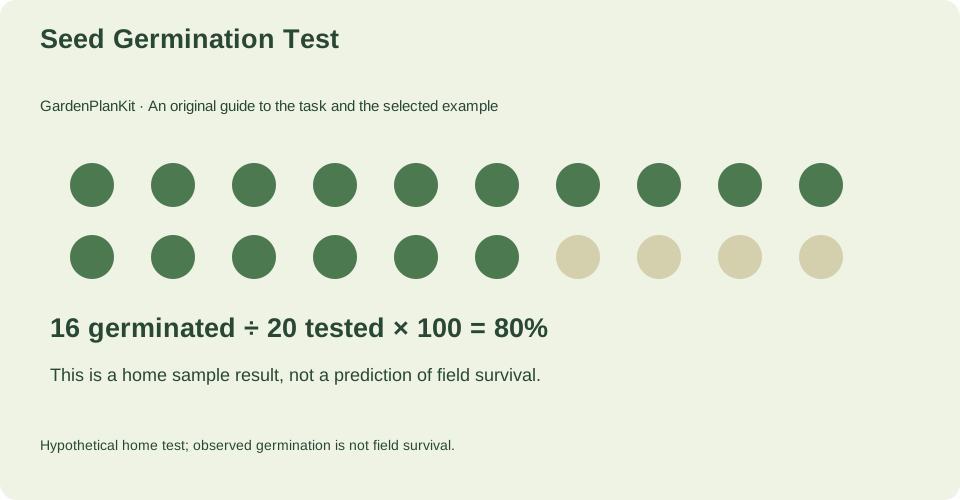
The germination percentage is the number germinated divided by the number tested, multiplied by 100. With the hypothetical example of 20 seeds tested and 16 germinated, the observed result is 80 percent. That is arithmetic on your sample, not a promise about the garden.
Interpret the number with its limits in view. A home check is not a field-establishment forecast or seed-health certification, so other losses between sowing and a standing plant are outside this result. Sample size also shapes confidence: 20 seeds is Iowa's minimum, while 50 or 100 give a larger sample. If the result is low or the sample was small, test again before making a large commitment to that lot.
- Divide germinated seeds by seeds tested.
- Multiply by 100 to get the observed percentage.
- Record the sample size beside the percentage so the result is not read as more precise than it is.
Source context: Iowa State University Extension
Use the result in a seed order and record
Use the observed percentage to translate a plant target into a seed quantity, then add your own allowance for losses the test does not measure. In the hypothetical example, a target of 24 plants divided by 0.80 gives 30 seeds before other losses. That 30 is arithmetic from the example, not a recommended sowing rate.
Keep the test record with the stored seed. Store seed cool and dry in labeled packets within an airtight container, and remember that storage conditions and species affect longevity. A table of typical years under good conditions does not replace testing a particular seed lot, so let your own labeled result guide reordering.
- Divide the target plant count by the observed germination fraction.
- Add your own allowance for losses outside the test before ordering.
- Store remaining seed cool and dry in a labeled packet inside an airtight container.
- File the test date, sample size, and percentage with the lot for the next order.
Source context: Iowa State University Extension
Work through this example
Hypothetical home test; observed germination is not field survival.
| Example detail | Selected value or observation |
|---|---|
| seeds tested | 20 |
| seeds germinated | 16 |
| observed germination percent | 80 |
| target plants for quantity example | 24 |
| arithmetic seeds before other losses | 30 |
The supplied example is hypothetical: 20 seeds tested and 16 germinated give 80 percent. Dividing a target of 24 plants by 0.80 gives 30 seeds before other losses. These are arithmetic illustrations, not crop advice or a field-survival forecast.
Use this example to structure your own notes. Check the source conditions for the crop, method and setting.
Your action checklist
- Sample at least 20 seeds randomly from the lot you plan to sow.
- Label variety, purchase or collection year, storage conditions, and test date.
- Space seeds apart on premoistened paper toweling and inspect regularly.
- Count only seeds with a root or cotyledon through the seed coat.
- Record sample size and percentage, then store remaining seed cool and dry in a labeled airtight container.
Questions that come up while planning
How many seeds should I test?
Iowa recommends at least 20 randomly chosen seeds, with 50 or 100 giving a larger sample. Use the larger sample when the result will guide a purchase.
What counts as germinated in a home test?
Iowa describes germination as a root or cotyledon appearing through the seed coat. Count that visible development and note mold, swelling, or unchanged seeds separately.
Does an 80 percent test result mean 80 percent of sown seeds will become plants?
No. The percentage is germinated seeds divided by seeds tested, times 100. A home check is not a field-establishment forecast or seed-health certification.
Sources & method
Horticultural guidance is linked to its original source and regional context. Geometry and unit conversions are calculated separately. Read how we prepare and check a page.
- How to Store Seeds and Test Germination RatesIowa State University Extension