
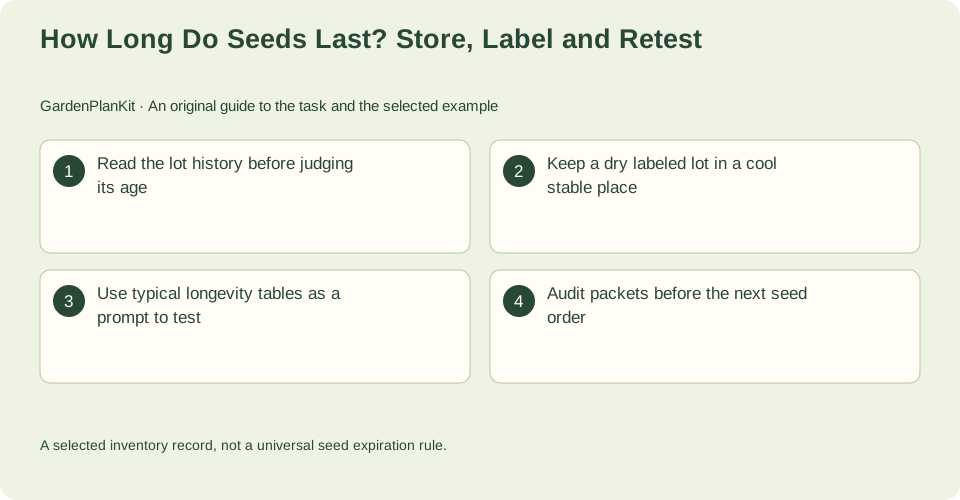
Read the lot history before judging its age
A purchase or collection year alone does not tell you whether a seed lot is still worth planting. The useful record combines variety, source, collection or purchase year, storage conditions, and the date of any germination test. Collected seed also needs thorough drying before storage, and excessive drying heat can damage it, so note how it was handled.
When you review a lot, ask what happened to it rather than only how old it is. Was it kept cool and dry in a labeled packet inside an airtight container? Did it experience a moisture incident, such as a damp shed or a spilled drink? Those details change the decision more than the calendar does.
- Write variety, source, and collection or purchase year on every packet.
- Record the container, storage location, and any moisture incident with the lot.
- Note the date of each germination test so later decisions use current information.
Source context: Iowa State University Extension
Keep a dry labeled lot in a cool stable place
Store seed cool and dry in labeled packets within an airtight container. Labeling matters because a mixed or unlabeled envelope loses its history, and without variety and year you cannot decide whether to test, sow, or discard. Storage conditions and species both affect longevity, so the same container does not make every lot equal.
Aim for a stable spot rather than one that swings between damp and dry. If a packet was exposed to moisture, treat that as a reason to test sooner rather than assuming the seed is fine.
- Place each labeled packet inside an airtight container.
- Choose a cool, dry, stable storage location and keep it consistent.
- Flag any lot that had a moisture incident for an earlier test.
Source context: Iowa State University Extension
Use typical longevity tables as a prompt to test
Tables of typical years under good conditions are useful for deciding which lots deserve a check, but they do not replace testing a particular seed lot. Species and storage conditions vary, so treat a table as a question, not an answer.
For a home germination check, Iowa recommends at least 20 randomly chosen seeds, with 50 or 100 giving a larger sample. Place separated seeds in premoistened paper toweling, label the lot, keep them suitably warm, and monitor the test. Germination percentage is the number germinated divided by the number tested, multiplied by 100. Iowa describes germination as a root or cotyledon appearing through the seed coat. This home check is not a field-establishment forecast or seed-health certification, so use it to decide whether to keep, test again, or replace a lot, not to promise how plants will perform in the garden.
- Pick at least 20 random seeds from the lot; use 50 or 100 for a larger sample.
- Place separated seeds in premoistened paper toweling and label the lot.
- Keep the test suitably warm and monitor it, recording germinated seeds.
- Divide germinated seeds by seeds tested and multiply by 100.
Source context: Iowa State University Extension
Audit packets before the next seed order
Before ordering, go through the packets you already hold. For each lot, check the label, storage record, and any test date. Lots with a clear history and a recent acceptable test can stay in the plan; lots with missing labels or a moisture incident should be tested before you budget seed quantities.
The supplied example is a selected inventory record, not a universal seed expiration rule: a lot labeled with variety, source, and collection or purchase year, a storage record naming container, location, and any moisture incident, and a next decision to test this lot before budgeting seed quantities. Use that pattern to make your own record, but let your test result drive the decision.
- List every packet with variety, source, and year.
- Mark lots missing a label or storage record for testing.
- Test flagged lots before deciding seed quantities for the next order.
Source context: Iowa State University Extension
Work through this example
A selected inventory record, not a universal seed expiration rule.
| Example detail | Selected value or observation |
|---|---|
| lot label | Variety, source, collection or purchase year. |
| storage record | Container, location and any moisture incident. |
| next decision | Test this lot before budgeting seed quantities. |
The example is a hypothetical inventory record, not a universal expiration rule. It shows the fields to keep for a lot: variety, source, and collection or purchase year; container, location, and any moisture incident; and a next decision to test the lot before budgeting seed quantities. It adds no new numerical results and does not predict germination.
Use this example to structure your own notes. Check the source conditions for the crop, method and setting.
Your action checklist
- Every packet is labeled with variety, source, and collection or purchase year.
- Storage record notes container, location, and any moisture incident.
- Lots flagged for age or moisture are tested before ordering.
- Test uses at least 20 random seeds, labeled and kept suitably warm.
- Germination percentage is calculated and dated with the lot.
Questions that come up while planning
Can I tell if seeds are good just by their age?
No. Species and storage conditions affect longevity, so age alone is not a reliable verdict. Read the lot history and run a home germination check when you are unsure.
How many seeds should I use in a home germination test?
Iowa recommends at least 20 randomly chosen seeds, with 50 or 100 giving a larger sample. Separate them in premoistened paper toweling, label the lot, keep them suitably warm, and monitor.
Does a home germination test predict garden performance?
No. It is not a field-establishment forecast or seed-health certification. It helps you decide whether to keep, retest, or replace a lot.
Sources & method
Horticultural guidance is linked to its original source and regional context. Geometry and unit conversions are calculated separately. Read how we prepare and check a page.
- How to Store Seeds and Test Germination RatesIowa State University Extension