
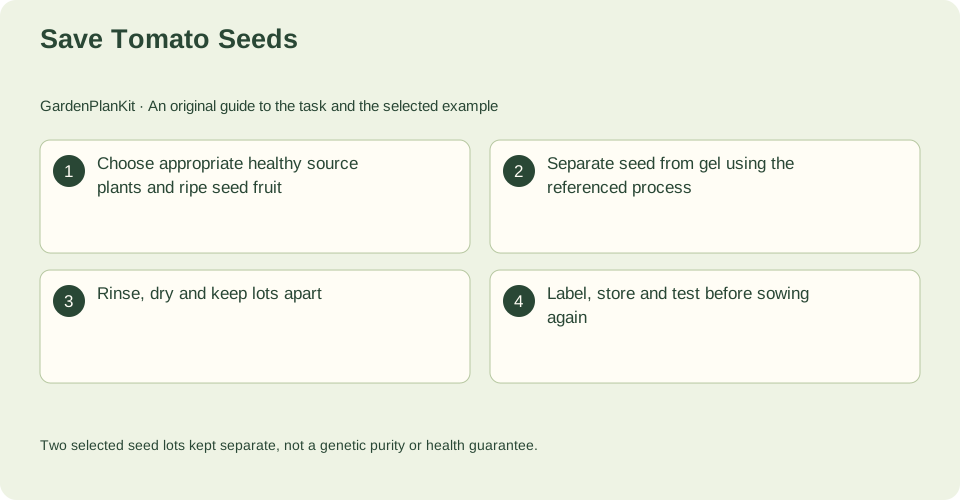
Choose source plants and ripe seed fruit
Start with plants you would want to grow again and fruit that is fully ripe for seed, not fruit picked early for eating. Illinois advises choosing seed crops carefully and allowing seed to mature before you separate it from wet fruit material. Look at the plant itself: note vigor, fruit shape and any disease symptoms you can see, and skip plants that look unhealthy if you have better options.
Decide what you know about the variety before you collect anything. Utah State distinguishes hybrid from open-pollinated seed: saved hybrid seed may not reproduce the parent type, and cross-pollination can change the next generation. Saving seed does not guarantee disease freedom, genetic purity or next-season performance, so write down what is known and what is uncertain rather than assuming the seed will match the parent.
- Select healthy plants and fully ripe fruit for seed.
- Record the variety name if known and whether it is hybrid or open-pollinated.
- Note the source plant and the collection year on a temporary tag.
Source context: University of Illinois Extension · Utah State University Extension
Separate seed from gel using controlled fermentation
Tomato seed sits in surrounding gel. The referenced process is controlled fermentation: hold the seed and gel together so the gel breaks down, then rinse the seed clean. Treat this as an approximate working process, not a guarantee of seed-health treatment. Watch the lot rather than the clock, and keep each variety in its own container so lots cannot mix.
Label the container before the process starts, not after. A jar with variety, source plant and collection year written on it prevents the most common mistake: two similar-looking lots becoming one unidentified lot.
- Scoop seed and gel into a labeled container, one lot per container.
- Let the gel break down under controlled fermentation, checking the lot as it changes.
- Rinse the seed thoroughly once the gel has separated.
Source context: University of Illinois Extension
Rinse, dry and keep lots apart
After rinsing, spread the seed out to dry thoroughly before storage. Illinois describes drying as a required step, not an optional one, so give the seed enough air and space to dry evenly. Keep lots physically separate during drying; a shared tray or unlabeled paper towel is how variety and source information gets lost.
This is also where you decide what each label says. A known open-pollinated source can carry its variety name, plant and year. An unknown or hybrid-status lot should keep that uncertainty on the label rather than being given a name it has not earned.
- Spread rinsed seed in a thin layer to dry completely.
- Dry each lot on its own labeled surface or container.
- Write variety, source plant, collection year and any uncertainty on the final label.
Source context: University of Illinois Extension · Utah State University Extension
Label, store and test before sowing again
Store dried seed in labeled, separate lots and connect each stored lot to a later germination check. A germination test before you plan quantities tells you whether a lot is worth sowing at the rate you intended; it does not prove the plants will perform like the parent. Use the test result to decide how much of that lot to rely on.
Keep the label with the seed through storage, and update it with the test result and date. If a lot's variety or pollination status was uncertain when collected, keep that note visible so future planning does not treat an unknown lot as a known variety.
- Store each dried lot separately with its full label.
- Run a germination check before sowing and record the result on the label.
- Plan quantities from the test result, not from an assumption about the lot.
Source context: University of Illinois Extension · Utah State University Extension
Work through this example
Two selected seed lots kept separate, not a genetic purity or health guarantee.
| Example detail | Selected value or observation |
|---|---|
| lot A | Known open-pollinated source; label plant and collection year. |
| lot B | Unknown or hybrid status; retain that uncertainty on the label. |
| next step | Dry and store separately; test germination before planning quantities. |
The supplied example is hypothetical: two selected seed lots are kept separate, one from a known open-pollinated source labeled with plant and collection year, and one with unknown or hybrid status whose uncertainty stays on the label. Both are dried and stored separately and germination-tested before planning quantities. The example shows lot separation and record-keeping only; it is not a genetic purity or health guarantee.
Use this example to structure your own notes. Check the source conditions for the crop, method and setting.
Your action checklist
- Source plants and fruit chosen and recorded as healthy and fully ripe.
- Each lot in its own labeled container before fermentation begins.
- Seed rinsed and spread to dry thoroughly, lots kept apart.
- Label shows variety, source plant, collection year and any hybrid or unknown status.
- Germination check done and result recorded before planning quantities.
Questions that come up while planning
Can I save seed from a hybrid tomato and get the same tomato next year?
Not reliably. Utah State notes that saved hybrid seed may not reproduce the parent type, and cross-pollination can also change the next generation. Label the lot as hybrid or uncertain so you know what you are working with.
Why does tomato seed need fermentation before drying?
Tomato seed has surrounding gel. The referenced cleaning process is controlled fermentation followed by rinsing and spreading the seed to dry. Treat it as an approximate process, not a guarantee of seed-health treatment.
Does saving my own tomato seed mean the seed is disease-free?
No. Saving seed does not guarantee disease freedom, genetic purity or next-season performance. Choose healthy source plants, keep lots labeled, and test germination before relying on a lot.
Sources & method
Horticultural guidance is linked to its original source and regional context. Geometry and unit conversions are calculated separately. Read how we prepare and check a page.
- Start Saving Your Seeds TodayUniversity of Illinois Extension
- Collecting and Storing Seeds from Your GardenUtah State University Extension