
Identify the four working parts
Start by locating the separator, the reservoir, the wicking path and the refill and overflow openings on the actual container. The separator is the structure that holds the growing medium above the water; its arrangement differs between self-watering designs, so plan around the container you have rather than a generic layout. The reservoir is the water-holding space below or beside the medium. The wicking path is the material or opening that carries water from the reservoir into the medium. The refill opening is where you add water, and the overflow opening marks the level beyond which excess water should escape.
Treat these as one system. If the wicking path is blocked or the overflow is plugged, the container will not behave as intended even if the reservoir is full. Check that each part is present, clear and correctly positioned before filling.
- Locate the separator and confirm it holds the growing medium above the reservoir.
- Find the wicking path and check that it reaches both the reservoir and the medium.
- Identify the refill opening and the overflow opening, and confirm both are unobstructed.
Source context: University of Maryland Extension
Measure medium and water separately
Growing-medium volume and reservoir water volume are not interchangeable. The medium volume describes the space roots occupy; the reservoir volume describes the water store. Calculate each from its own measured dimensions. For the medium, use the inside footprint and the depth of the growing layer above the separator. For the reservoir, use its own internal dimensions and depth. If the separator has thickness, measure it and subtract it from the total internal depth rather than ignoring it.
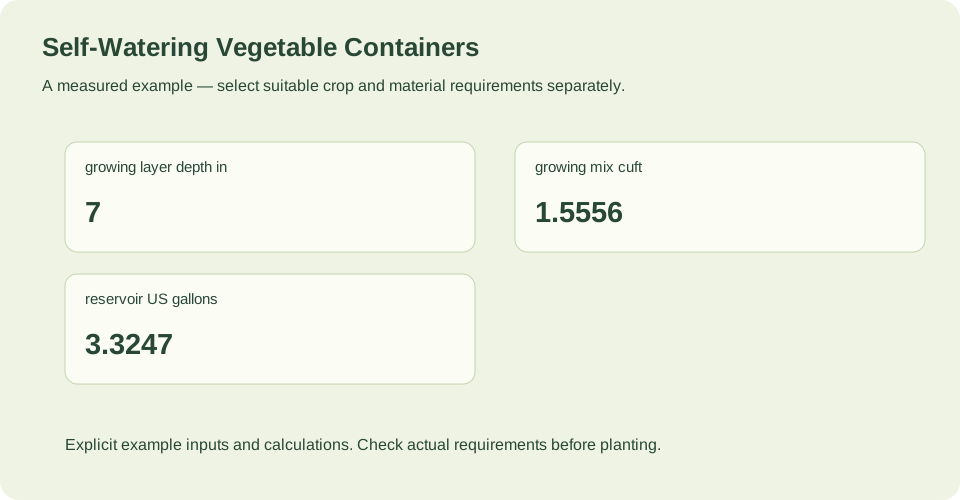
The supplied example is geometry only: a box planter with a 24 by 16 inch inside footprint, 10 inches of total internal depth, a separately measured 2 inch reservoir and a 1 inch rim gap. That leaves a 7 inch growing layer, which works out to about 1.56 cubic feet of growing mix, while the 2 inch reservoir works out to about 3.32 US gallons. The example ignores divider thickness; in a real planter, measure and subtract it. These figures describe this box, not a crop spacing or planting recommendation.
- Measure the inside footprint and the growing-layer depth above the separator.
- Measure the reservoir's own dimensions and depth separately.
- Subtract separator thickness from total internal depth before calculating the growing layer.
- Record medium volume in cubic feet or liters and reservoir volume in gallons or liters, keeping the units distinct.
Source context: University of Maryland Extension · University of Maryland Extension
Choose and prepare the growing medium
The growing medium must support roots while holding appropriate water and air. Dense garden soil behaves differently from a container mix, so do not assume field soil will perform the same way in a reservoir planter. The source guide lists commercial soilless mix and an equal-volume soilless-mix and compost blend among its container options. Follow the package label for volume conversions, since label units govern how bag sizes translate into the volume you calculated.
Remove plant debris before assessing old medium. A history of root disease rules that material out for reuse; otherwise, assess its changed structure and need for fresh ingredients rather than treating it as an unused product. Plan the blend before refilling so the growing layer depth you measured is actually filled with medium.
- Select a medium suited to containers, such as commercial soilless mix or the equal-volume soilless-mix and compost blend.
- Convert bag volume using the package label units.
- Remove plant residue before reuse and discard medium associated with root disease.
- Blend old and fresh material rather than treating old mix as unchanged.
Source context: University of Maryland Extension
Fill, water and inspect
Set up the container in the order the design requires: place the wicking path, add medium to the measured growing depth, then fill the reservoir through the refill opening. Watch the overflow opening as you fill; water escaping there indicates the reservoir has reached its upper level. Do not treat a full reservoir as a permanent solution. Watering needs vary with weather, plant growth and growing medium, so inspect the container regularly and check both the reservoir level and the medium.
A reservoir reduces watering work but still needs inspection. Look for a blocked wicking path, a plugged overflow, or medium that stays too wet or too dry. Adjust your routine based on what you observe rather than a fixed schedule.
- Fill the reservoir through the refill opening and stop when water reaches the overflow.
- Check the reservoir level and the medium moisture on a regular inspection.
- Clear any blockage in the wicking path or overflow opening.
- Adjust watering frequency as weather, plant growth and medium conditions change.
Source context: University of Maryland Extension · University of Maryland Extension
Check your measured example
Box planter geometry only: inside footprint 24 × 16 in, 10 in total internal depth, a separately measured 2 in reservoir and 1 in rim gap. The divider thickness is ignored in this illustration; measure and subtract it for a real planter.
| Quantity | Calculated result |
|---|---|
| growing layer depth in | 7 |
| growing mix cuft | 1.5556 |
| reservoir US gallons | 3.3247 |
The example is a geometry illustration for one box planter, not crop advice. A 24 by 16 inch inside footprint with 10 inches total internal depth, a 2 inch reservoir and a 1 inch rim gap gives a 7 inch growing layer, about 1.56 cubic feet of mix, and a reservoir of about 3.32 US gallons. Divider thickness is ignored in the illustration; measure and subtract it for a real planter. No additional numerical results are implied.
Example inputs explain the method. Review the source context, chosen cultivar and actual site before planting or ordering.
Your before-you-plant checklist
- Separator, reservoir, wicking path, refill and overflow are all located and unobstructed.
- Growing-layer depth is measured above the separator, with divider thickness subtracted.
- Medium volume and reservoir volume are recorded separately with their own units.
- Medium choice matches a container option and bag volume is converted using package label units.
- Reservoir is filled to the overflow and the container is inspected regularly.
Questions that come up while planning
Does a self-watering container mean I never have to water it?
No. The reservoir reduces watering work, but watering needs vary with weather, plant growth and growing medium, and the container still needs regular inspection.
Should I measure growing-medium volume and reservoir volume the same way?
Measure them separately. Medium volume comes from the growing layer above the separator; reservoir volume comes from the water space below or beside it. Keep the units distinct.
Can I reuse growing medium in a self-watering container?
Remove plant residue and do not save medium associated with root disease. The source guide describes blending old and fresh material rather than assuming old mix is unchanged.
Sources & method
Horticultural guidance is linked to its original source and regional context. Geometry and unit conversions are calculated separately. Read how we prepare and check a page.
- Growing Vegetables in Containers and Salad TablesUniversity of Maryland Extension
- Growing Media (Potting Soil) for ContainersUniversity of Maryland Extension