
Observe heat stress and light before choosing cloth
Start with what the plants and site are actually doing. Look for signs of heat stress during the hottest part of the day, and note where and when direct light is strongest. Delaware reports benefits from shade cloth in heat stress and discusses 30% shade as a useful reference for many vegetables in its work. That is a regional reference, not a universal target for every crop or site.
Record the crop, its stage, the time of day, and whether the stressed plants are also short of water or airflow. These observations help you decide whether shade is the right response and how much light reduction to consider. If plants look stressed only in one exposed corner, the problem may be site-specific rather than a reason to cover the whole garden.
- Walk the garden at midday and note which crops show heat stress and where light is strongest.
- Record crop, growth stage, time, and any watering or airflow issues alongside the observations.
- Decide whether the problem is light and heat exposure or something else before selecting cloth.
Source context: University of Delaware Cooperative Extension
Read nominal shade percentages in context
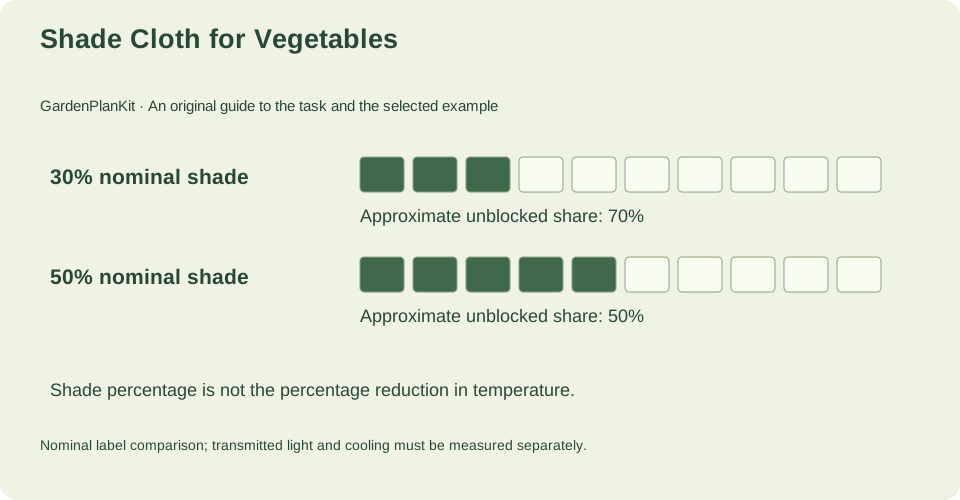
A 30% nominal shade cloth is rated to block about 30% of light, leaving roughly 70% unblocked. A 50% cloth leaves roughly 50% unblocked. Those figures describe light reduction only; they are not an equal percentage drop in temperature. The supplied example compares these two nominal labels and explicitly does not calculate a temperature drop from shade percentage.
Delaware describes higher 50–70% shade in some heat-sensitive crops such as lettuce. Use that as a regional example, not a rule for every lettuce planting or every site. Light, temperature, crop stage, airflow, and the plant's response under the cloth still need observation. Choose a percentage you can justify from your own conditions, then check how the covered crop responds.
- Compare labels by nominal shade percentage and the unblocked light share each implies.
- Treat higher percentages as a regional example for heat-sensitive crops, not a universal recommendation.
- Plan to observe the crop under the cloth rather than assuming the label predicts cooling.
Source context: University of Delaware Cooperative Extension
Plan support, airflow and access
Shade cloth needs appropriate support, and the plan should keep ventilation and access open. A cloth that sags, traps still air, or makes watering and harvesting difficult can create new problems even if the light reduction is right. Decide how you will secure the cloth, how air will move under and around it, and how you will reach the plants without removing the whole cover.
Build access into the layout from the start. Leave room to check plants, water, and harvest, and make sure the cloth can be adjusted or removed when conditions change. The goal is a cover you can manage, not a permanent barrier.
- Choose a support method that holds the cloth without sagging onto plants.
- Leave gaps or open sides so air can move under and around the cloth.
- Plan a route to water, inspect, and harvest without dismantling the cover.
Source context: University of Delaware Cooperative Extension
Compare the covered crop with actual conditions
After the cloth is up, compare the covered crop with the conditions you observed before. Check whether heat stress signs ease, whether light looks adequate, and whether airflow and access remain workable. Because a nominal shade percentage is not a temperature guarantee, the crop's response is the useful check.
If the crop still shows stress, review light, temperature, crop stage, airflow, and watering together rather than assuming a different percentage will fix it. If growth looks weak or leggy, the cloth may be reducing light more than the crop needs. Adjust based on what you see, and keep notes so the next season's choice is grounded in your own site.
- Compare covered plants with your pre-cloth observations at the same time of day.
- Check light, heat stress signs, airflow, and access together.
- Adjust the cloth or its placement based on the crop's response, and record what you observed.
Source context: University of Delaware Cooperative Extension
Work through this example
Nominal label comparison; transmitted light and cooling must be measured separately.
| Example detail | Selected value or observation |
|---|---|
| cloth A nominal shade percent | 30 |
| cloth B nominal shade percent | 50 |
| approximate unblocked share A percent | 70 |
| approximate unblocked share B percent | 50 |
| temperature drop | Not calculated from shade percentage. |
The supplied example is hypothetical. It compares a 30% nominal shade cloth, leaving about 70% unblocked light, with a 50% nominal cloth, leaving about 50% unblocked. It does not calculate a temperature drop from shade percentage; transmitted light and cooling must be measured separately.
Use this example to structure your own notes. Check the source conditions for the crop, method and setting.
Your action checklist
- Observed heat stress and light at midday before choosing cloth.
- Recorded crop, stage, time, and any watering or airflow issues.
- Compared nominal shade percentages and the unblocked light share they imply.
- Planned support, ventilation, and access to water, inspect, and harvest.
- Compared the covered crop with pre-cloth conditions and adjusted as needed.
Questions that come up while planning
What percentage shade cloth should I use for a vegetable garden?
There is no single universal percentage. Delaware discusses 30% shade as a useful reference for many vegetables and describes higher 50–70% shade in some heat-sensitive crops such as lettuce, but these are regional examples. Choose based on your crop, site, stage, and observed response.
Does a 50% shade cloth lower temperature by 50%?
No. A nominal shade percentage describes light reduction, not an equal percentage drop in temperature. The supplied example compares 30% and 50% nominal cloths and explicitly does not calculate a temperature drop from shade percentage.
What should I check after installing shade cloth?
Compare the covered crop with your earlier observations: whether heat stress signs ease, whether light seems adequate, and whether airflow and access still work. Adjust based on the crop's response rather than the label alone.
Sources & method
Horticultural guidance is linked to its original source and regional context. Geometry and unit conversions are calculated separately. Read how we prepare and check a page.
- Protecting Garden Vegetables from Heat StressUniversity of Delaware Cooperative Extension