
Pasteurization and sterilization are different goals
Pasteurization aims to reduce many organisms in a medium without driving the material to a fully sterile state. Sterilization implies eliminating all viable organisms, which is a much stronger claim than home heat treatment can responsibly promise. In practice, home methods are difficult to control: temperature varies through the mass of medium, moisture changes how heat moves, and the container or appliance may not distribute heat evenly. Because of that, this guide does not provide microwave or oven times, and it does not claim that home heating guarantees pathogen eradication.
The practical question is not whether you can sterilize soil at home, but whether treating it is likely to help your situation. If the medium is associated with root disease, the safer assumption is that the material is contaminated and should not be saved for sensitive container crops.
- Decide whether your goal is reducing organisms or eliminating them entirely, and treat those as different outcomes.
- Avoid relying on improvised heating schedules as proof that a medium is pathogen-free.
Source context: Penn State Extension · University of Maryland Extension
When replacing medium is the better choice
Replacing is preferable when the medium is linked to root disease. The reuse guidance is direct: remove plant residue and do not save medium associated with root disease. Diseased roots, lingering residue, and shared containers can carry problems forward, and fresh medium removes that uncertainty more reliably than heat treatment.
Replacement also makes sense when the old material has broken down. The guide describes blending old and fresh material rather than assuming old mix is unchanged, which acknowledges that reused medium is not the same as new mix. If you are unsure whether a problem came from the medium or from equipment, start clean on both fronts rather than treating one and reusing the other.
- Discard medium associated with root disease instead of treating and reusing it.
- Remove plant residue from containers and tools before starting the next crop.
- Choose fresh commercial soilless mix or an equal-volume soilless-mix and compost blend for container vegetables.
Source context: University of Maryland Extension
Clean equipment and clean starting medium
Clean equipment and clean starting medium matter as much as any treatment decision. A potting-medium formulation balances water retention, nutrients, and aeration, and those qualities support roots only when the material is appropriate for containers. Dense garden soil behaves differently from a container mix, so substituting garden soil changes the growing conditions rather than simply saving money.
Compost-based media vary with their ingredients, so a recipe name alone is not a quality test. Read what is actually in the mix and how it is described, rather than assuming a familiar label means consistent performance. For container vegetables, the guide lists commercial soilless mix and an equal-volume soilless-mix and compost blend among its options.
- Clean containers, trays, and tools before filling them with new medium.
- Check the ingredients of compost-based media rather than judging by the recipe name.
- Use a medium formulated to hold appropriate water and air while supporting roots.
Source context: Penn State Extension · University of Maryland Extension
Use a replacement decision before treating
Replacing disease-associated medium avoids assuming that an improvised heating attempt made it suitable for reuse. Follow an appropriate validated protocol when a specific treatment is required.
If you are planning a container project, use the arithmetic to check quantities against the medium you have chosen, then confirm the actual fill depth and mix from your own plan rather than from the example.
Source context: Penn State Extension · University of Maryland Extension
Check your measured example
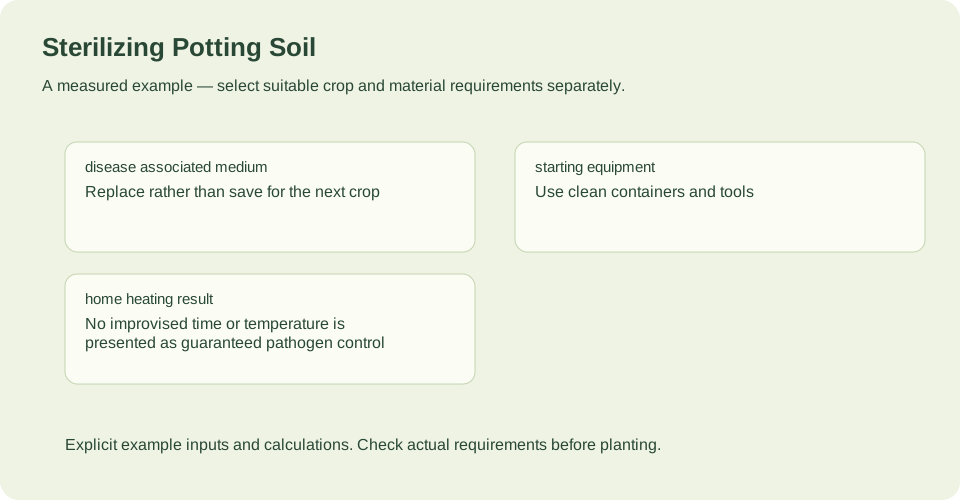
A reuse decision scenario, not a home heat-treatment protocol. Pasteurization and complete sterilization are different processes.
| Quantity | Calculated result |
|---|---|
| disease associated medium | Replace rather than save for the next crop |
| starting equipment | Use clean containers and tools |
| home heating result | No improvised time or temperature is presented as guaranteed pathogen control |
Replacing disease-associated medium avoids assuming that an improvised heating attempt made it suitable for reuse. Follow an appropriate validated protocol when a specific treatment is required.
Example inputs explain the method. Review the source context, chosen cultivar and actual site before planting or ordering.
Your before-you-plant checklist
- Identify whether the medium is associated with root disease before deciding to reuse it.
- Remove plant residue and clean containers and tools before the next crop.
- Choose a container-appropriate medium rather than dense garden soil.
- Check compost-based mix ingredients instead of relying on the recipe name.
- Use the example table only for inventory arithmetic, not as a depth or treatment recommendation.
Questions that come up while planning
Can home heating sterilize potting soil?
Home heat treatment is hard to control and is not a guaranteed way to eliminate pathogens. This guide avoids improvised microwave or oven times and does not claim that home heating sterilizes medium.
Should I reuse potting mix after a root disease?
No. The reuse guidance says not to save medium associated with root disease. Replace it and clean containers and tools before planting again.
Is a compost-based mix automatically better?
Not necessarily. Compost-based media vary with their ingredients, so a recipe name alone is not a quality test. Check what the mix contains and whether it suits container growing.
Sources & method
Horticultural guidance is linked to its original source and regional context. Geometry and unit conversions are calculated separately. Read how we prepare and check a page.
- Organic Transplant Production NotesPenn State Extension
- Growing Media (Potting Soil) for ContainersUniversity of Maryland Extension