
Confirm you have French tarragon, not seed-grown Russian
French tarragon is propagated almost exclusively by stem cuttings and root divisions. It seldom flowers, so seed is rarely available, and plants grown from seed are generally Russian tarragon, which has vastly inferior flavor. When buying, ask a reputable nursery or garden center to confirm the type rather than relying on a label alone.
If you are dividing an existing plant, work in spring as new shoot tips emerge. French tarragon roots are brittle, so lift and separate divisions with a knife rather than a shovel or hoe. The source notes that a parent plant can yield three to five new plants; treat that as a propagation expectation from the source, not a container yield.
- Ask the nursery to confirm the plant is French tarragon and was propagated vegetatively.
- Plan divisions for spring, just as new shoots appear, and use a knife to limit root damage.
Source context: Utah State University Extension
Choose a pot by shape, drainage and root space
Container guidance groups tarragon with smaller herbs such as basil, thyme, mint and oregano, for which the named reference range is 2 to 5 US gallons. That is a group reference, not a crop-specific minimum, and volume alone does not define a suitable shape. Match both the mature top growth, about 24 to 36 inches tall with a 12 to 15 inch spread, and the root space the plant needs.
Drainage holes must stay open. Stones or gravel under the mix do not improve drainage, and a saucer left full of water keeps roots saturated. Measure the actual fill volume of your pot rather than trusting a nursery trade-gallon label, since labels and true volume can differ.
- Check that the pot has open drainage holes and stands so excess water can leave.
- Measure inside diameter and usable fill height, then calculate fill volume and compare it with the 2 to 5 gallon herb group reference.
- Empty the saucer after watering so the root zone is not left standing in water.
Source context: University of Maryland Extension
Set up the growing medium and position
A container medium must support roots while holding appropriate water and air; dense garden soil behaves differently from a container mix. The container guide lists commercial soilless mix and an equal-volume soilless-mix and compost blend among its options. French tarragon has low fertilizer requirements, and the source notes that herb flavor is intensified in nutrient-poor soils, so fertilize only when planting rather than routinely.
French tarragon prefers full sun and warm but not hot conditions. Where summer temperatures exceed 90 degrees F, the source says partial shading increases survival. Transplant in spring after the last frost. The source's spacing figure of 24 inches apart is an in-ground planting figure and should not be converted into a pot minimum; use it only as context for the plant's spread.
If you reuse medium, remove plant residue and do not save medium associated with root disease. Blend old and fresh material rather than assuming old mix is unchanged.
- Fill the pot with soilless mix or an equal-volume soilless-mix and compost blend, leaving a rim gap for watering.
- Fertilize only at planting, following the product label.
- Place the pot in full sun, and provide partial shade where summers regularly exceed 90 degrees F.
- Renovate or divide the plant every 2 to 3 years to maintain flavor and vigorous growth.
Source context: Utah State University Extension · University of Maryland Extension · University of Maryland Extension
Water and monitor the container through the season
Once established, water sparingly rather than keeping the pot constantly wet. Check the medium before watering and confirm the drainage holes are clear. Harvest sprigs regularly for fresh use, or dry the plant at the end of the season for storage.
Keep the plant trimmed to maintain its form, and watch for the need to divide as growth thickens. Because French tarragon is grown for flavor rather than a measured crop, judge success by healthy growth and confirmed plant type, not by a promised harvest weight.
- Check medium moisture before each watering and water sparingly once the plant is established.
- Harvest sprigs regularly and trim the plant to keep its form.
- At season's end, dry the plant for storage if desired.
- Review the pot each spring for division or renovation timing.
Source context: Utah State University Extension · University of Maryland Extension
Check your measured example
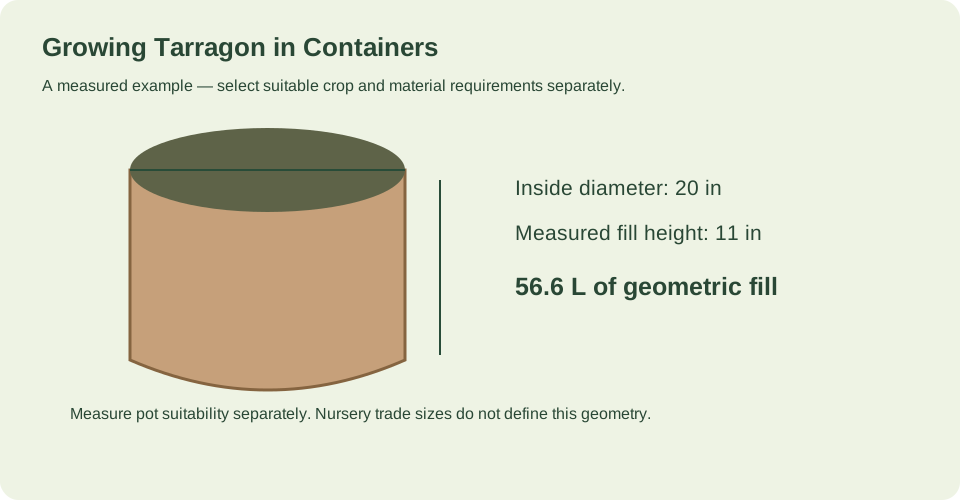
Volume-only illustration: one straight-sided pot with inside diameter 20 in, inside height 12 in and 1 in rim gap. The resulting fill capacity is not a minimum pot size for tarragon; confirm a suitable container separately.
| Quantity | Calculated result |
|---|---|
| inside diameter in | 20 |
| fill height in | 11 |
| volume cuft | 1.9999 |
| volume liters | 56.6296 |
| US liquid gallons | 14.96 |
The worked example is a volume-only illustration: a straight-sided pot with a 20 inch inside diameter, 12 inch inside height and a 1 inch rim gap, giving a fill height of 11 inches. Its calculated fill capacity is about 2.0 cubic feet, 56.6 liters or 15.0 US liquid gallons. That figure describes this particular pot's fill volume; it is not a minimum pot size for tarragon, and a suitable container must be confirmed separately using shape, drainage and root space.
Example inputs explain the method. Review the source context, chosen cultivar and actual site before planting or ordering.
Your before-you-plant checklist
- Plant type confirmed as French tarragon and vegetatively propagated.
- Pot has open drainage holes and a shape that suits the plant's mature top growth and root space.
- Actual fill volume measured and compared with the 2 to 5 gallon herb group reference.
- Soilless mix or equal-volume soilless-mix and compost blend used, with fertilizer only at planting.
- Saucer emptied after watering and division or renovation planned for spring.
Questions that come up while planning
What pot size should I use for French tarragon?
Container guidance groups tarragon with smaller herbs for which the named reference range is 2 to 5 US gallons. That is a group reference, not a crop-specific minimum. Match pot shape and root space to the plant's mature size, and measure actual fill volume rather than relying on trade-gallon labels.
Can I grow French tarragon from seed?
No reliable route is described. French tarragon seldom flowers and is propagated almost exclusively by stem cuttings and root divisions. Seed-grown plants are generally Russian tarragon, which has vastly inferior flavor.
How often should I water tarragon in a pot?
Water sparingly once the plant is established, checking the medium first rather than following a fixed schedule. Keep drainage holes open and empty the saucer so roots are not left saturated.
Sources & method
Horticultural guidance is linked to its original source and regional context. Geometry and unit conversions are calculated separately. Read how we prepare and check a page.
- How to Grow French Tarragon in Your GardenUtah State University Extension
- Growing Vegetables in Containers and Salad TablesUniversity of Maryland Extension
- Growing Media (Potting Soil) for ContainersUniversity of Maryland Extension