
Start with light, pot dimensions and habit
Before picking crops, note how much direct light the spot receives and measure the pot's width and depth. Pot dimensions matter because roots need room and because a small pot dries faster than a large one. Growth habit matters too: compact or bush types fit tighter spaces, while sprawling or vining plants need room to spread or a support to climb.
Treat these as planning filters, not crop advice. A plant that fits your light and pot size may still need support, more frequent watering or a longer season than you want to manage. Choose crops whose habit and care fit your routine rather than ranking vegetables as universally best.
- Measure each pot's width and depth and record the light the spot receives.
- List crops by habit: compact, sprawling or vining, and note which need support.
- Decide how much watering and daily care you can realistically provide.
Source context: University of Maryland Extension · University of Maryland Extension
Plan watering and growing medium for the actual container
Container watering needs vary with weather, plant growth and the growing medium. A pot in hot, windy weather can dry much faster than the same pot in cool, still conditions, and a larger plant uses more water than a small seedling. Plan for the actual container and growing system you have; self-watering designs have different water-reservoir arrangements, so read how yours works rather than assuming it behaves like a standard pot.
Growing medium must support roots while holding appropriate water and air. Dense garden soil behaves differently from a container mix, so do not treat them as interchangeable. For container vegetables, the source lists commercial soilless mix and an equal-volume soilless-mix and compost blend among its options. If you reuse medium, remove plant residue and do not save medium associated with root disease. The source describes blending old and fresh material rather than assuming old mix is unchanged.
- Check whether your container is standard or self-watering and learn its reservoir arrangement.
- Choose a medium option from the source list and keep the package label units for any volume conversion.
- If reusing medium, remove plant residue and discard medium linked to root disease before blending old and fresh material.
Source context: University of Maryland Extension · University of Maryland Extension
Compare crops by care and harvest goal
Build a short comparison rather than a ranking. For each candidate crop, note light, pot dimensions, habit, support needs, watering demand and what you want to harvest. Compatible herbs can share space with compact vegetables when their light and care needs line up, but check each plant's habit before combining them.
The goal is a plan you can check: does each crop fit the pot, the light and the support you can provide? Does the watering routine match the container? If a crop fails one of these checks, adjust the plan instead of assuming it will work.
- Write one row per crop with light, pot size, habit, support, watering and harvest goal.
- Mark any crop that fails a check and revise the pot, support or crop choice.
- Group only herbs and vegetables whose light and care needs match.
Source context: University of Maryland Extension · University of Maryland Extension
Compare the named crop-volume references
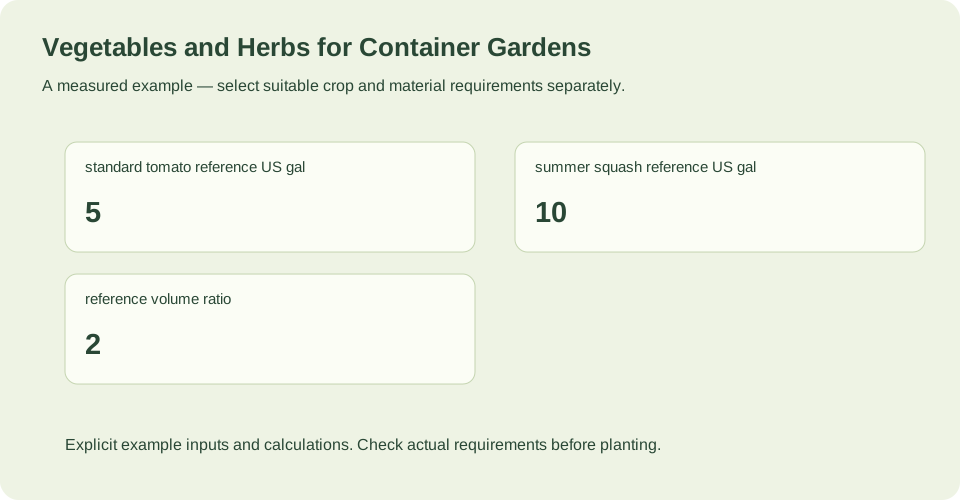
The summer-squash reference is twice the standard-tomato reference volume in this table. That ratio compares the named guide entries and does not predict plant yield or a suitable cultivar choice.
Use this arithmetic to check how much material a measured area and chosen layer would require, not to decide how deep to fill a pot or how much amendment to add. Those choices depend on the crop, container and medium, and are outside this example.
Source context: University of Maryland Extension · University of Maryland Extension
Check your measured example
A comparison of named Maryland reference volumes, not a yield test: a standard tomato is listed at 5 US gal, while summer squash is listed at 10 US gal. These crop references do not establish a universal size for all cultivars or systems.
| Quantity | Calculated result |
|---|---|
| standard tomato reference US gal | 5 |
| summer squash reference US gal | 10 |
| reference volume ratio | 2 |
The summer-squash reference is twice the standard-tomato reference volume in this table. That ratio compares the named guide entries and does not predict plant yield or a suitable cultivar choice.
Example inputs explain the method. Review the source context, chosen cultivar and actual site before planting or ordering.
Your before-you-plant checklist
- Light, pot width and pot depth recorded for each container.
- Each crop's habit and support need noted before selection.
- Watering plan matched to the actual container and growing system.
- Medium choice and reuse handled according to the source facts.
- Volume example kept separate from potting depth and amendment decisions.
Questions that come up while planning
Can I use garden soil in a container?
Dense garden soil behaves differently from a container mix. The source lists commercial soilless mix and an equal-volume soilless-mix and compost blend among container vegetable options, so plan the medium for the actual container rather than assuming garden soil is interchangeable.
How often should I water container vegetables?
There is no single schedule. Container watering needs vary with weather, plant growth and growing medium, and self-watering designs have different reservoir arrangements. Plan around your actual container and check it regularly.
Can I reuse old growing medium?
Remove plant residue and do not save medium associated with root disease. The source describes blending old and fresh material rather than assuming old mix is unchanged.
Sources & method
Horticultural guidance is linked to its original source and regional context. Geometry and unit conversions are calculated separately. Read how we prepare and check a page.
- Growing Vegetables in Containers and Salad TablesUniversity of Maryland Extension
- Growing Media (Potting Soil) for ContainersUniversity of Maryland Extension