
Confirm aphids and inspect new growth
Start where aphids are most likely to gather: tender new growth, shoot tips and the undersides of young leaves. Look closely rather than from standing height. Aphids are small sap-feeding insects that can appear in clusters; honeydew, a sticky residue, is another sign associated with them.
Do not assume every curled tomato leaf has aphids. Curling can have other causes, and the insects present may be cast skins left after molting or beneficial insects rather than an active aphid colony. Distinguish what is actually there before deciding on any response. A hand lens helps separate live aphids from shed skins and from insects that may be working against them.
- Inspect shoot tips and the undersides of new leaves on several parts of the plant.
- Look for clustered sap-feeding insects and for sticky honeydew.
- Separate live aphids from cast skins and from beneficial insects before acting.
Source context: University of California Statewide IPM
Check damage, ants and beneficial insects
Before choosing a response, record what the plant is showing and what else is present. Note the condition of new growth and any honeydew. Then watch for ants: ant activity can interfere with natural enemies, so their presence changes how you read the situation.
Also look for predators and parasitoids. Preserving these beneficial insects is part of managing aphids on tomatoes, so identifying them first prevents a response that works against the very insects helping you. Keep your observations as a record of this plant at this time rather than treating one inspection as a verdict on the whole garden.
- Record visible damage and honeydew on the shoots you inspected.
- Note whether ants are active on or near the plant.
- Identify beneficial insects present and preserve them when choosing a response.
Source context: University of California Statewide IPM
Use suitable physical and cultural responses
On sturdy plants, a water spray can remove aphids. This is a physical response, and it suits plants strong enough to take the spray. Avoid excessive nitrogen, which the source identifies as something to steer away from in aphid management.
Avoid unnecessary broad-spectrum insecticides, since they can work against the beneficial insects you are trying to preserve. If you select a labeled soap, oil or other product, follow the exact label, including edible-crop restrictions and application conditions. Do not substitute dish detergent, and do not treat any product as a guaranteed natural cure.
- Use a water spray on sturdy plants to remove aphids.
- Avoid excessive nitrogen and unnecessary broad-spectrum insecticides.
- If using a labeled product, follow its edible-crop restrictions and application conditions exactly.
Source context: University of California Statewide IPM
Recheck the plant before escalating control
After a physical or cultural response, return to the same kind of new growth you inspected before and recheck. Compare what you see now with your earlier record: live aphids, cast skins, honeydew, damage, ants and beneficial insects. This comparison is more useful than a single count.
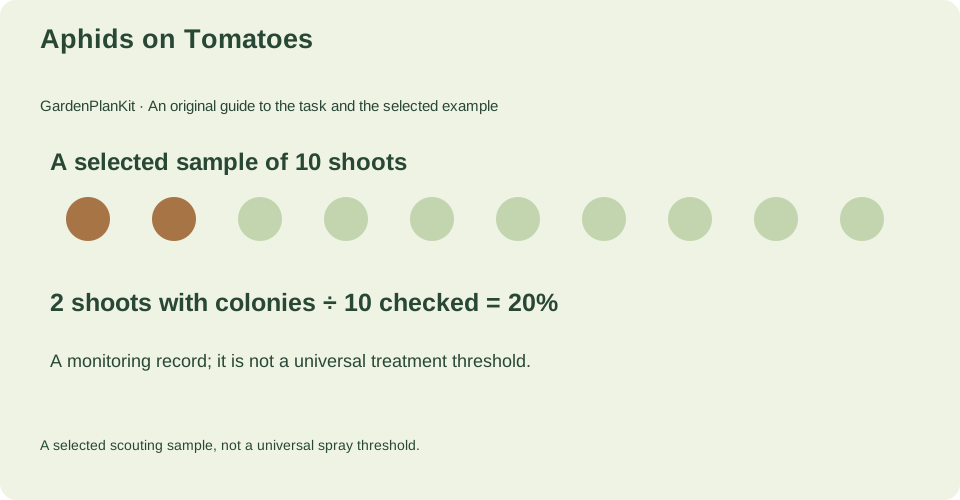
An observed proportion of inspected shoots is a monitoring record, not a universal treatment threshold or an estimate of the whole garden population. Use the recheck to decide whether the response helped and whether escalation is warranted, rather than escalating on the basis of one sample alone.
- Reinspect the same new growth and compare with your earlier notes.
- Check again for ants and beneficial insects before escalating.
- Treat the proportion of affected shoots as a record, not a threshold.
Source context: University of California Statewide IPM
Work through this example
A selected scouting sample, not a universal spray threshold.
| Example detail | Selected value or observation |
|---|---|
| shoots inspected | 10 |
| shoots with visible colonies | 2 |
| sample incidence percent | 20 |
| decision | Record damage and natural enemies before selecting any control. |
The supplied example is hypothetical: 10 shoots were inspected and 2 had visible colonies, giving a sample incidence of 20 percent. That figure is a selected scouting sample and a monitoring record, not a universal spray threshold or an estimate of the whole garden population. The stated decision is to record damage and natural enemies before selecting any control.
Use this example to structure your own notes. Check the source conditions for the crop, method and setting.
Your action checklist
- Inspected shoot tips and undersides of new leaves on several parts of the plant.
- Separated live aphids from cast skins and beneficial insects.
- Recorded damage, honeydew and any ant activity.
- Chose a physical or cultural response suited to a sturdy plant and preserved beneficial insects.
- Rechecked the same new growth and compared it with earlier notes before escalating.
Questions that come up while planning
How do I know whether curled tomato leaves are caused by aphids?
Inspect new growth closely and look for clustered sap-feeding insects and honeydew. Distinguish live aphids from cast skins and beneficial insects rather than assuming every curled leaf has aphids.
Can I spray aphids off tomato plants with water?
On sturdy plants, a water spray can remove aphids. Preserve predators and parasitoids, and consider ant activity, which can interfere with natural enemies.
Should I use a soap or oil product on tomatoes?
If a labeled soap, oil or other product is selected, follow the exact label, edible-crop restrictions and application conditions. Do not substitute dish detergent or expect a guaranteed natural cure.
Sources & method
Horticultural guidance is linked to its original source and regional context. Geometry and unit conversions are calculated separately. Read how we prepare and check a page.
- AphidsUniversity of California Statewide IPM