
Identify the nutrient question before buying
Start by writing down what you observed and what you want to change. Slow or pale growth can come from light, compaction, root problems and other stresses, so fertilizer is not a universal repair. If you have not tested the soil, the honest first step is a laboratory soil test rather than a product choice.
A soil test gives you a basis for comparing what the bed has with what the crop needs. Keep the test report with your garden records so later decisions refer to the same numbers. Supplying nutrients is also different from calculating the volume of compost used as an amendment; those are separate questions.
- Write the specific concern, such as pale leaves or a planned heavy-feeding crop.
- Obtain a laboratory soil test before selecting a fertilizer.
- Note the crop and growth stage the test result will be compared against.
Source context: University of Maryland Extension
Read grade numbers as labeled nutrient percentages
The three numbers on a fertilizer grade are percentages by product weight. The first is nitrogen as N, the second is phosphorus expressed as phosphate (P2O5), and the third is potassium expressed as potash (K2O). Do not report the second and third numbers as elemental phosphorus and potassium mass.
Multiplying product mass by a percentage gives the labeled nutrient mass in that product. That arithmetic describes the bag; it does not determine how much fertilizer a particular bed needs. Treat it as label reading, not as a dose calculation.
- Confirm the grade is listed as N, P2O5 and K2O percentages by weight.
- Multiply product mass by each percentage only to find labeled nutrient mass.
- Keep the result separate from any decision about how much to apply.
Source context: University of Maryland Extension
Compare product, crop and test instructions
Once a test supports fertilizing, compare three things: the product label, the crop and growth stage, and the test report. Organic and synthetic products still need their label analysis, application instructions and compatibility checked. A product that fits one crop or stage may not fit another.
Read the label for how the product should be applied and what it is compatible with. If the label, the crop need and the test result do not line up, stop and resolve the mismatch rather than guessing. The limitation that matters here is that label arithmetic alone cannot justify an application rate.
- Check the product label analysis, application instructions and compatibility notes.
- Match the crop and growth stage to the nutrient need shown by the test.
- Pause if the label and test do not support the same decision.
Source context: University of Maryland Extension · University of Maryland Extension
Apply and record only a justified plan
Apply only when the test, crop need and label instructions together justify it. Record what you used, the grade, the date and the reason, so the next decision can be checked against the same information. Excess fertilizer can harm plants, so a recorded, justified plan is safer than repeated additions.
After applying, watch the bed and note whether the original concern changes. If it does not, revisit light, compaction and root problems rather than adding more fertilizer.
- Apply according to the label only after the test and crop need support it.
- Record product, grade, date and the reason for applying.
- Recheck the original concern before considering any further addition.
Source context: University of Maryland Extension
Work through this example
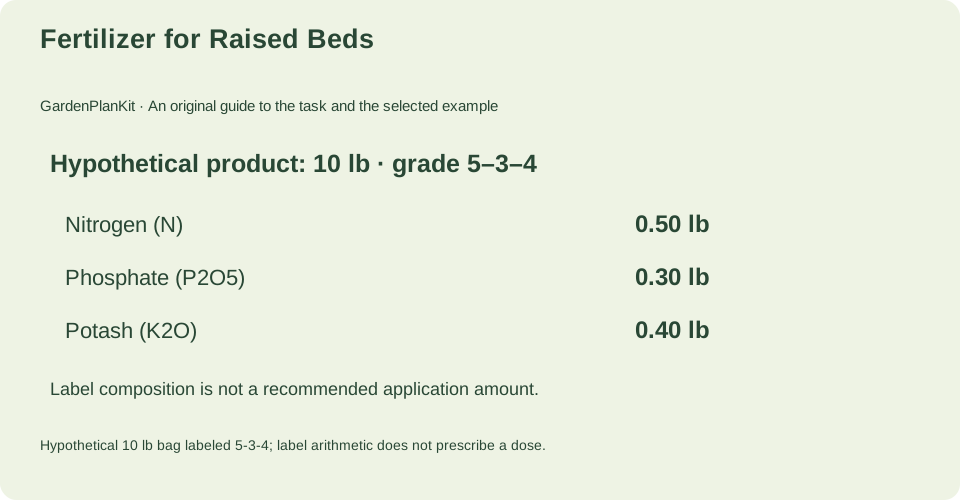
Hypothetical 10 lb bag labeled 5-3-4; label arithmetic does not prescribe a dose.
| Example detail | Selected value or observation |
|---|---|
| product mass lb | 10 |
| N percent | 5 |
| phosphate P2O5 percent | 3 |
| potash K2O percent | 4 |
| N mass lb | 0.5 |
| phosphate P2O5 mass lb | 0.3 |
| potash K2O mass lb | 0.4 |
The supplied example is hypothetical: a 10 lb bag labeled 5-3-4 contains 0.5 lb N, 0.3 lb phosphate (P2O5) and 0.4 lb potash (K2O) by label arithmetic. This shows how to read a grade; it does not prescribe a dose for any bed.
Use this example to structure your own notes. Check the source conditions for the crop, method and setting.
Your action checklist
- A laboratory soil test is on file before buying fertilizer.
- The crop and growth stage are noted alongside the test result.
- Grade numbers are read as N, P2O5 and K2O percentages by weight.
- Product label instructions and compatibility are checked against the test.
- The application, grade, date and reason are recorded.
Questions that come up while planning
Do I need a soil test before fertilizing a raised bed?
Maryland guidance recommends laboratory soil tests and plant needs for fertilizer decisions. Without a test, you lack the basis for comparing the bed with the crop's needs.
What do the three numbers on a fertilizer bag mean?
They are percentages by product weight: nitrogen as N, phosphorus as phosphate (P2O5) and potassium as potash (K2O). The second and third are not elemental P and K mass.
Does bag arithmetic tell me how much to apply?
No. Multiplying product mass by a percentage gives labeled nutrient mass in the product, but it does not determine how much fertilizer a particular bed needs.
Sources & method
Horticultural guidance is linked to its original source and regional context. Geometry and unit conversions are calculated separately. Read how we prepare and check a page.
- Fertilizing Vegetable GardensUniversity of Maryland Extension
- Garden Fertilizer BasicsUniversity of Maryland Extension