
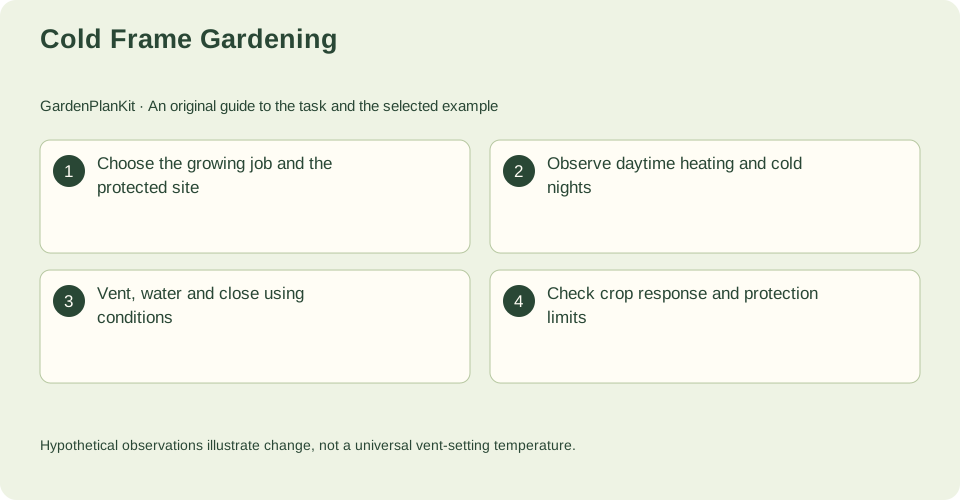
Choose the growing job and the protected site
Decide explicitly whether you are hardening seedlings or growing a mature crop. These are different uses and should be planned separately, because the space, access and attention each needs differ. Also choose suitable cool-season crops for the structure rather than assuming any crop will thrive.
Site the frame for access and drainage, and anchor it so it stays put in wind. Protection depends on the actual structure, site and weather. A light cover is not a rated wind or snow structure, so treat exposed or stormy locations as a material limitation when you place and secure the frame.
- Write down the job: hardening seedlings or growing a mature crop.
- List suitable cool-season crops you intend to grow.
- Check that the site drains, allows easy access and can anchor the frame.
Source context: South Dakota State University Extension
Observe daytime heating and cold nights
Daytime solar heating can create overheating even while nights remain cold. Use thermometers to observe the microclimate inside and outside the frame, and record readings at more than one time of day so you can see the change rather than a single snapshot.
The supplied example is hypothetical: 55 F in the morning and 80 F at midday illustrate change, not a universal vent-setting temperature. The decision in that example is to check actual crop requirements, ventilate appropriately and monitor again. Daytime warmth does not prove overnight frost protection, so keep watching night conditions separately.
- Place thermometers to read inside and outside air.
- Record morning, midday and evening readings.
- Compare readings with the crop's actual requirements before acting.
Source context: South Dakota State University Extension
Vent, water and close using conditions
Manage ventilation and closing according to what your thermometers and weather show, not a fixed number copied from elsewhere. When midday heat builds, ventilate appropriately and monitor again. Before cold nights, close the frame, but remember that closing alone does not guarantee frost protection.
Water based on the crop and the conditions you observe, and check drainage so excess water does not sit in the frame. Keep the anchoring and cover condition in mind during wind, and do not treat a light cover as a rated wind or snow structure.
- Vent when observed heat rises, then recheck the reading.
- Close before cold nights and monitor overnight conditions.
- Check drainage and anchoring after watering or wind.
Source context: South Dakota State University Extension
Check crop response and protection limits
Watch the plants themselves alongside the thermometer. Note whether seedlings or mature crops show stress after hot days or cold nights, and adjust venting, watering and closing to the conditions you actually observe.
State the limit once where it matters: a cold frame is a season-extension structure, not a guaranteed year-round greenhouse, and example readings do not guarantee frost protection. Use crop response and your own observations to decide whether the frame is meeting the job you chose.
- Inspect crops after hot and cold periods.
- Adjust venting, watering and closing to observed conditions.
- Reassess whether the frame still suits the chosen job.
Source context: South Dakota State University Extension
Work through this example
Hypothetical observations illustrate change, not a universal vent-setting temperature.
| Example detail | Selected value or observation |
|---|---|
| morning air inside F | 55 |
| midday air inside F | 80 |
| decision | Check actual crop requirements, ventilate appropriately and monitor again. |
| night limit | Daytime warmth does not prove overnight frost protection. |
The hypothetical example shows 55 F in the morning and 80 F at midday. It illustrates change, not a universal vent-setting temperature. The decision is to check actual crop requirements, ventilate appropriately and monitor again; daytime warmth does not prove overnight frost protection.
Use this example to structure your own notes. Check the source conditions for the crop, method and setting.
Your action checklist
- The growing job is written down as hardening seedlings or growing a mature crop.
- Suitable cool-season crops are chosen for the frame.
- The site drains, allows access and can anchor the frame.
- Thermometer readings are recorded at more than one time of day.
- Crop response is checked after hot days and cold nights.
Questions that come up while planning
Can I use one vent-opening temperature for every cold frame?
No. The supplied facts say not to give universal vent-opening temperatures. Observe your own microclimate with thermometers and check actual crop requirements before ventilating.
Does daytime warmth inside the frame mean plants are safe overnight?
No. Daytime warmth does not prove overnight frost protection. Nights can still be cold, so monitor night conditions and close appropriately.
Is a cold frame a year-round greenhouse?
No. It is described as a season-extension structure. Protection depends on the actual structure, site and weather, and a light cover is not a rated wind or snow structure.
Sources & method
Horticultural guidance is linked to its original source and regional context. Geometry and unit conversions are calculated separately. Read how we prepare and check a page.
- Cold FramesSouth Dakota State University Extension