
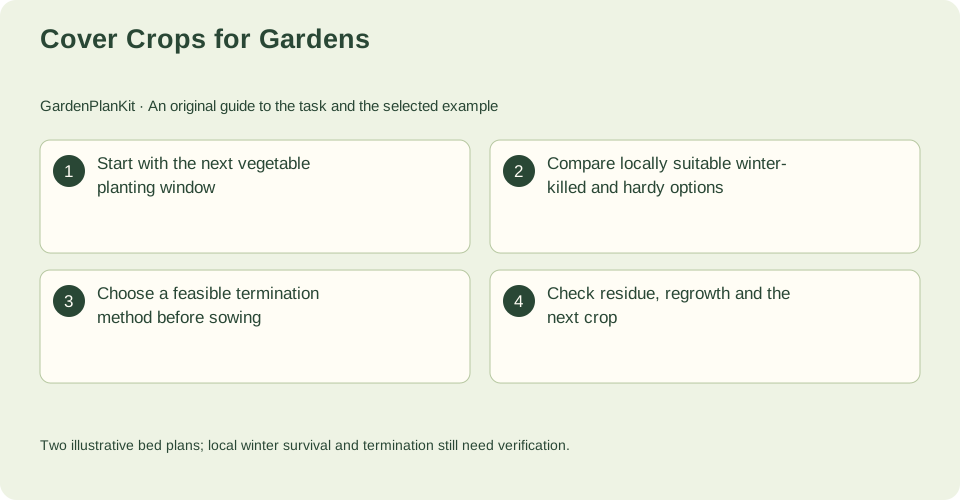
Start with the next vegetable planting window
Before choosing a cover crop, write down when the next vegetable crop needs to be in the ground. That date sets how much time the cover crop has to grow and how much time you have to terminate it and manage residue. A cover crop that fits an early spring planting is a different decision from one that precedes a later planting.
Maryland describes cover crops as living plants that protect soil between vegetable crops, support soil organic matter, and capture nutrients. Selection depends on your local planting window, winter survival, the next vegetable crop, and a workable termination method. Treat these as linked decisions rather than choosing a species first.
- Record the target planting date for the next vegetable crop.
- Note how much bed preparation time you can realistically give before that date.
- Decide whether the cover crop must be gone early or can occupy the bed longer.
Source context: University of Maryland Extension
Compare locally suitable winter-killed and hardy options
Maryland discusses oats and other winter-killed options, but winter kill depends on the actual climate where you garden. A species described as winter-killed in one region may survive in a milder one. Confirm local suitability with your state extension or another local source before relying on winter kill to end the crop for you.
Hardy options that survive winter need a planned termination rather than an assumed winter kill. Match the choice to your next planting window: an early next crop may call for investigating a locally suitable winter-killed option, while a later next crop can allow a realistic termination and residue window. This is a planning comparison, not a crop recommendation.
- Check local guidance for whether a candidate species reliably winter-kills in your climate.
- Separate winter-killed candidates from hardy ones that will need active termination.
- Match each candidate to the planting window you recorded.
Source context: University of Maryland Extension
Choose a feasible termination method before sowing
Decide how and when you will terminate the cover crop before you sow it. Cutting, smothering, or combined methods can be used when suitable, and regrowth must be checked afterward. Do not assume every mowing kills every species, and do not let the cover crop become an unmanaged weed.
Feasibility matters as much as method. Consider the equipment you actually have and the time available before the next planting. If a method depends on equipment or timing you cannot provide, that is a reason to reconsider the species or the plan, not to hope it works out.
- Name the termination method you will use and the equipment it requires.
- Set a target termination date that leaves time for residue to break down before planting.
- Plan a regrowth check after termination and a follow-up action if the cover crop returns.
Source context: University of Maryland Extension
Check residue, regrowth and the next crop
After termination, check for regrowth and assess residue before planting the next vegetable. Residue can affect how you prepare the bed, so confirm the bed is workable for the next crop rather than assuming the cover crop is finished.
A cover crop does not replace all fertilizer decisions or guarantee a fixed nitrogen contribution. Use local species and seeding guidance rather than inventing a universal rate. Record what you sowed, when, your termination plan, and your regrowth checks so the next planning cycle starts from real observations.
- Inspect the bed for regrowth after termination.
- Check that residue is manageable for the next crop's bed preparation.
- Record species, sowing date, termination plan, and regrowth checks.
Source context: University of Maryland Extension
Work through this example
Two illustrative bed plans; local winter survival and termination still need verification.
| Example detail | Selected value or observation |
|---|---|
| bed A | Early next crop: investigate a locally suitable winter-killed option. |
| bed B | Later next crop: allow a realistic termination and residue window. |
| record | Species, sowing date, termination plan and regrowth checks. |
The supplied example is hypothetical: Bed A has an early next crop and calls for investigating a locally suitable winter-killed option, while Bed B has a later next crop and allows a realistic termination and residue window. The record lists species, sowing date, termination plan, and regrowth checks. Local winter survival and termination still need verification; the example adds no new numerical results.
Use this example to structure your own notes. Check the source conditions for the crop, method and setting.
Your action checklist
- Next vegetable planting date recorded.
- Local winter survival of the chosen species confirmed.
- Termination method and equipment identified before sowing.
- Target termination date leaves residue time before planting.
- Regrowth check scheduled after termination.
Questions that come up while planning
Can I just let a cover crop winter-kill to end it?
Only if the species reliably winter-kills in your actual climate. Maryland discusses oats and other winter-killed options, but winter kill depends on local conditions, so confirm suitability locally before relying on it.
Does a cover crop replace fertilizer?
No. A cover crop does not replace all fertilizer decisions or guarantee a fixed nitrogen contribution. Use local species and seeding guidance rather than a universal rate.
What should I decide before sowing a cover crop?
Decide how and when you will terminate it, and confirm the method and equipment are feasible. Cutting, smothering, or combined methods can work when suitable, and regrowth must be checked.
Sources & method
Horticultural guidance is linked to its original source and regional context. Geometry and unit conversions are calculated separately. Read how we prepare and check a page.
- Cover Crops for GardensUniversity of Maryland Extension