
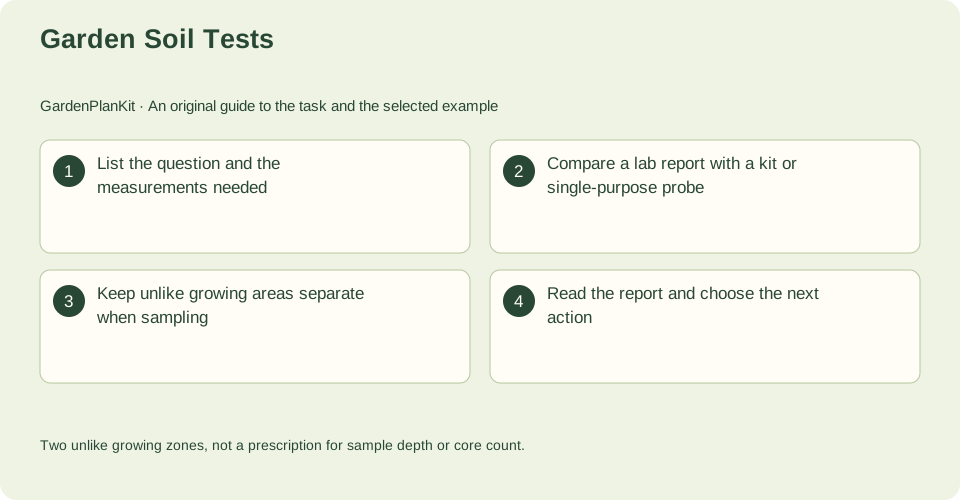
List the question and the measurements needed
Write down what you are trying to decide before buying anything. Maryland describes laboratory soil testing as a way to assess pH and nutrients and receive amendment guidance, so a lab report fits questions about overall fertility and pH adjustment. Test packages differ, so request the measurements relevant to the site and crop rather than accepting a default package.
If your question is narrower, a narrower tool may fit. A moisture or pH reading is not a complete nutrient or contamination assessment. Decide whether you need pH only, pH plus nutrients, or something beyond a basic report before you compare options.
- Write the decision you need to make, such as adjusting pH or planning amendments.
- List the measurements that decision requires for your site and crop.
- Check whether the package or tool you are considering reports those measurements.
Source context: University of Maryland Extension
Compare a lab report with a kit or single-purpose probe
Home kits, probes and laboratory reports are not interchangeable capabilities. Check what a tool actually measures instead of assuming a similar-looking product does the same job. A probe that reads pH or moisture answers a single question; it does not substitute for a nutrient report.
A laboratory report is the option Maryland describes for pH, nutrients and amendment guidance, but packages vary, so confirm the included measurements. This guide does not compare kit accuracy or prices. If contaminants are a concern, note that special contaminants may require an additional test, so a basic soil report must not be treated as proof that a site is safe for food production.
- Read the list of measurements each option reports.
- Match that list to the measurements you wrote down.
- Ask the laboratory whether an additional contaminant test is needed if that is your question.
Source context: University of Maryland Extension
Keep unlike growing areas separate when sampling
Keep areas with different soil or management histories separate rather than blending a raised-bed mix with native garden soil. A raised bed filled with imported growing medium and an in-ground garden are unlike zones, and mixing them hides the difference you may be trying to measure.
Follow the selected laboratory's own sampling, depth, handling and submission directions. Those directions govern how many cores to take and how deep to go; this guide does not set sample depth or core counts. Label each sample by zone so the report can be matched back to the right area.
- Divide the garden into zones with different soil or management histories.
- Sample each zone separately and label it clearly.
- Follow the chosen laboratory's sampling, depth, handling and submission directions for each sample.
Source context: University of Maryland Extension
Read the report and choose the next action
Read the report against the question you started with. If you asked about pH and nutrients, look for those results and any amendment guidance the laboratory provided, then decide the next action for that zone. Keep each zone's result attached to its own area rather than averaging unlike samples together.
If the report does not answer your original question, that is a signal to check whether a different package or an additional test is needed. Do not treat a basic report as a contamination assessment. Record what you decided and which zone it applies to so the plan stays traceable.
- Match each result to its labeled zone.
- Compare the results with the measurements you originally listed.
- Choose one next action per zone, or request an additional test if the report does not answer the question.
Source context: University of Maryland Extension
Work through this example
Two unlike growing zones, not a prescription for sample depth or core count.
| Example detail | Selected value or observation |
|---|---|
| zone A | Raised bed with imported growing medium. |
| zone B | Native in-ground garden soil. |
| submission plan | Two labeled composite samples following the chosen laboratory directions. |
The supplied example is hypothetical: a raised bed with imported growing medium and a native in-ground garden are two unlike zones, submitted as two labeled composite samples following the chosen laboratory's directions. It illustrates keeping zones separate; it is not a prescription for sample depth or core count.
Use this example to structure your own notes. Check the source conditions for the crop, method and setting.
Your action checklist
- The decision you need to make is written down.
- The measurements required for that decision are listed.
- Each tool or package is checked against what it actually measures.
- Unlike growing zones are sampled and labeled separately.
- The laboratory's own sampling, depth, handling and submission directions are followed.
Questions that come up while planning
Is a pH probe the same as a soil test for a vegetable garden?
No. A pH or moisture reading is not a complete nutrient or contamination assessment. Check what a tool actually measures and compare it with the measurements your question requires.
Should I mix raised-bed mix and native soil into one sample?
No. Keep areas with different soil or management histories separate rather than blending a raised-bed mix with native garden soil, and follow the laboratory's sampling directions for each.
Does a basic soil report prove my site is safe for growing food?
No. Special contaminants may require an additional test, so a basic soil report must not be described as proof that a site is safe for food production.
Sources & method
Horticultural guidance is linked to its original source and regional context. Geometry and unit conversions are calculated separately. Read how we prepare and check a page.
- Soil Testing and Soil Testing LabsUniversity of Maryland Extension